Can You Detect ChatGPT-Written Text?
Yes — and it's more reliable than most people think. ChatGPT and other large language models have distinctive writing patterns that modern detection tools can identify with high accuracy. Whether you're a teacher checking student essays, a hiring manager reviewing cover letters, or a publisher vetting submitted articles, there are now reliable ways to determine if text was written by ChatGPT.
In this guide, we'll cover exactly how ChatGPT detection works, which free tools are most accurate in 2026, how to spot AI-written text even without software, and what to do when you find it.
How ChatGPT Detection Works
Understanding why detection works requires understanding how ChatGPT generates text in the first place.
How ChatGPT Writes
ChatGPT generates text by predicting the most statistically likely next word (or "token"), given everything that came before it. When you ask ChatGPT to write an essay, it doesn't "think" about the topic — it calculates probabilities. At each step, it selects the word that its training data suggests is most likely to come next in that context.
This process creates text that is grammatically perfect, logically structured, and impressively fluent. But it also creates text that is statistically predictable — and that predictability is exactly what detectors exploit.
What Detectors Measure
AI detectors analyze two primary statistical properties of text:
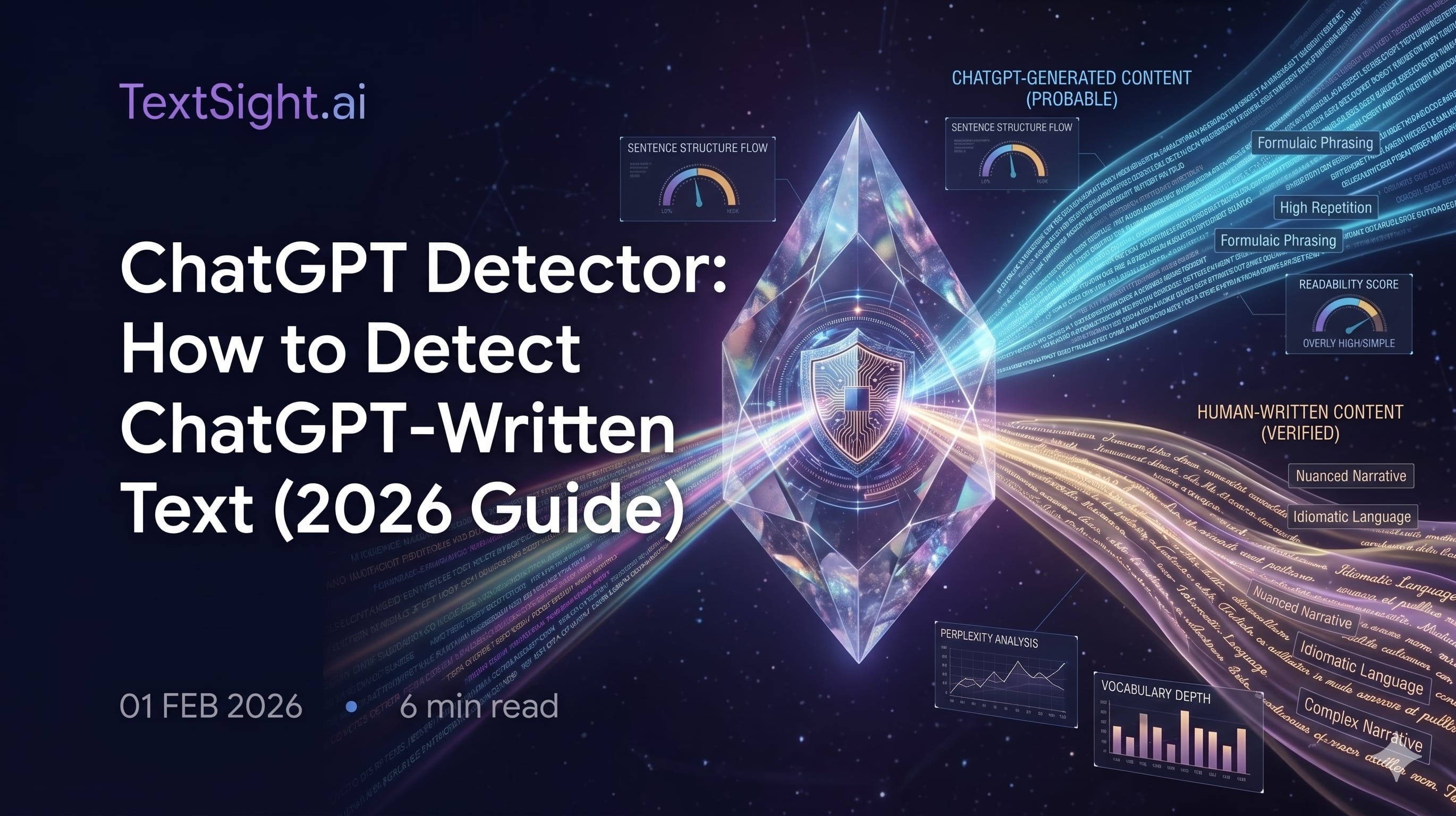
Perplexity: This measures how surprising or unpredictable the word choices are. When ChatGPT writes, it consistently picks high-probability words — resulting in low perplexity. Human writers are more creative, more random, and more likely to use unexpected word choices. They make deliberate stylistic choices, use slang, employ sarcasm, and sometimes just pick a word because it "sounds right" rather than because it's statistically optimal. This results in higher perplexity.
Burstiness: This measures the variation in sentence structure and length. ChatGPT tends to produce sentences of remarkably uniform length — typically 15 to 25 words per sentence, with consistent paragraph structures. Human writing is "bursty" — we write a three-word sentence followed by a forty-word sentence. We start paragraphs with a question, then answer it in fragments. This natural variation is extremely difficult for AI to replicate convincingly.
Machine Learning Classification
Beyond statistical analysis, the best detectors (including TextSight.ai) use machine learning models trained on millions of text samples — both human-written and AI-generated from multiple models including GPT-3.5, GPT-4, GPT-4o, Claude, Gemini, and others. These models learn to recognize patterns that go beyond simple metrics:
- Vocabulary preferences: ChatGPT overuses certain words like "delve," "crucial," "landscape," "multifaceted," and "it's important to note." These words appear in AI text at rates 5-10x higher than in typical human writing.
- Transition patterns: ChatGPT uses formulaic transitions — "Furthermore," "Moreover," "Additionally," "In conclusion" — in predictable positions within its text.
- Structural uniformity: Every ChatGPT paragraph tends to follow the same formula: topic sentence → supporting detail → concluding thought. Human paragraphs are structurally diverse.
- Emotional flatness: ChatGPT expresses opinions in hedged, balanced terms ("This is both exciting and concerning"). Humans are more decisive and more likely to take a clear position.
Best Free ChatGPT Detectors in 2026
Not all ChatGPT detectors are equally accurate. Here's a detailed comparison of the top tools available today:
1. TextSight.ai — Best Overall (Recommended)
TextSight.ai combines machine learning classification with statistical analysis to deliver the most detailed and transparent results of any free detector. Here's what sets it apart:
- Published accuracy, not a marketing number — roughly 88–92% on long-form English and lower on short passages, with the full method and its limits documented rather than summarised into one figure
- Sentence-level highlighting: Every sentence is individually classified as human, mixed, or AI-generated with color coding. You can see exactly which parts of a document were likely written by ChatGPT.
- "Why this score?" explanations: TextSight is the only detector that tells you why text was flagged. It cites specific patterns — "flowery language," "uniform sentence structure," "low burstiness," "high vocabulary complexity" — giving you evidence you can point to.
- Humanization Score: A unique metric that goes beyond the binary AI/human classification to tell you how natural the text sounds overall.
- Built-in AI Humanizer: If you're a writer whose own content is getting falsely flagged, TextSight can rewrite it to sound more natural — right in the same tool.
- Free tier: 20,000 characters of detection a month on a new free account.
2. GPTZero
GPTZero was one of the first ChatGPT detectors to gain widespread adoption, particularly in education. It displays perplexity scores per paragraph and offers a probability distribution view. The free tier allows up to 10,000 words per month. It's reliable for academic content but lacks the sentence-level detail and explanation features that TextSight provides. Paid plans start at $23.99/month.
3. ZeroGPT
ZeroGPT offers a quick, no-signup detection experience. You can paste text and get a result immediately. It supports up to 11,000 characters per scan on the free tier. The accuracy is good for straightforward ChatGPT output but less reliable for edited or mixed content. It doesn't provide sentence-level analysis.
4. Copyleaks
Copyleaks is an enterprise-focused platform that combines plagiarism detection with AI detection. It supports over 30 languages, making it one of the better options for multilingual content. However, most features require a paid subscription ($7.99/month), and the free tier is limited. It's better suited for institutional deployment than individual use.
5. Originality.ai
Originality.ai is a premium detector popular with content marketers and publishers. It has no free tier — credits start at $14.95/month. The accuracy is high, particularly for content marketing text, but the cost makes it impractical for casual or educational use.
How Accurate Are ChatGPT Detectors?
Let's be honest about accuracy, because misleading claims don't help anyone.
In 2026, the top-tier detectors achieve 92–97% accuracy on unmodified, pure ChatGPT output. We do not publish a single number, because accuracy moves with text length: our internal testing puts long-form English at roughly 88–92%, and passages under 100 words materially lower. Those are internal results, not a peer-reviewed study, and the methodology and its limits are published in full.
However, real-world accuracy is lower. Here's when detection becomes less reliable:
- Heavily edited text: If a human takes ChatGPT output and significantly rewrites it — changing sentence structure, adding personal examples, varying word choices — the AI signatures diminish. Accuracy can drop to 60-80%.
- Humanizer tools: Tools specifically designed to rewrite AI text to evade detection can reduce accuracy further. However, the best detectors (including TextSight) are continuously updating their models to catch humanized content.
- Very short text: Below 100 words, there isn't enough statistical signal for reliable analysis. A single paragraph can't be reliably classified.
- Technical content: Scientific papers, legal documents, and technical manuals naturally use formal, standardized language that can resemble AI output. False positives are more common in these genres.
- Non-native English: Writers working in their second language often produce text with the same characteristics detectors look for in AI text — low vocabulary diversity, predictable sentence structures, and limited use of idiomatic expressions.
The honest conclusion: AI detection is a powerful tool, but it's not infallible. Use detection scores as evidence — not proof. Combine them with context, your own judgment, and direct conversation when the stakes are high.
How to Spot ChatGPT Text Without Any Tool
Even without software, experienced readers can learn to notice common ChatGPT writing patterns. Here are the most reliable tells:
Phrases That Scream ChatGPT
- "It's important to note that..." — ChatGPT uses this phrase constantly. Real humans rarely write it.
- "In today's rapidly evolving world..." — a classic AI opening that sounds profound but says nothing.
- "Delve into..." — ChatGPT's favorite verb. Human writers almost never use "delve."
- "Navigate the complexities of..." — generic filler that AI loves.
- "Plays a crucial role in..." — vague attribution that avoids specifics.
- "In conclusion, [restatement of introduction]..." — AI consistently mirrors its opening in the closing.
Structural Patterns
- Lists for everything: ChatGPT defaults to bullet points and numbered lists far more than human writers do. If an essay is essentially a series of lists with brief introductions, that's suspicious.
- No specific examples: AI gives vague, generic examples ("for instance, many companies have found that...") rather than concrete, specific ones ("in 2024, Spotify's engineering team discovered that...").
- Constant hedging: "On one hand... on the other hand..." — ChatGPT hedges relentlessly. It rarely takes a strong, definitive position.
- Perfect grammar throughout: Humans make occasional errors — a comma splice here, a fragment there. Perfectly polished text from start to finish is unusual in casual or student writing.
- Uniform sentence length: Read a paragraph aloud. If every sentence feels the same length and rhythm, it's likely AI.
Content Red Flags
- No personal voice: ChatGPT doesn't have opinions, experiences, or personality. If an essay about a personal topic reads like a Wikipedia article, something is wrong.
- Suspiciously comprehensive: A student who usually writes 500-word essays suddenly submits a perfectly structured 2,000-word piece covering every possible angle? That's worth investigating.
- Generic conclusions: ChatGPT endings typically say "In conclusion, [topic] is both challenging and important, and as we move forward, it will continue to play a significant role." This formula is remarkably consistent.
What to Do When You Find ChatGPT Content
What you do with a detection result depends entirely on the context. There's no one-size-fits-all answer.
Academic Context
If you're a teacher and a student's essay flags as AI-generated, follow your institution's academic integrity process. Important guidelines:
- Don't accuse the student based solely on a detection score
- Have a conversation — ask them to explain their arguments and describe their writing process
- Compare against their previous work and in-class writing samples
- Use the sentence-level analysis to understand which parts are flagged
- Consider whether your AI use policy was clear enough
AI detection scores are supporting evidence, not definitive proof. Treat them as one data point alongside your professional judgment.
Content Marketing and Publishing
In the content world, the situation is more nuanced. Many organizations use AI as a drafting tool, then have human editors review, fact-check, and refine the output. This workflow can produce high-quality content that still triggers AI detectors.
The key question isn't "Was AI involved?" but "Is the final content accurate, valuable, and trustworthy?" Run your content through a detector before publishing — if it scores high, revise it to add more personal expertise, specific examples, and original insights. Google's algorithms increasingly favor content that demonstrates genuine Experience and Expertise.
Hiring and Recruitment
A cover letter or writing sample that's 100% AI-generated may indicate a lack of genuine interest or misrepresentation of writing skills. However, using AI to polish grammar or improve structure is increasingly normal.
Consider it a signal in the broader context of the candidate's interview performance, work samples, and references — not a disqualifying finding on its own.
ChatGPT Detection FAQ
Can ChatGPT detect its own writing?
No. If you paste ChatGPT output back into ChatGPT and ask "Did you write this?", the answer is unreliable. ChatGPT cannot reliably identify its own output. You need a dedicated detection tool.
Does paraphrasing ChatGPT output fool detectors?
Light paraphrasing (changing a few words) usually doesn't fool modern detectors. Significant restructuring — rewriting sentence by sentence in your own voice — can reduce detection accuracy, but the best tools still catch many patterns.
Are ChatGPT detectors biased?
There is documented evidence that non-native English writing can trigger higher false positive rates on some detectors. This is an active area of research and improvement. Always use detection scores in context, especially when evaluating ESL writers.
Will detection still work as ChatGPT improves?
Detection is an arms race. As AI models get better at mimicking human writing, detectors get better at catching them. The fundamental challenge — that AI generates text through statistical prediction — hasn't changed, and that's what detectors exploit.
Check Your Content Now
TextSight.ai is among the most detailed free ChatGPT detectors available. Paste your text and get results in under 5 seconds — complete with sentence-level highlighting, "why this score?" explanations, and a 0–100 Humanization Score showing how close your writing is to reading fully human.
Create your free account and start detecting ChatGPT content today. No credit card required.
Try it on your own writing