HO
How to Use AI for Research Without Spreading Hallucinations
Learn how to use AI for research without spreading hallucinations. A practical workflow to summarize, verify, and cite AI-assisted findings safely.
Honest essays on detection, the Authenticity Score, SEO in 2026, classroom integrity, and the strange new craft of being a human writer.
Learn how to use AI for research without spreading hallucinations. A practical workflow to summarize, verify, and cite AI-assisted findings safely.
How to use AI summarizers for content research without losing nuance. A practical workflow to summarize, verify, and write from real sources.
AI detection for podcasters helps you verify guest pitches, vet show notes, and spot synthetic voices before they reach your audience.
Learn how to detect AI in legal documents and contracts, spot fabricated case citations, and verify drafts before they reach a court or client.
Why content agencies need a multi-modal AI detection policy covering text, images, and audio, and how to build one that protects client trust at scale.
Text-only AI checks miss images, audio, and code. Here's why multi-modal AI detection is becoming the foundation of real content trust.
How newsrooms verify visual content and spot election deepfakes in 2026: a practical verification workflow for journalists and fact-checkers.
AI-generated code is everywhere now. Learn the real AI-generated code risks for teams: security, licensing, maintainability, and how to manage them.
How AI code detection works, the real signatures of LLM-generated programming, and how to review machine-written code responsibly and accurately.
Learn how to detect AI-generated images with practical forensic analysis: visual tells, metadata, provenance signals, and detection tools that scale.
Does Grammarly use AI? Yes. Here's how it works, whether it triggers AI detectors, and how students can edit essays safely without risking integrity.
A practical guide for PhD students and grad coordinators on keeping research integrity in the AI age: verify sources, citations, and claims.
The same recording can come back scored differently depending on which copy you upload. That is not the detector being unreliable, and understanding why makes you much better at using one.
Skip the gotcha accusations. A practical guide to productive conversations with students about AI use, evidence, and academic integrity.
As of 2 August 2026 this stopped being purely an ethics question in the EU. Here is where the line actually falls between a production tool and a thing you must label.
A practical framework for an AI-literate classroom. Teach students to use, question, and verify AI responsibly across every subject.
You run the same clip through three tools and get 91 percent AI, 34 percent AI, and inconclusive. Nothing is broken. Here is what those numbers actually are.
Design AI-resistant assignments that reward real thinking. Practical assignment-design strategies for teachers and professors in the AI era.
A detector score is the last thing to reach for, not the first. Here is the order of work that holds up when a newsroom has 40 minutes and a clip nobody can source.
Learn how to bulk check student papers for AI fairly and efficiently. A teacher's guide to batch document scanning, triage, and honest conversations.
The honest answer is that phone audio destroys most of the evidence a detector needs, and the reasons why are worth understanding before you buy anything that claims otherwise.
How to use AI as a study assistant without plagiarizing. A practical, ethical guide for students on summarizing, citing, and verifying AI output.
The known cases did not succeed because the audio was flawless. They succeeded because the payment process had a hole in it that a familiar voice could walk through.
Learn how to paraphrase sources correctly to avoid plagiarism with a step-by-step guide for students and writers, plus citation and verification tips.
A detector can tell you speech was synthesised. It cannot honestly tell you which product made it, and this is why that distinction matters more than it sounds.
See how a citation checker protects academic integrity by catching broken references, formatting errors, and fabricated AI sources before you submit.
Synthetic speech doesn't sound robotic anymore, so detectors stopped listening for that years ago. Here is what they actually measure, and where the measurement breaks.
AI hallucinations in student research invent fake sources and false facts. Learn to spot fabricated citations and verify AI claims before you submit.
Learn how to verify AI-generated content with a practical 5-step fact-checking workflow that catches fabricated facts, fake citations, and errors.
Spot AI music from Suno and Udio in 2026 using audio, lyric, and metadata tells. Learn how spectral detection works and its honest limits.
AI hallucinations cause real harm in newsrooms, courts, medicine, and finance. Learn the stakes and how claim-by-claim verification protects your work.
A plain-English guide to Google SynthID watermarking for images, audio, video, and text in 2026, plus the honest limits of what it can and cannot detect.
AI hallucination is when a model invents false facts that sound real. Learn what causes it, how to spot fabricated claims, and how to verify AI text.
Indian students studying abroad are flagged by AI detectors at disproportionate rates — not because they're cheating, but because of how English is taught in India. Here's the full picture.
A plain-English 2026 guide to C2PA Content Credentials, who adopts them, how to verify one step by step, and their honest limits.
No ads, no press, no accelerator. Here's the exact playbook I used to get TextSight to 1,000 users — including the channels that didn't work at all.
I didn't build TextSight because it was a good market opportunity. I built it because I kept watching the same broken thing happen to real people — and I couldn't let it go.
Everything that makes writing feel human comes down to one thing: rhythm. Here are the 5 rhythm rules that lower your AI score without making your writing worse.
50 freelancer submissions due Friday. Here's how content agencies build an AI quality-check workflow that actually scales — without reading every word.
The accuracy wars between AI detectors and AI models won't end with a winner. Here's what actually comes next — and why it changes everything.
An honest 2026 review of Undetectable AI: what its humanizer and detector really do, the pricing, and why "bypass" claims keep getting weaker.
Research papers are high-risk for AI detection flags — formal register, tight structure, hedging language. Here's what actually works to fix it without destroying your writing.
An honest 2026 review of Winston AI. Real accuracy vs the 99% claim, false-positive risk, pricing tiers, and who should and shouldn't use it.
Readability scores measure how easy your writing is to understand. They're also quietly one of AI detection's most reliable signals — here's why.
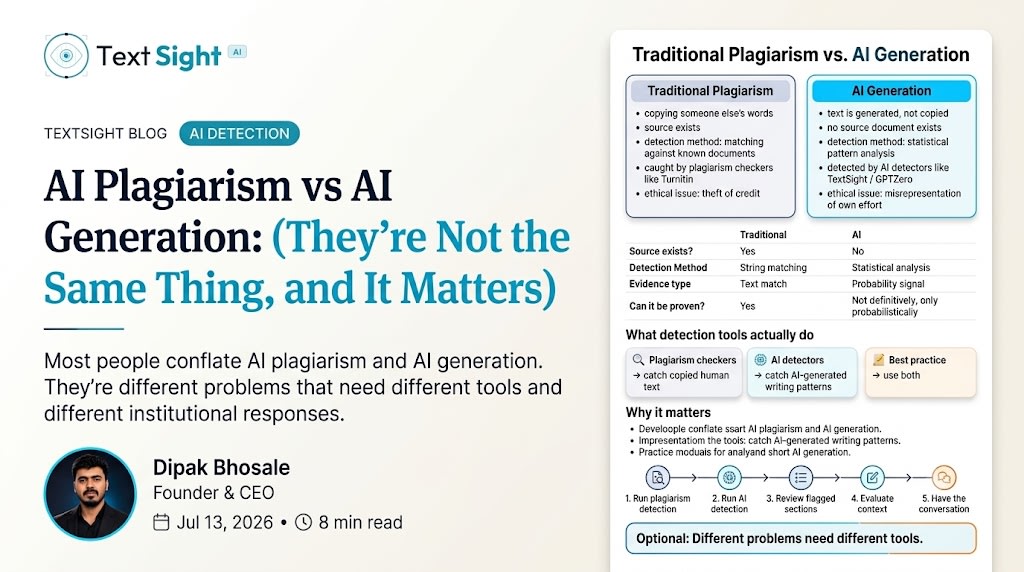
Most people conflate AI plagiarism and AI generation. They're different problems that need different tools and different institutional responses.
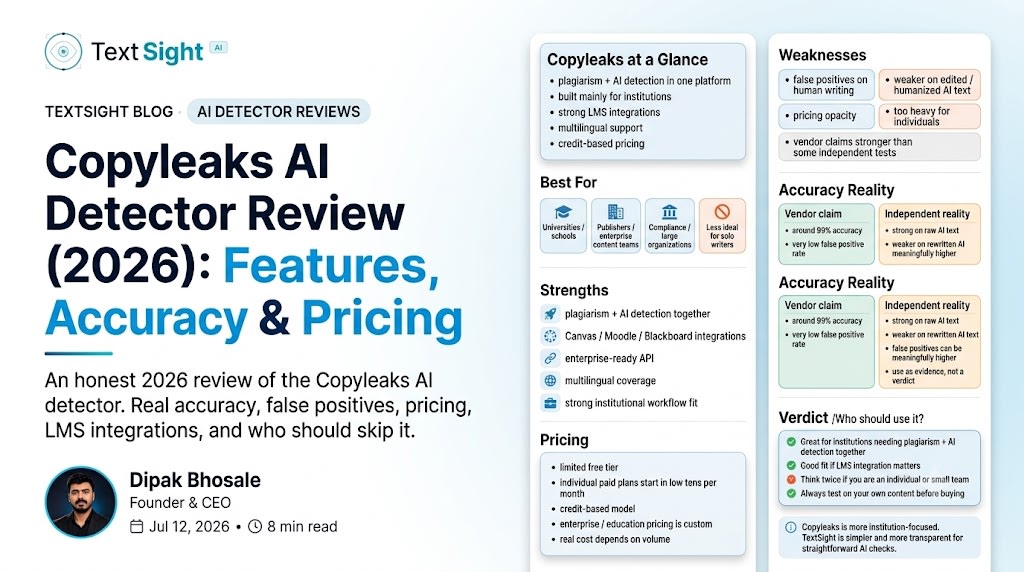
An honest 2026 review of the Copyleaks AI detector. Real accuracy, false positives, pricing, LMS integrations, and who should skip it.
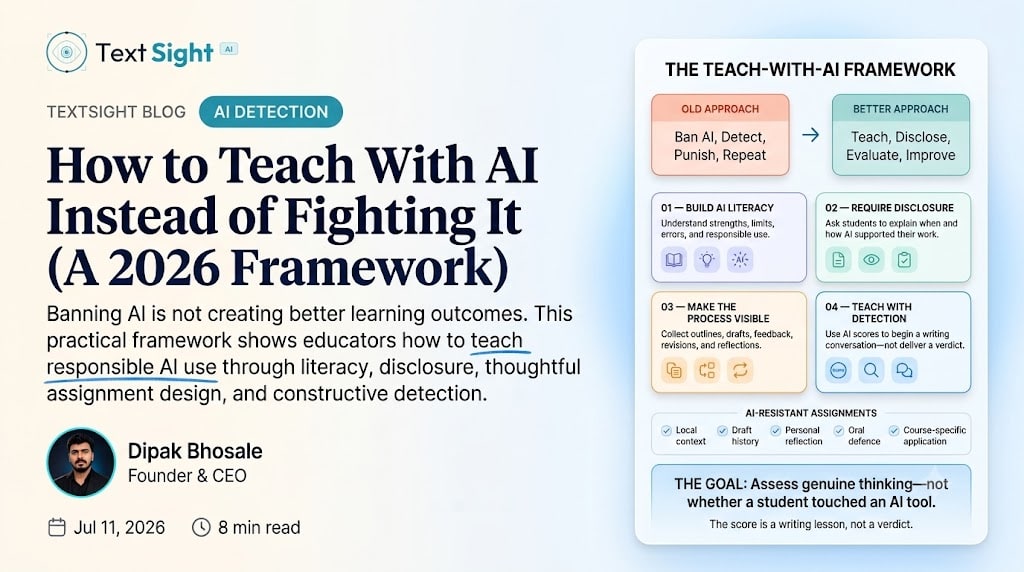
The 'ban AI' approach isn't working. Here's what forward-thinking educators are doing instead — and how to have the honest conversation with your students.
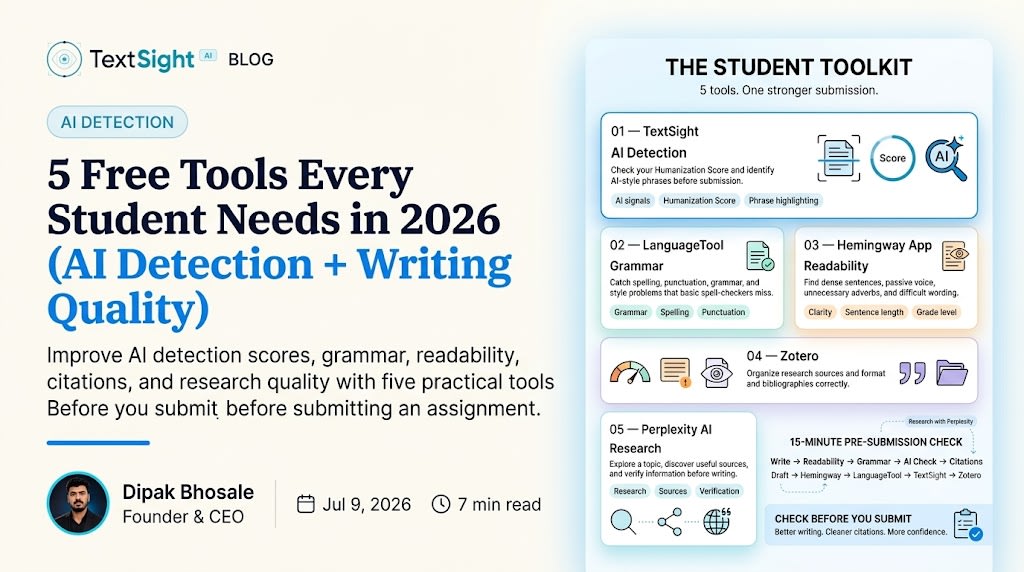
Five tools that will genuinely improve your writing and keep you out of trouble with AI detection — most of them free, all of them worth using.
We tested every major AI detector in 2026. Here's what actually works, what's snake oil, and why no single tool should be your final verdict.
TextSight and Turnitin do fundamentally different things. Whether you need one or both depends entirely on who you are and when in the writing process you're checking.
An honest 2026 review of Originality.ai. Real strengths for publishers, the credit pricing model, false-positive reality, and who it fits.
A 78% AI-flagged draft, three editing rounds, and a final score of 12%. Here's every step of the process, including the specific sentences that changed.
Per-word pricing and monthly word caps quietly destroy the value of AI humanizer tools. Here's what different user types actually pay.
An honest 2026 review of GPTZero: how it works, real accuracy and false-positive tradeoffs, pricing tiers, best use cases, and who should look elsewhere.
61.3% of essays written by non-native English speakers are incorrectly flagged as AI. That's not a bug. It's baked into how these systems were built.
AI detectors were trained on English data and struggle badly with non-English and translated text. The field knows this. Nobody's fixed it yet.
Document-level AI scores tell you nothing you can act on. Sentence-level feedback tells you exactly what to fix — and that changes everything.
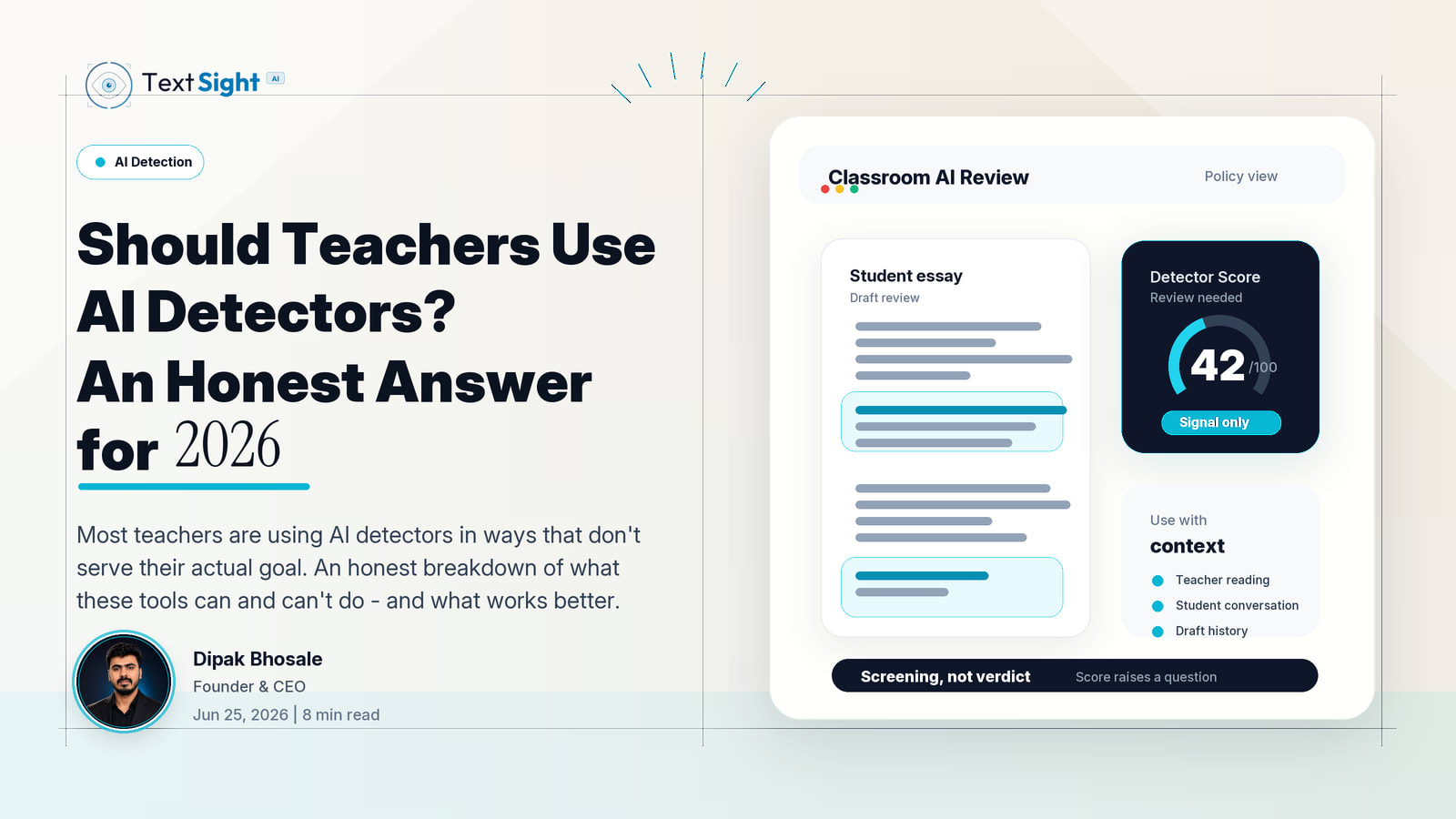
Most teachers are using AI detectors in ways that don't serve their actual goal. An honest breakdown of what these tools can and can't do — and what works better.
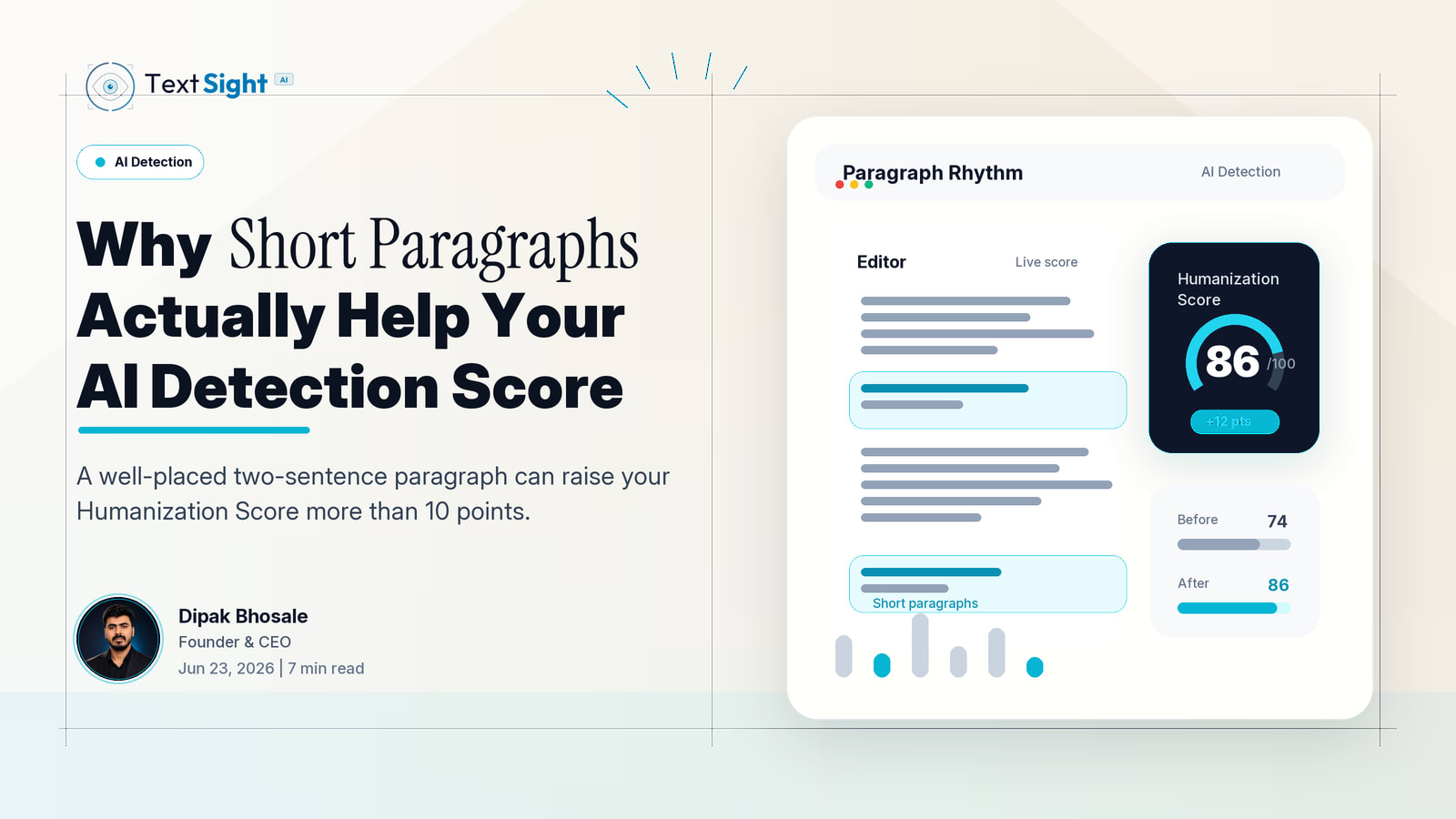
A well-placed two-sentence paragraph can raise your Humanization Score more than 10 points. Here's why it works — and why it only works if you do it right.
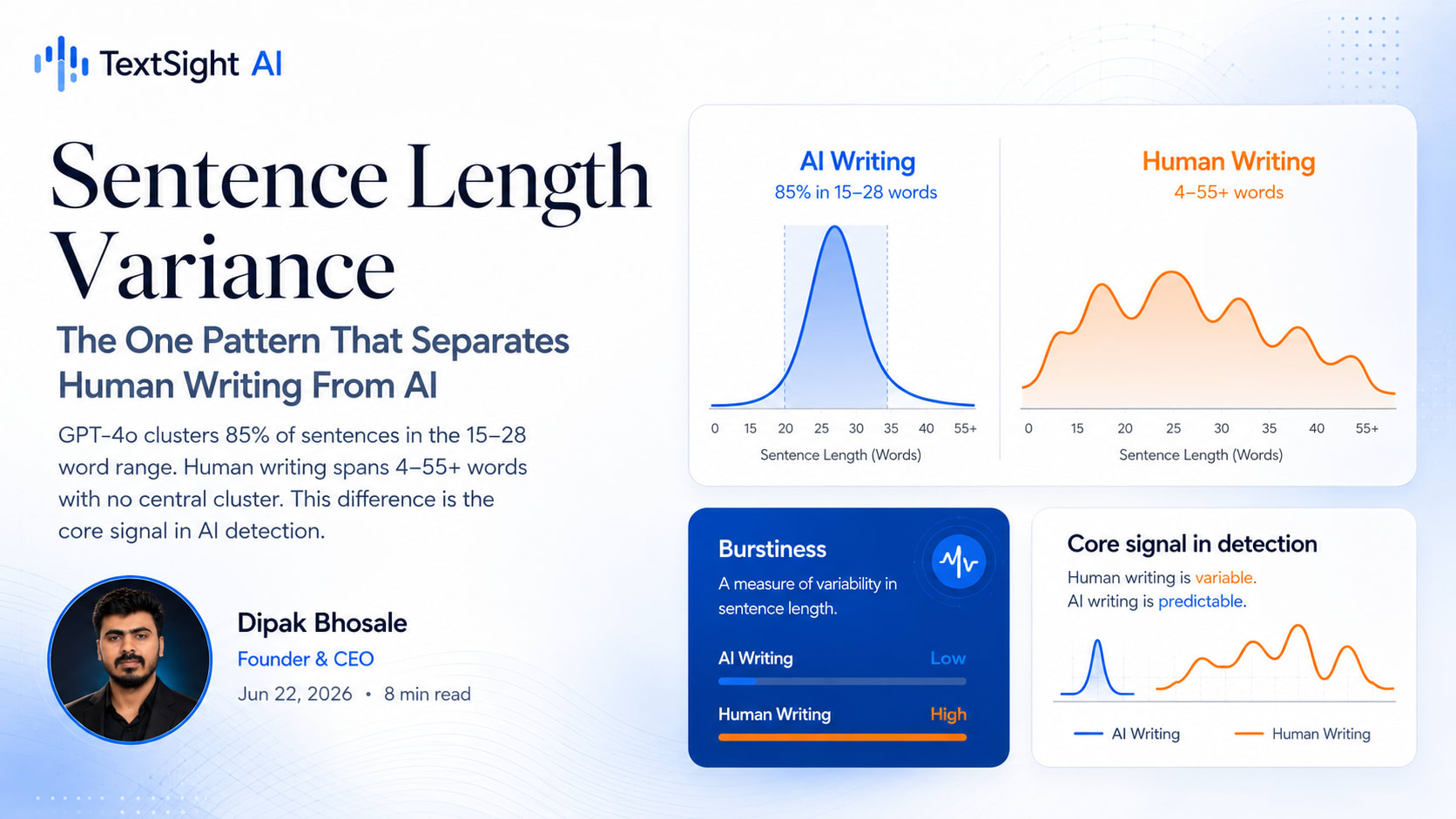
GPT-4o clusters 85% of sentences in the 15–28 word range. Human writing spans 4–55+ words with no central cluster. This difference is the core signal in AI detection.
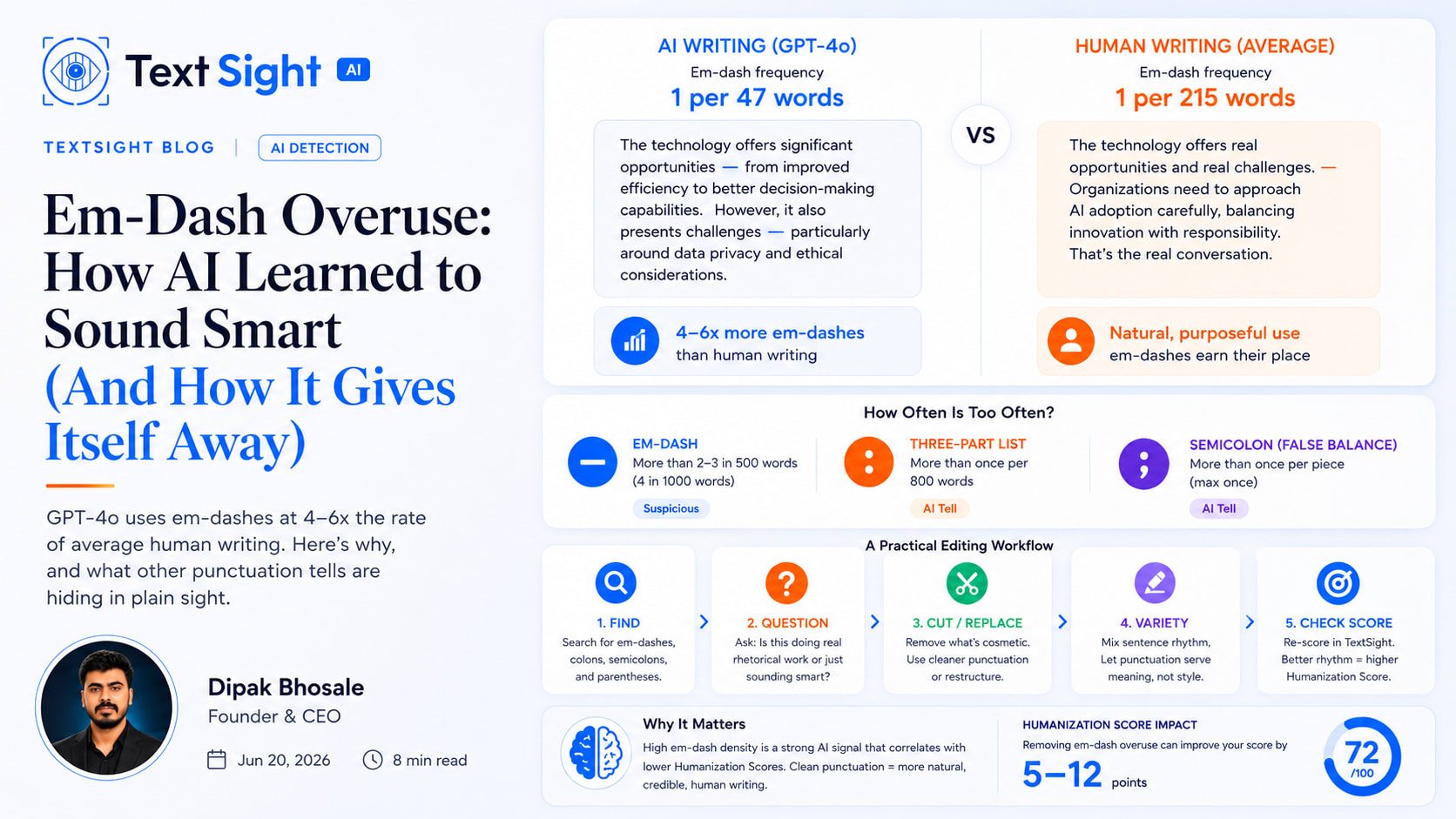
GPT-4o uses em-dashes at 4–6x the rate of average human writing. Here's why, and what other punctuation tells are hiding in plain sight.
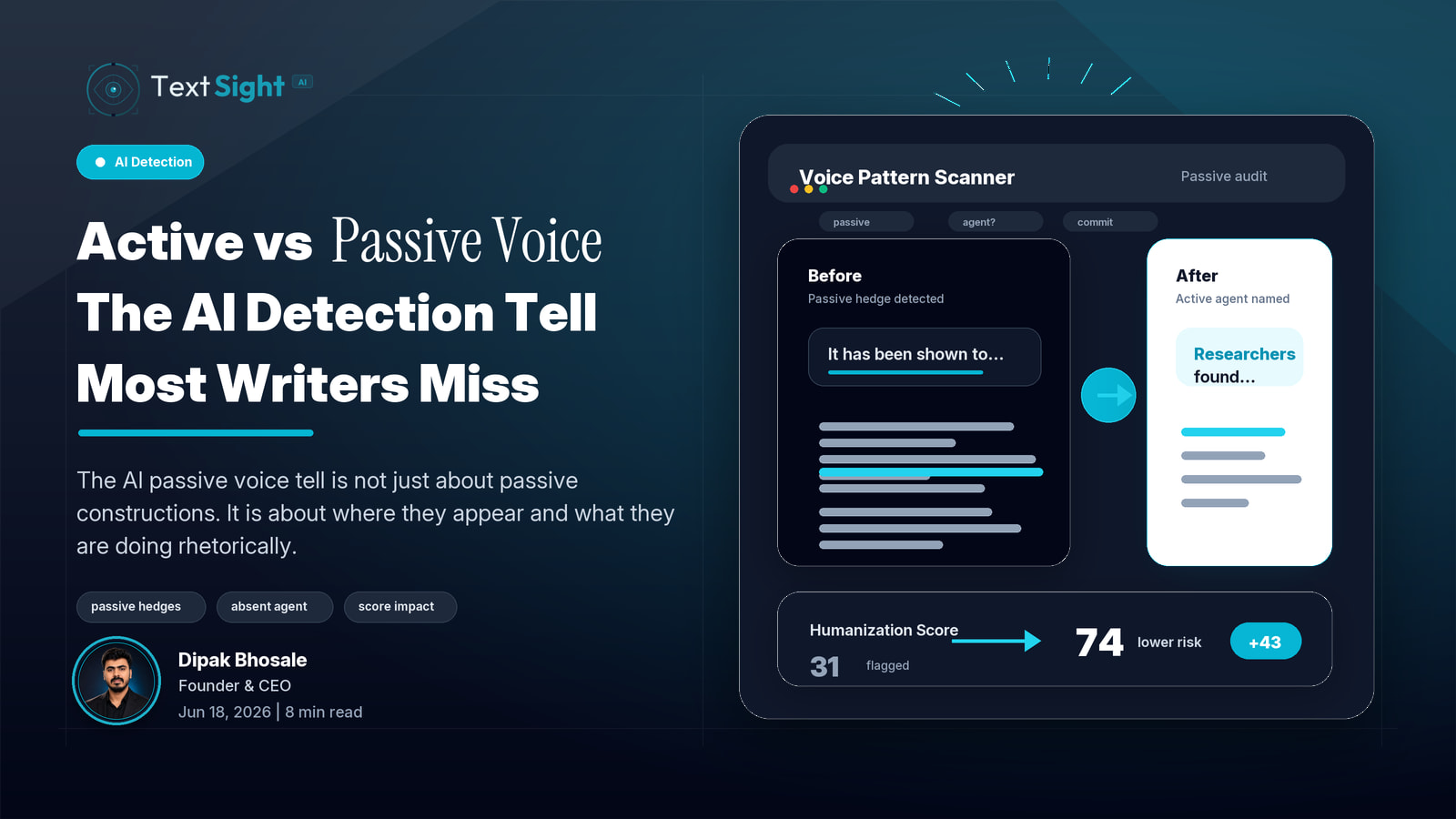
The AI passive voice tell isn't just about passive constructions — it's about where they appear and what they're doing rhetorically. Here's how to spot it.
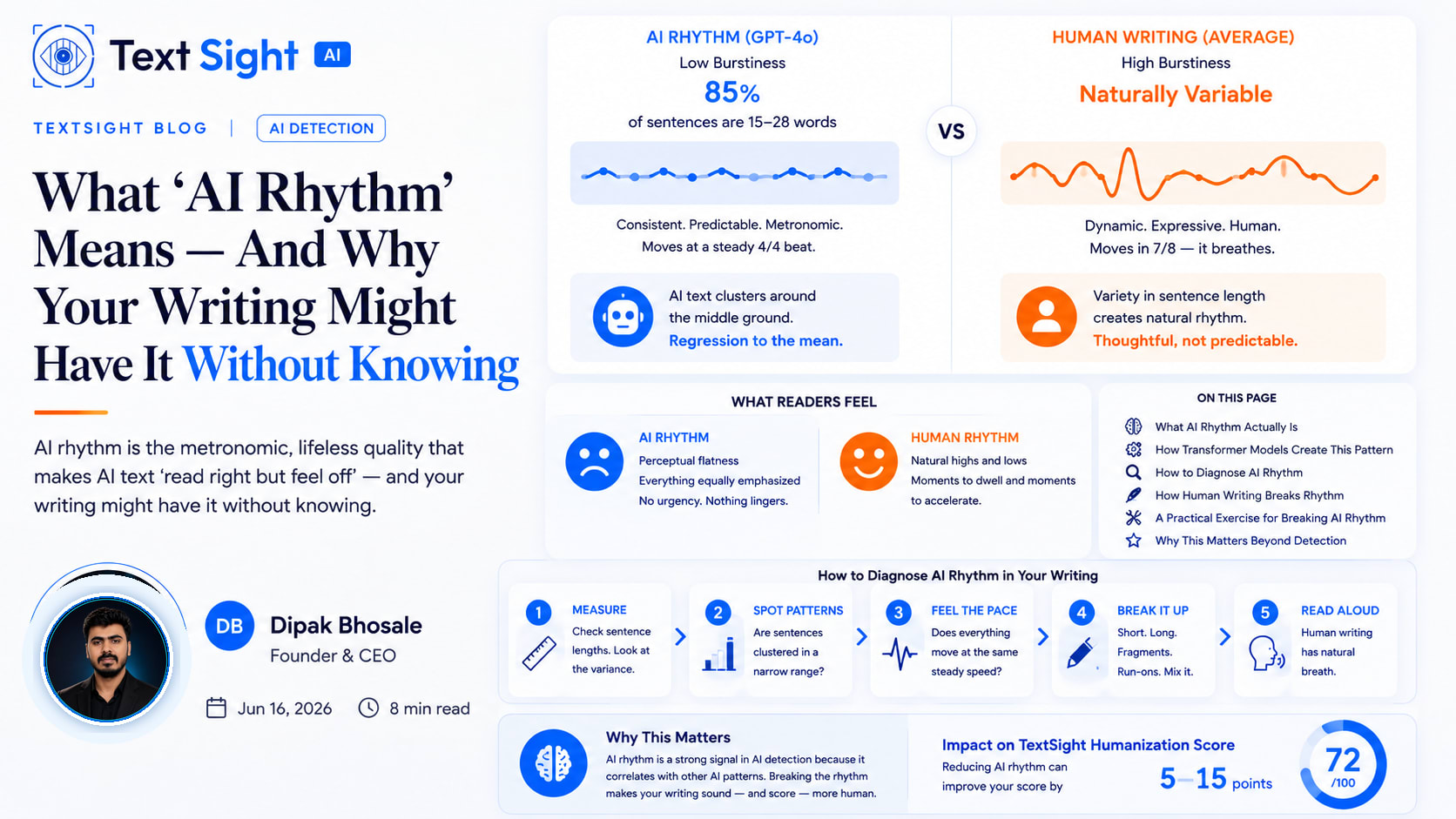
AI rhythm is the metronomic, lifeless quality that makes AI text 'read right but feel off' — and your writing might have it without knowing.
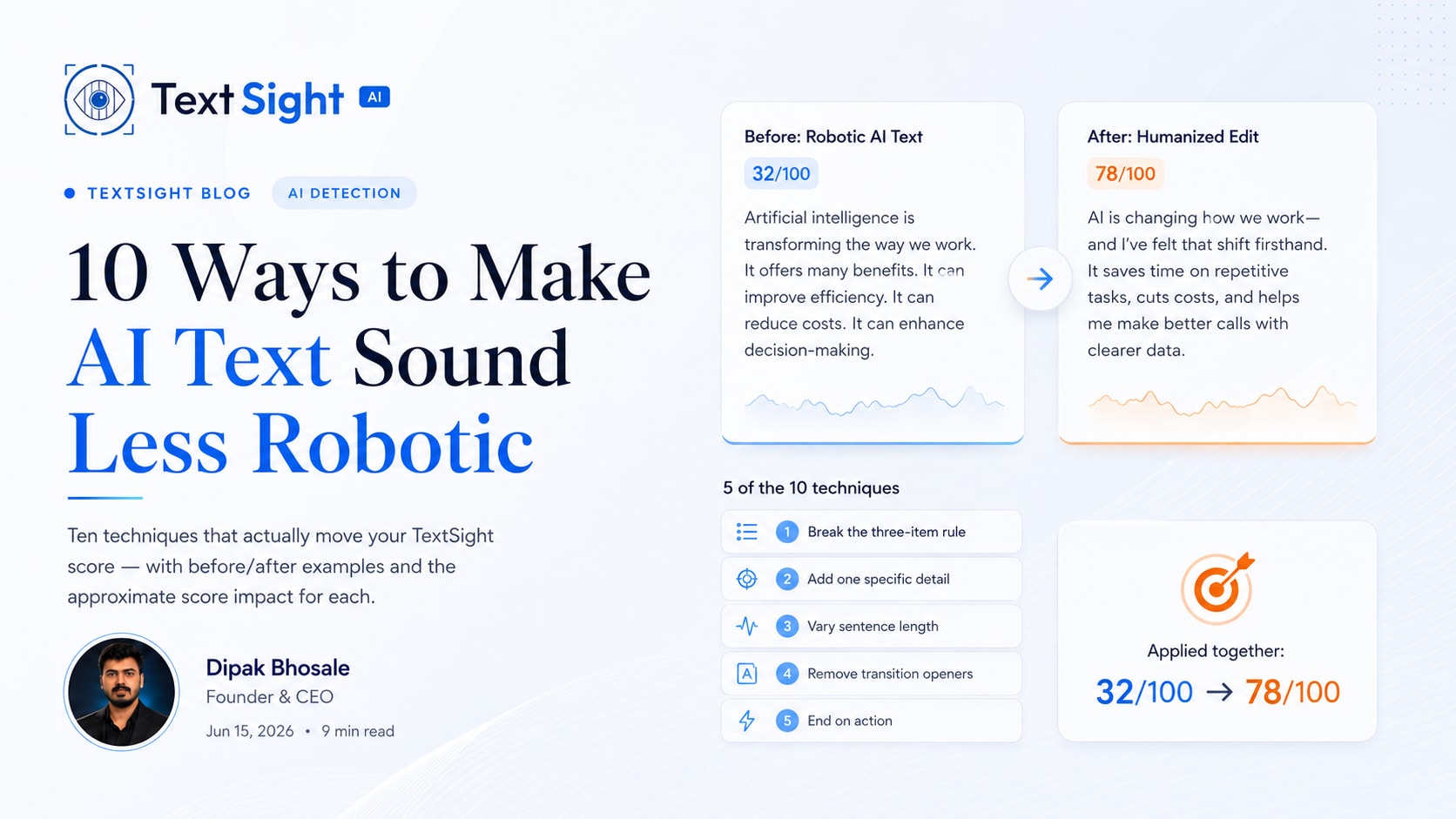
Ten techniques that actually move your TextSight score — with before/after examples and the approximate score impact for each.
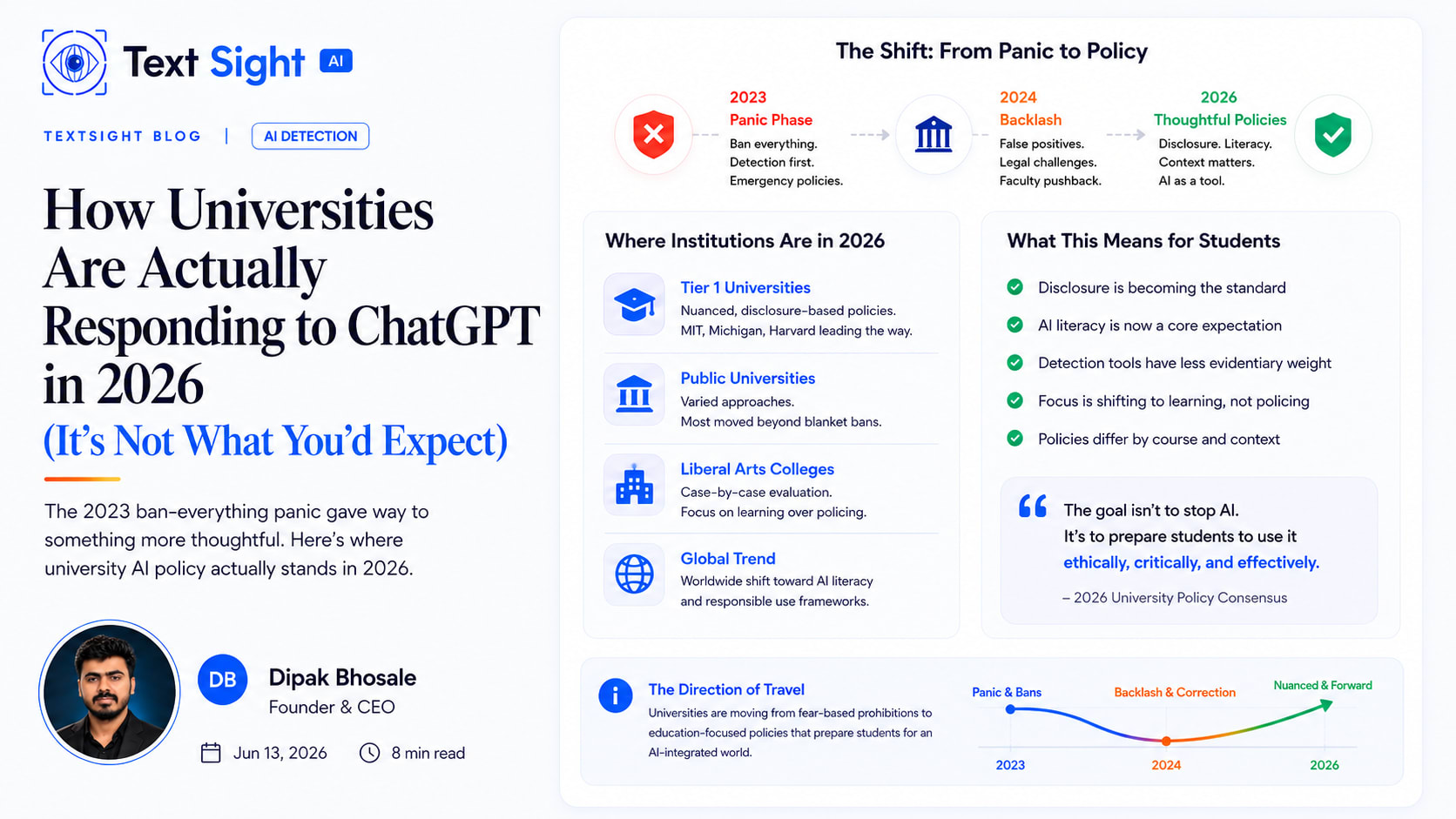
The 2023 ban-everything panic gave way to something more thoughtful. Here's where university AI policy actually stands in 2026.
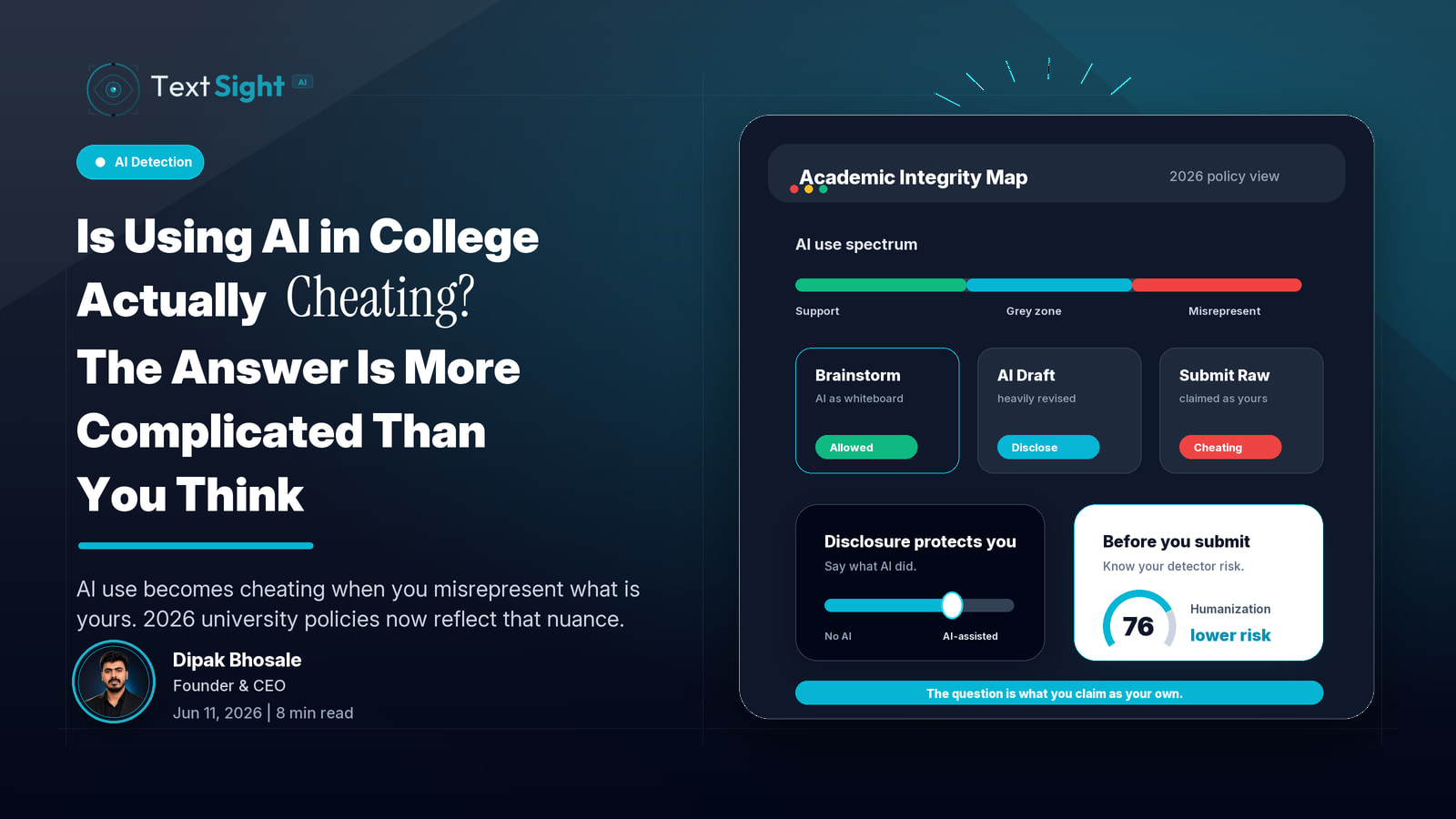
Whether AI use is cheating depends on what you're representing as your own — and most 2026 university policies have finally caught up to that nuance.
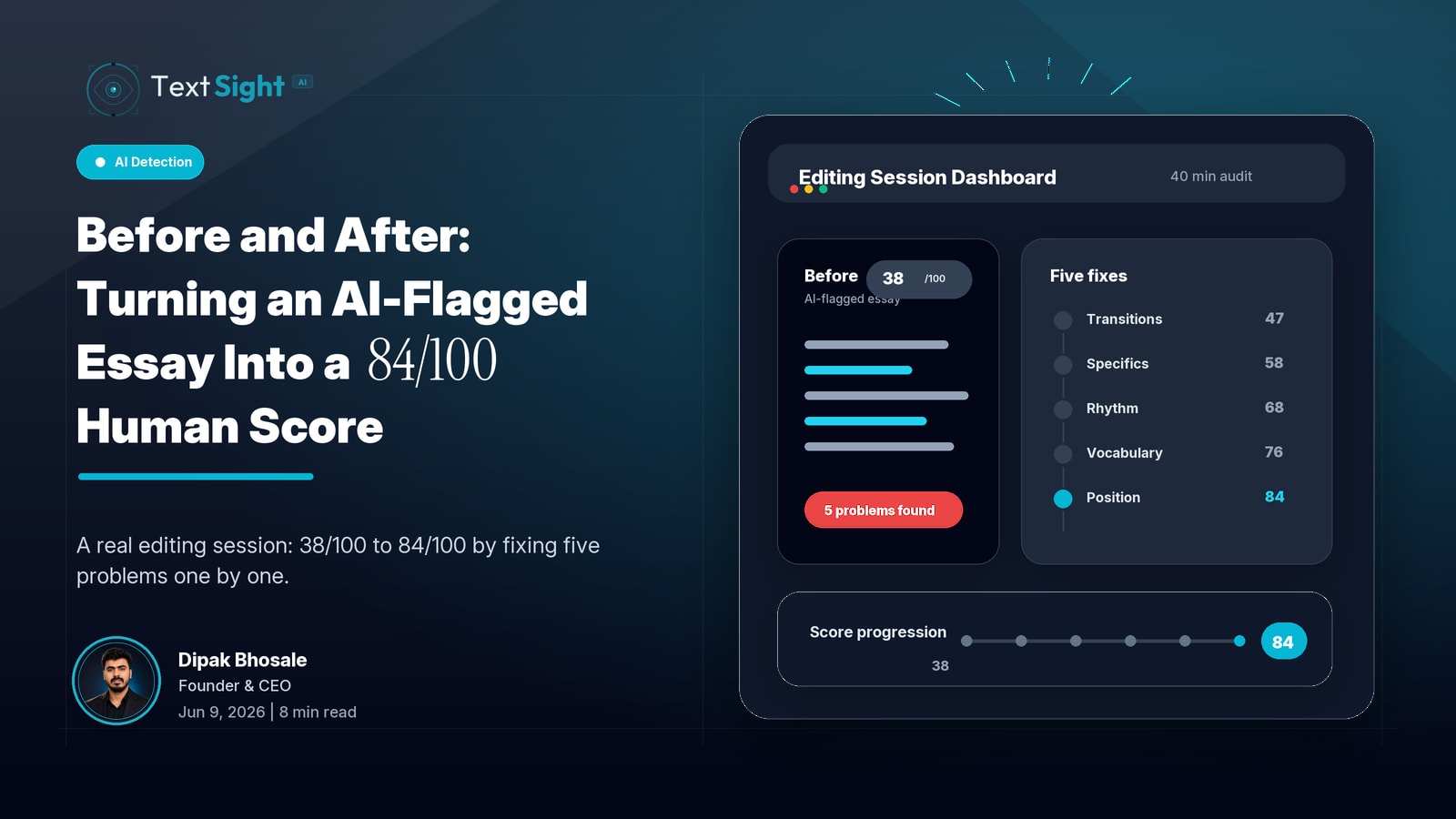
A real editing session: we took a 38/100 AI-flagged essay, identified 5 problems, fixed them one by one, and hit 84/100. Here's every step.
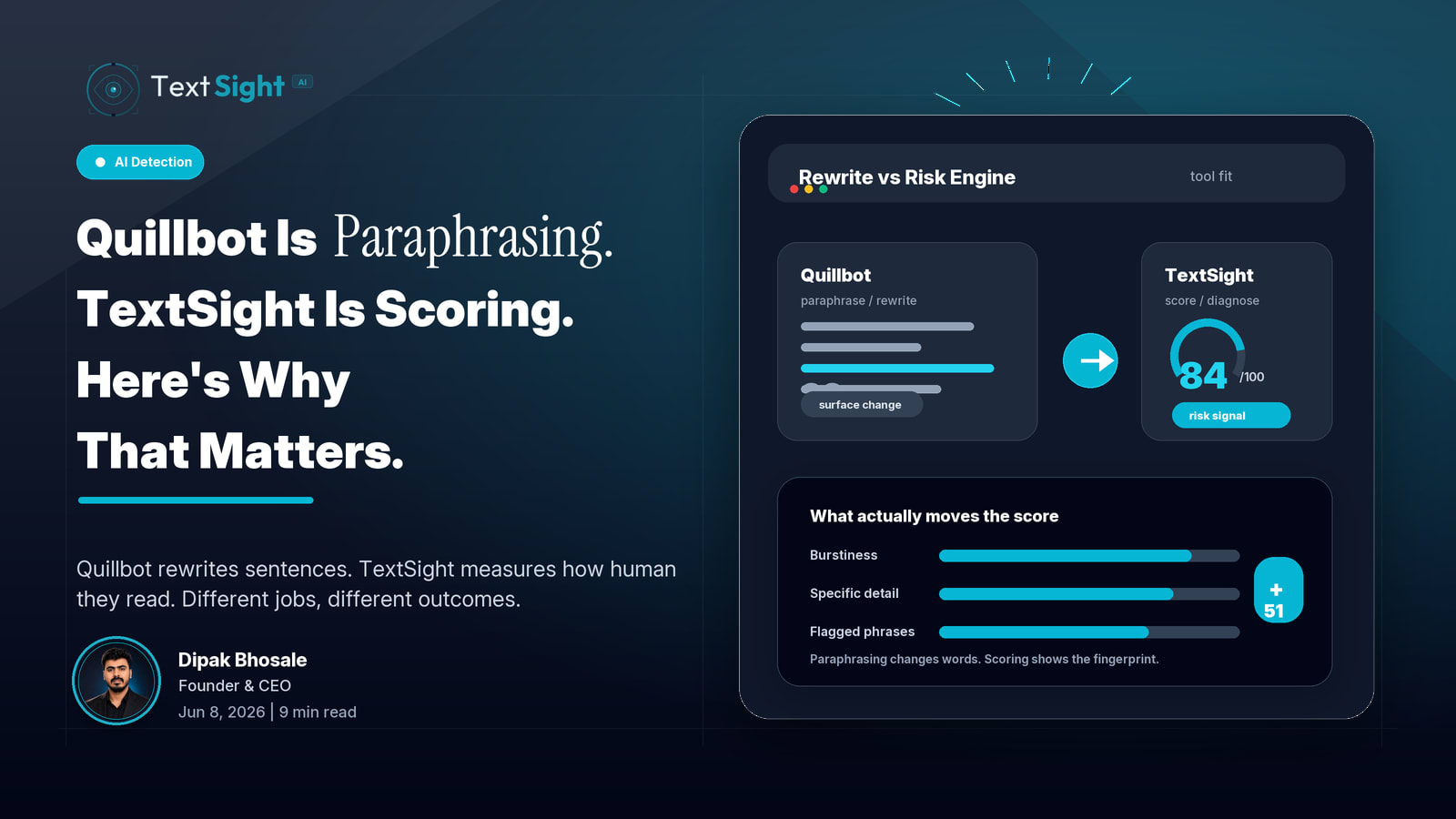
Quillbot rewrites sentences. TextSight measures how human they read. These are completely different jobs — and confusing them wastes your time.
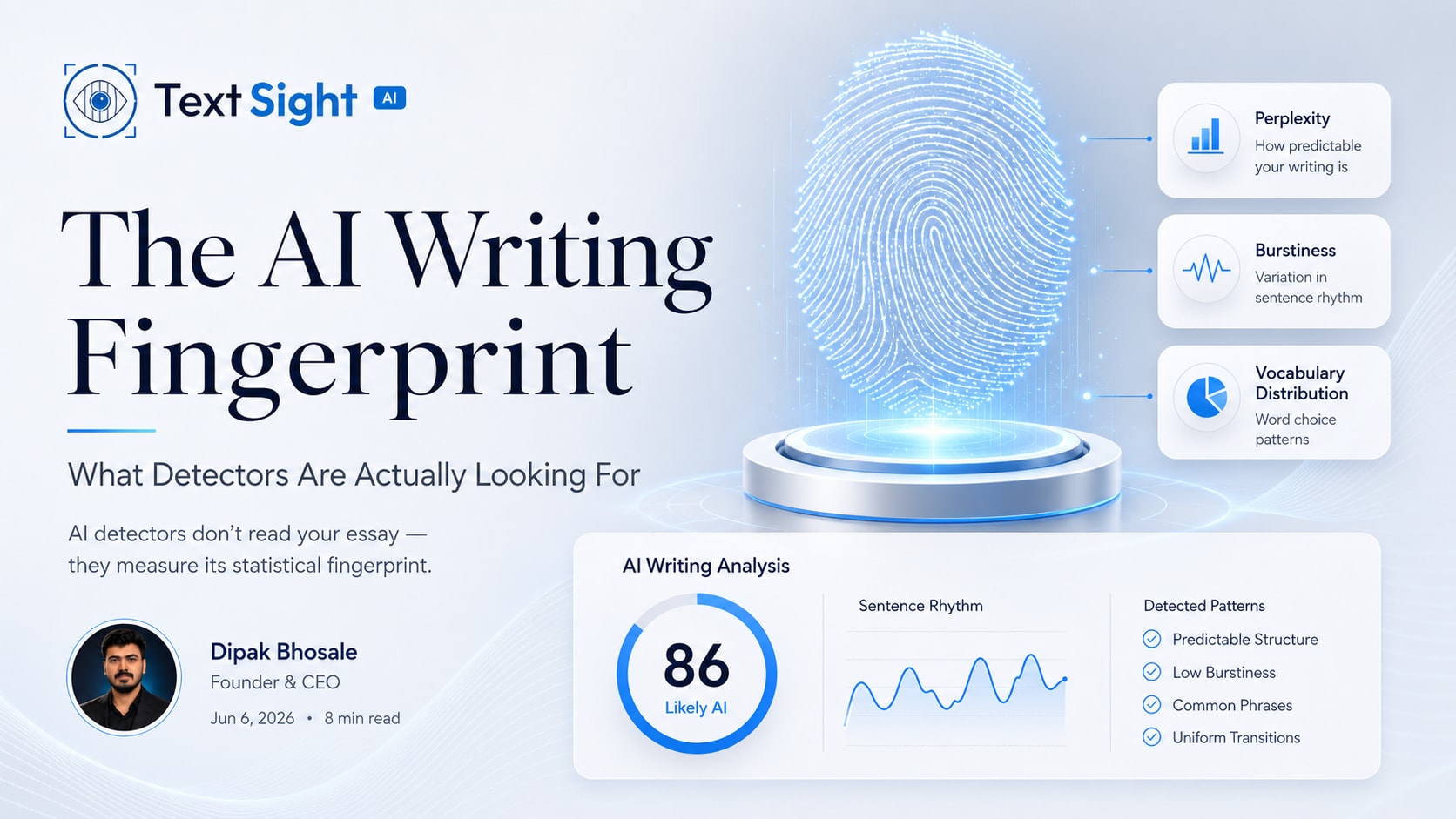
AI detectors don't read your essay — they measure its statistical fingerprint. Here's exactly what that means.
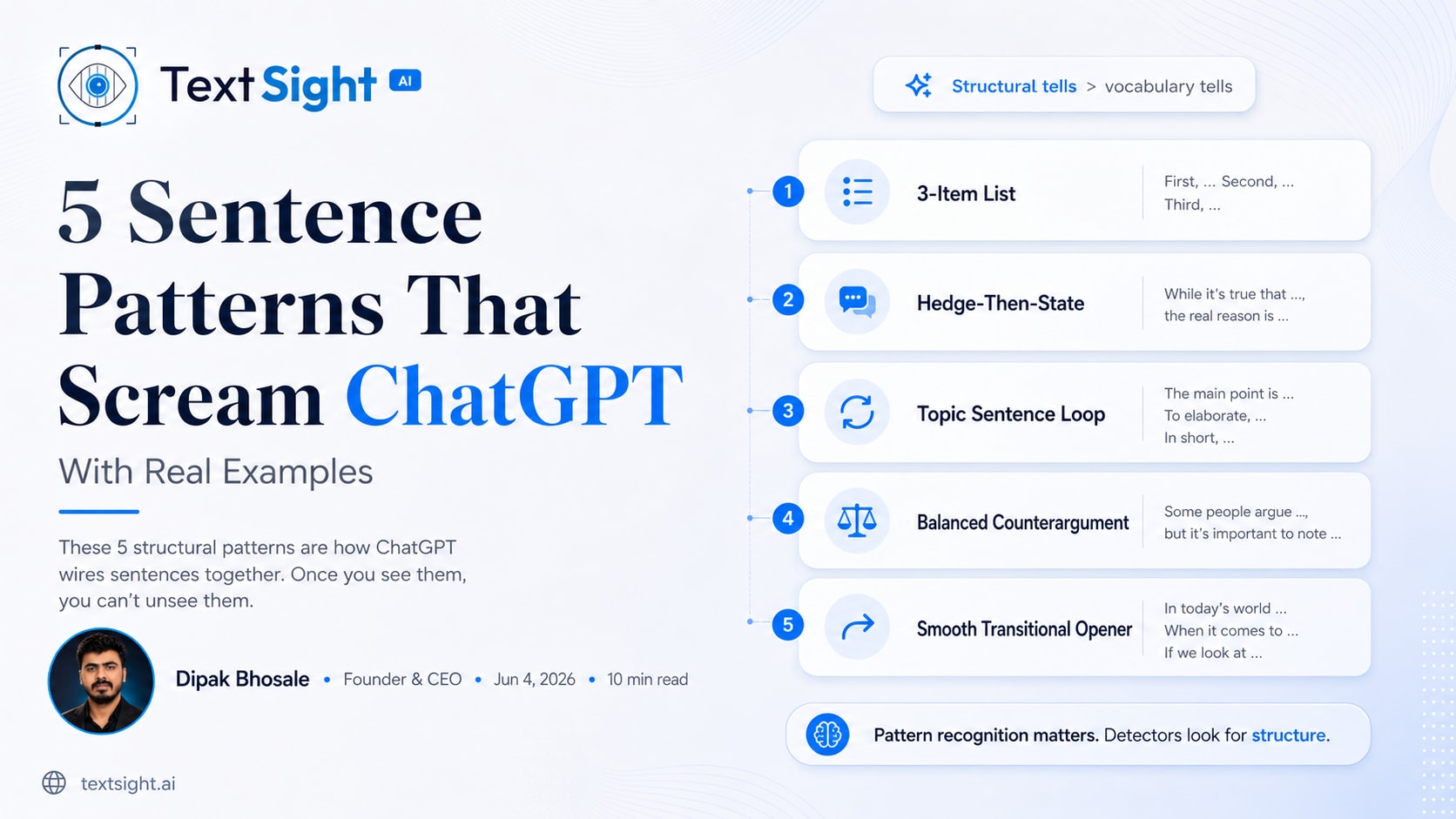
These 5 structural patterns are how ChatGPT wires sentences together. Once you see them, you can't unsee them.
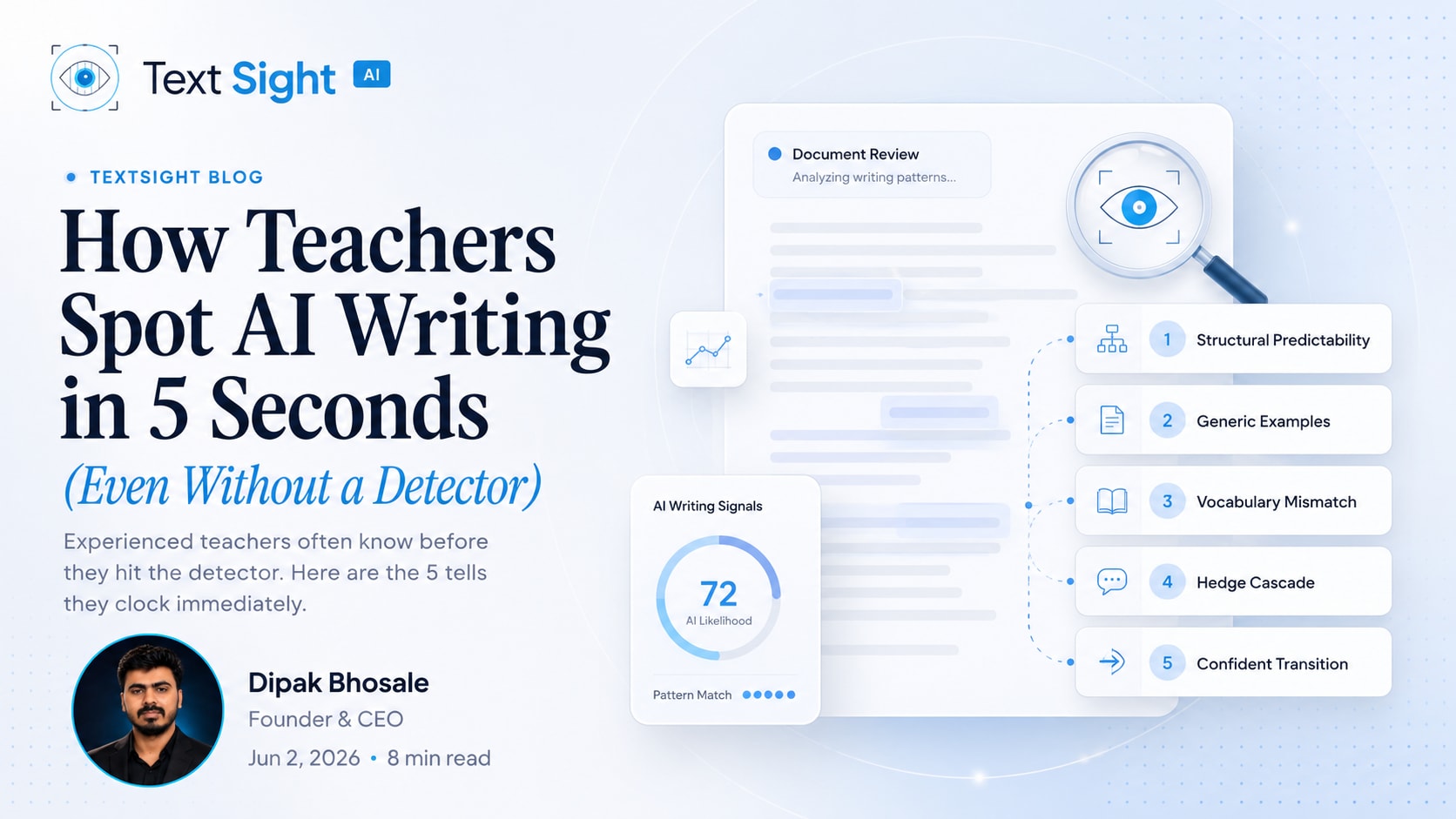
Experienced teachers often know before they hit the detector. Here are the 5 tells they clock immediately.
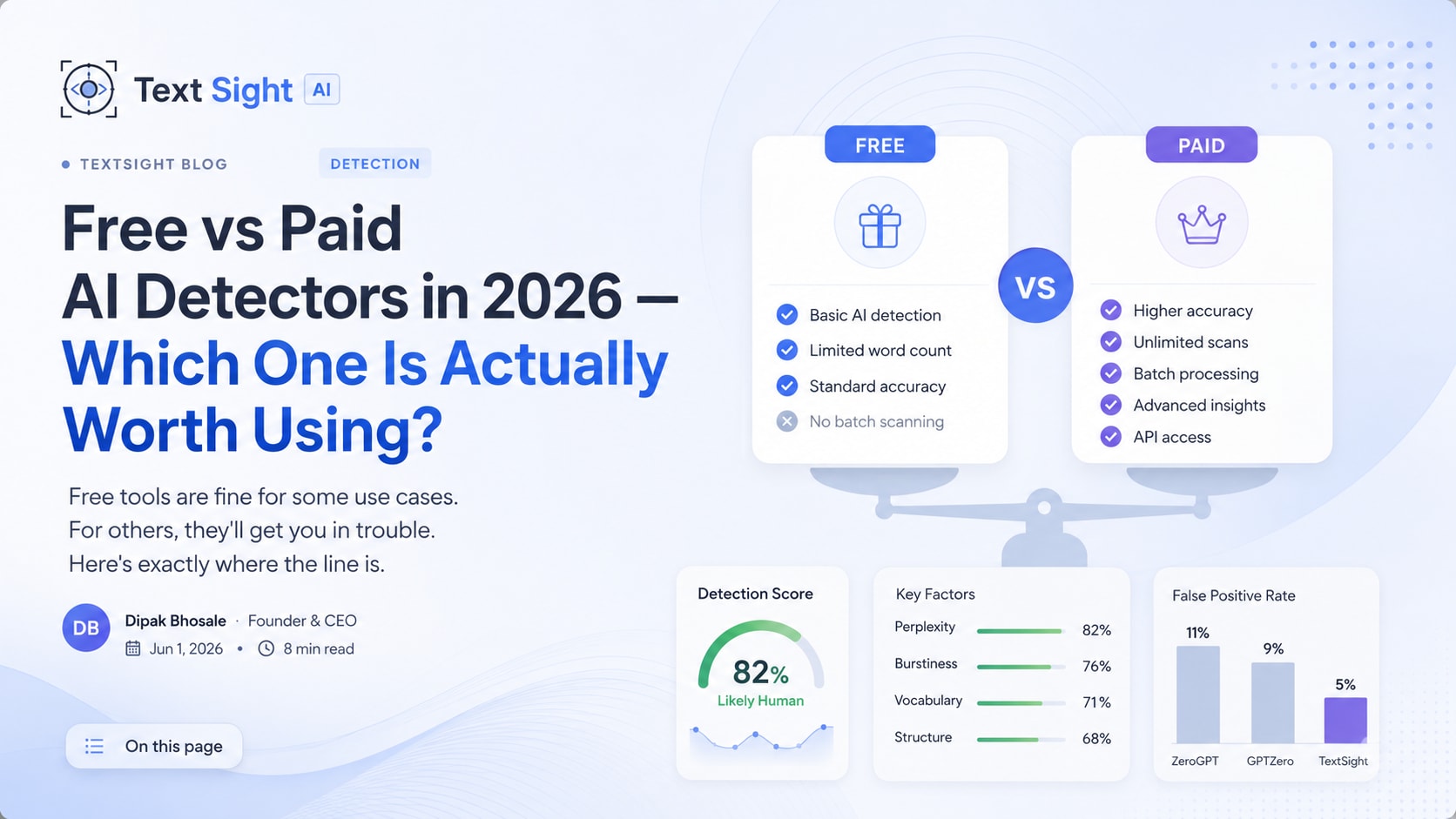
Free tools are fine for some use cases. For others, they'll get you in trouble. Here's exactly where the line is.
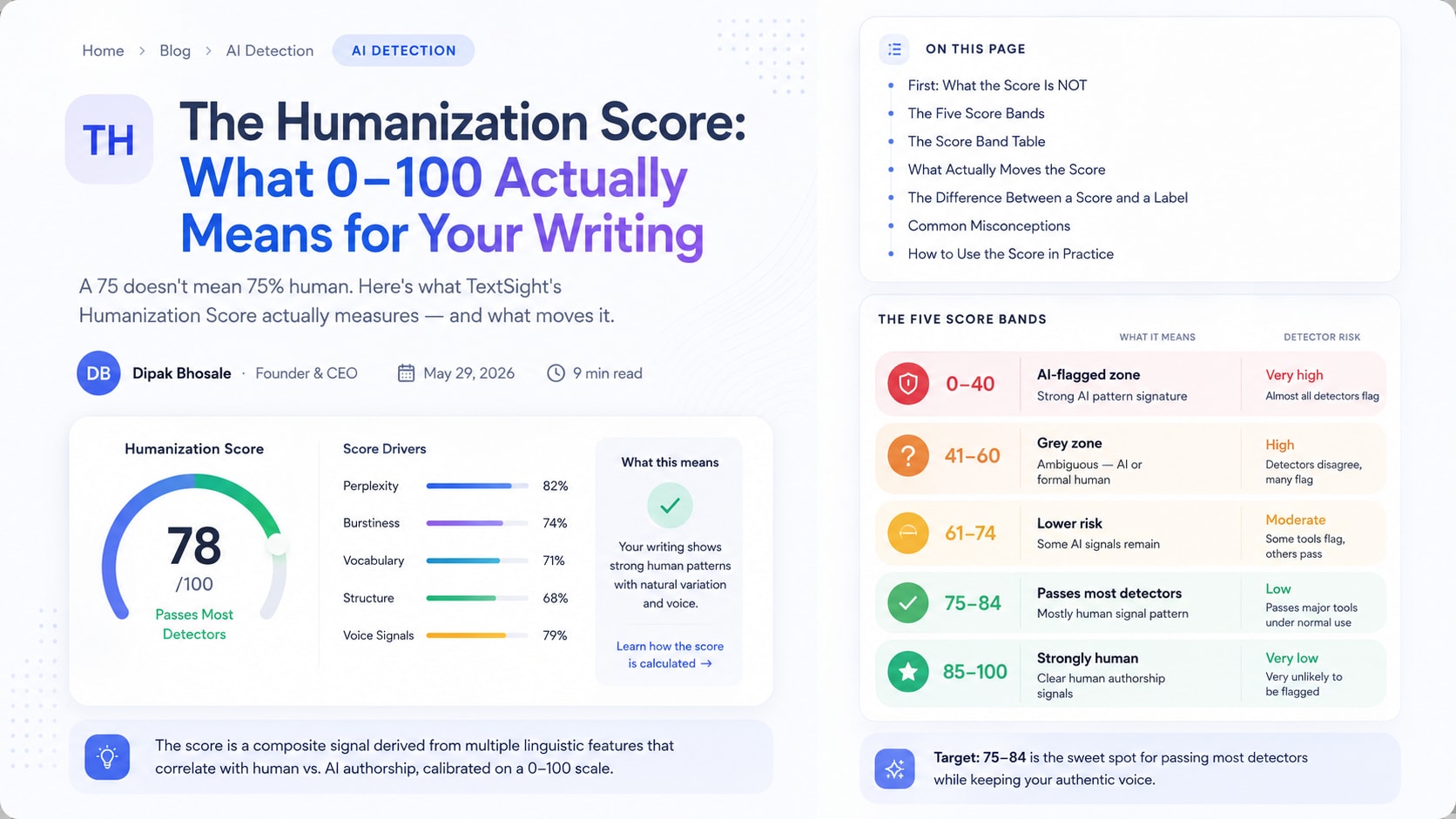
A 75 doesn't mean 75% human. Here's what TextSight's Humanization Score actually measures — and what moves it.
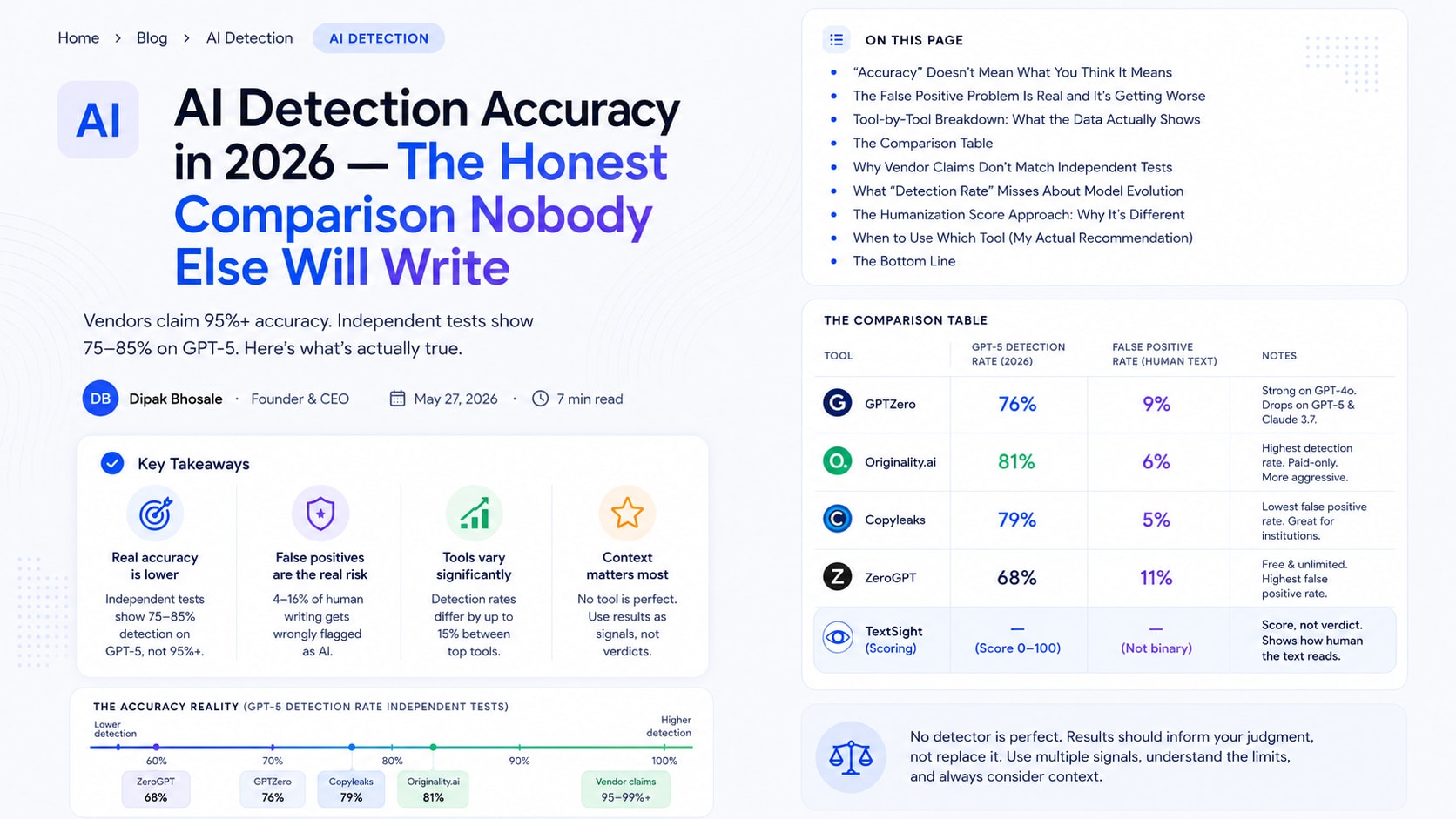
Vendors claim 95%+ accuracy. Independent tests show 75–85% on GPT-5. Here's what's actually true.
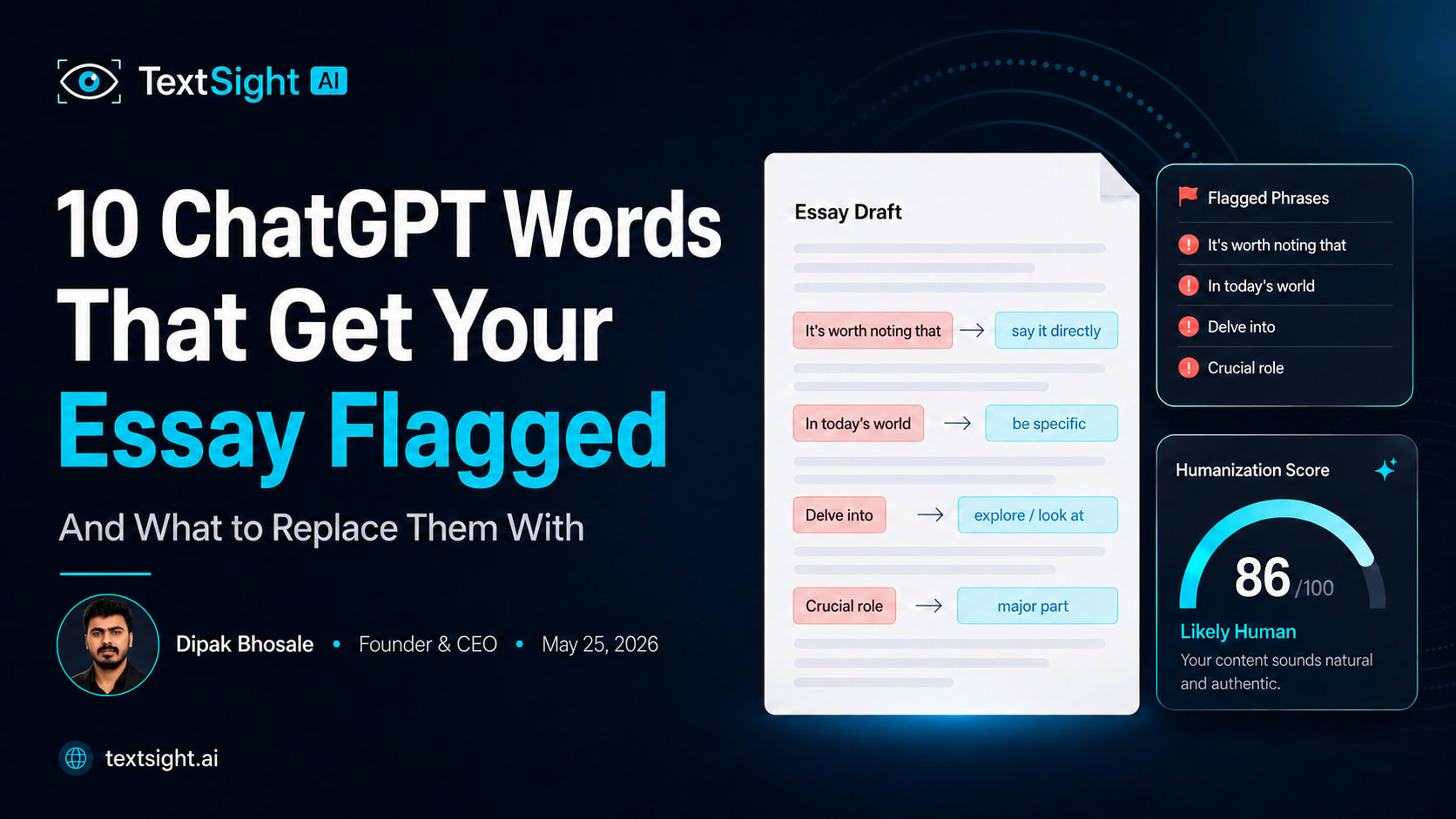
GPT-4o uses these 10 phrases 3–8x more than humans do. Here's what to replace them with.
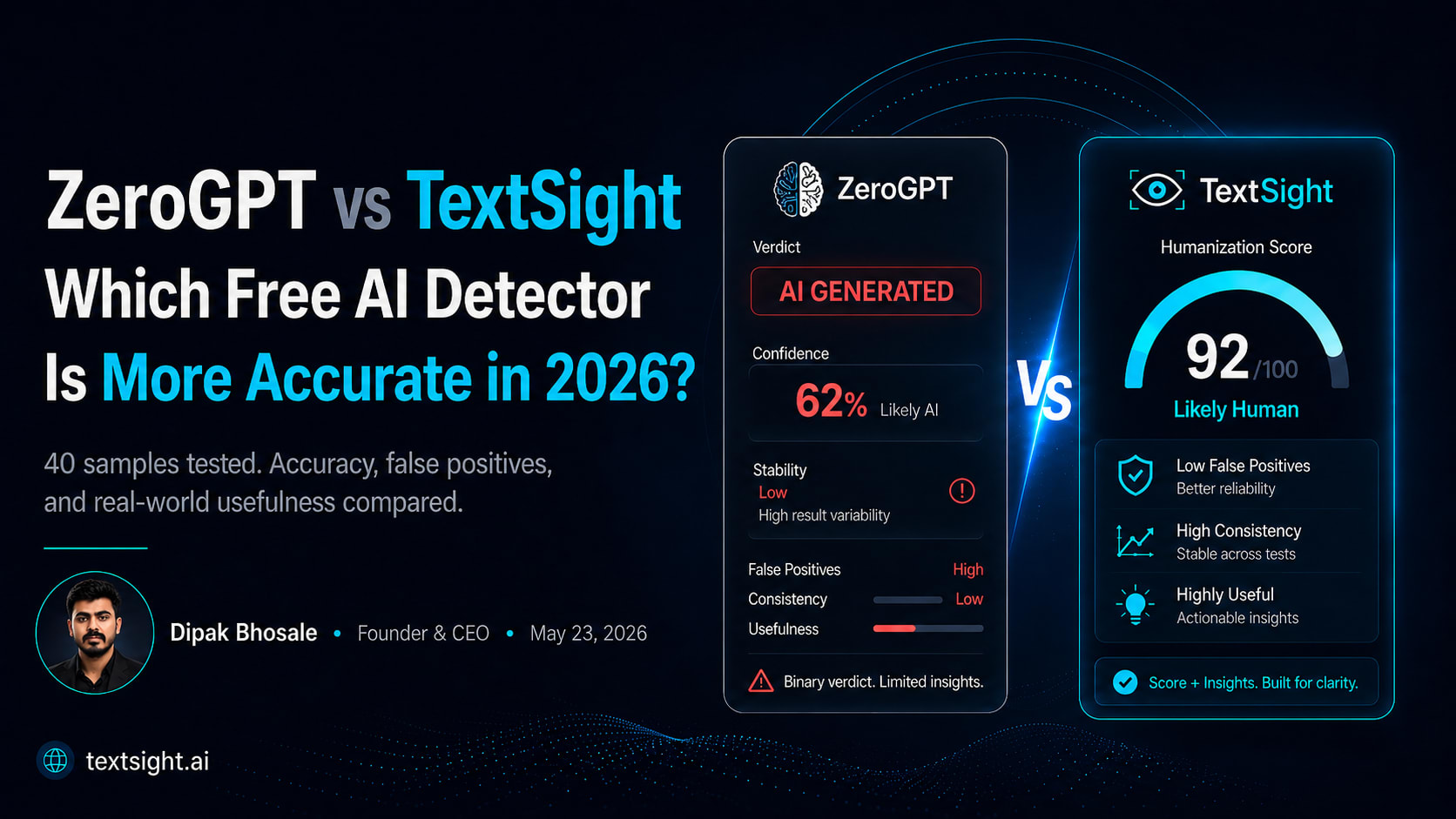
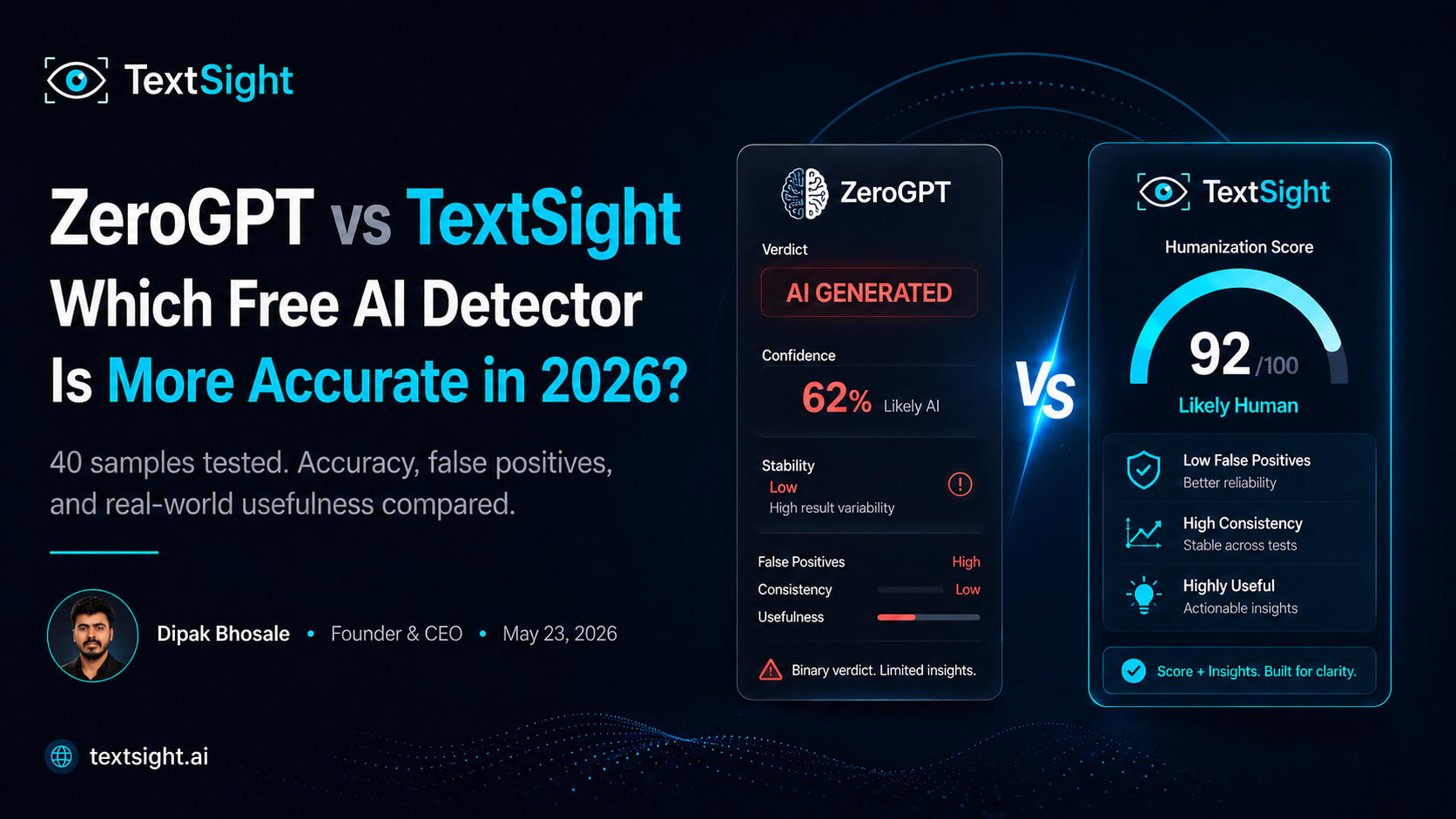
ZeroGPT is the free AI detector millions of people use first. TextSight gives you a 0-100 Humanization Score instead of a binary verdict. We ran 40 identical samples through both tools and compared accuracy, false positives, and usefulness. Here's the full breakdown.
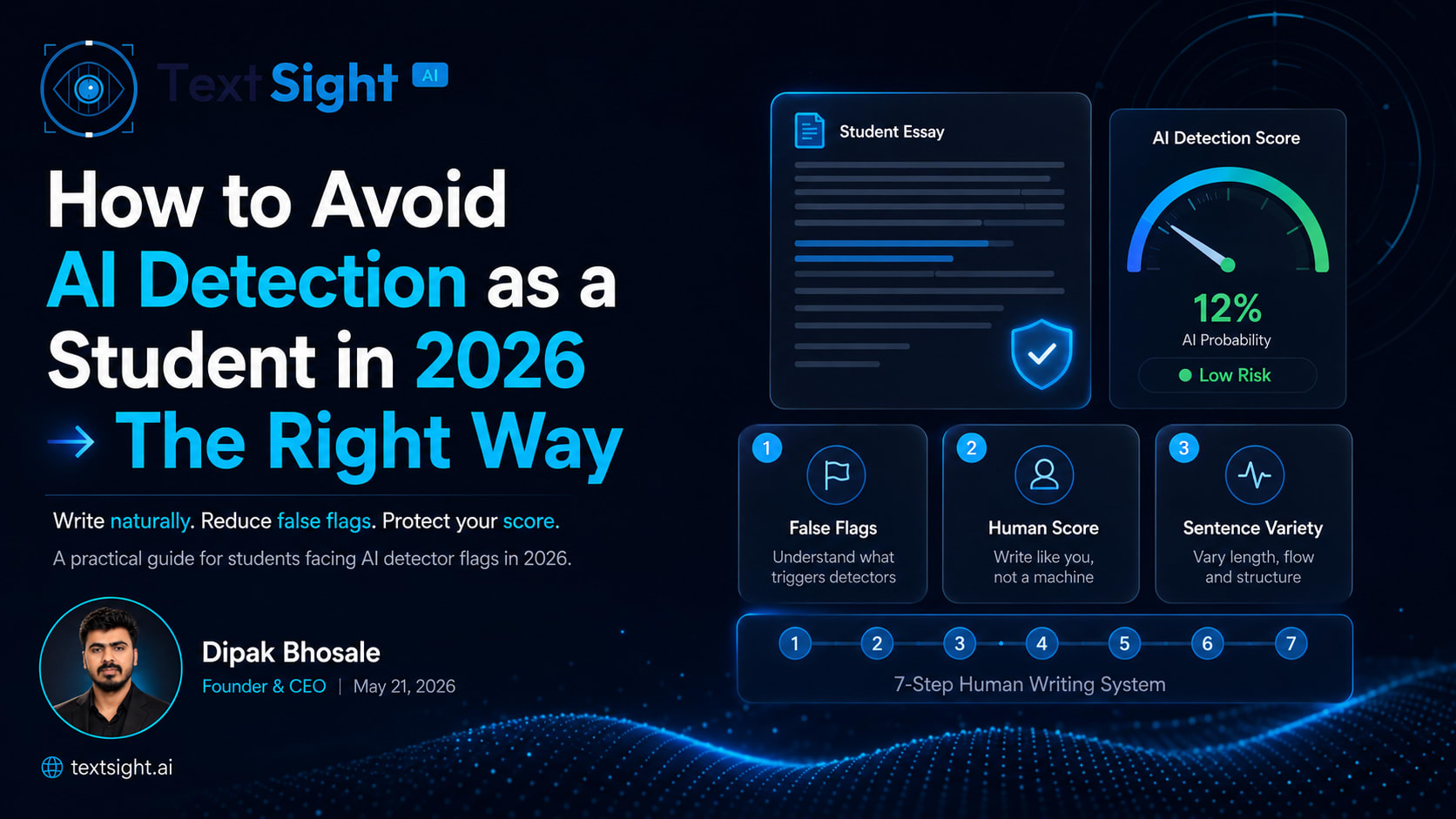
AI detectors are flagging student work at record rates in 2026 — including work that was genuinely written by humans. Here's the only guide you need: how to write so detectors don't flag you, what to do if you're already flagged, and why your score matters more than whether you used AI at all.
GPT-5 writes differently than GPT-4o — more human, less predictable, harder to flag. But can today's AI detectors actually catch it? We ran 30 GPT-5 samples through 5 major detectors and scored every output. Here's what we found.

ChatGPT, Gemini, and Claude all write differently — and AI detectors catch them at different rates. We ran 50 text samples through 3 major detectors and scored every output on TextSight. Here's the full breakdown: which model evades detection best, which content types are most at risk, and what actually matters more than model choice.
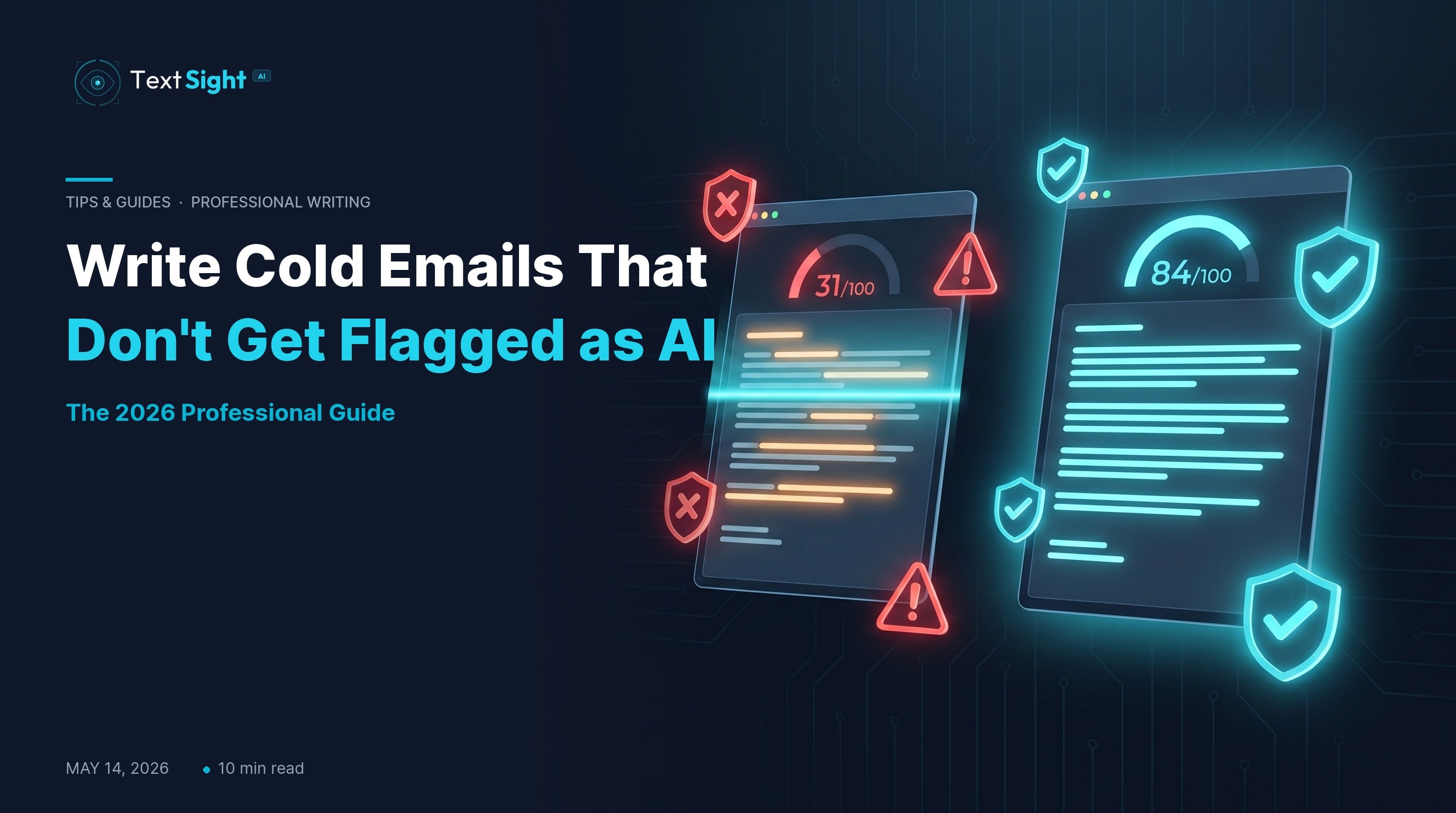
AI-written cold emails are getting ignored, filtered, and now flagged before a human ever reads them. Here's the 2026 guide to writing outreach, proposals, and business emails that read genuinely human — and actually get replies.
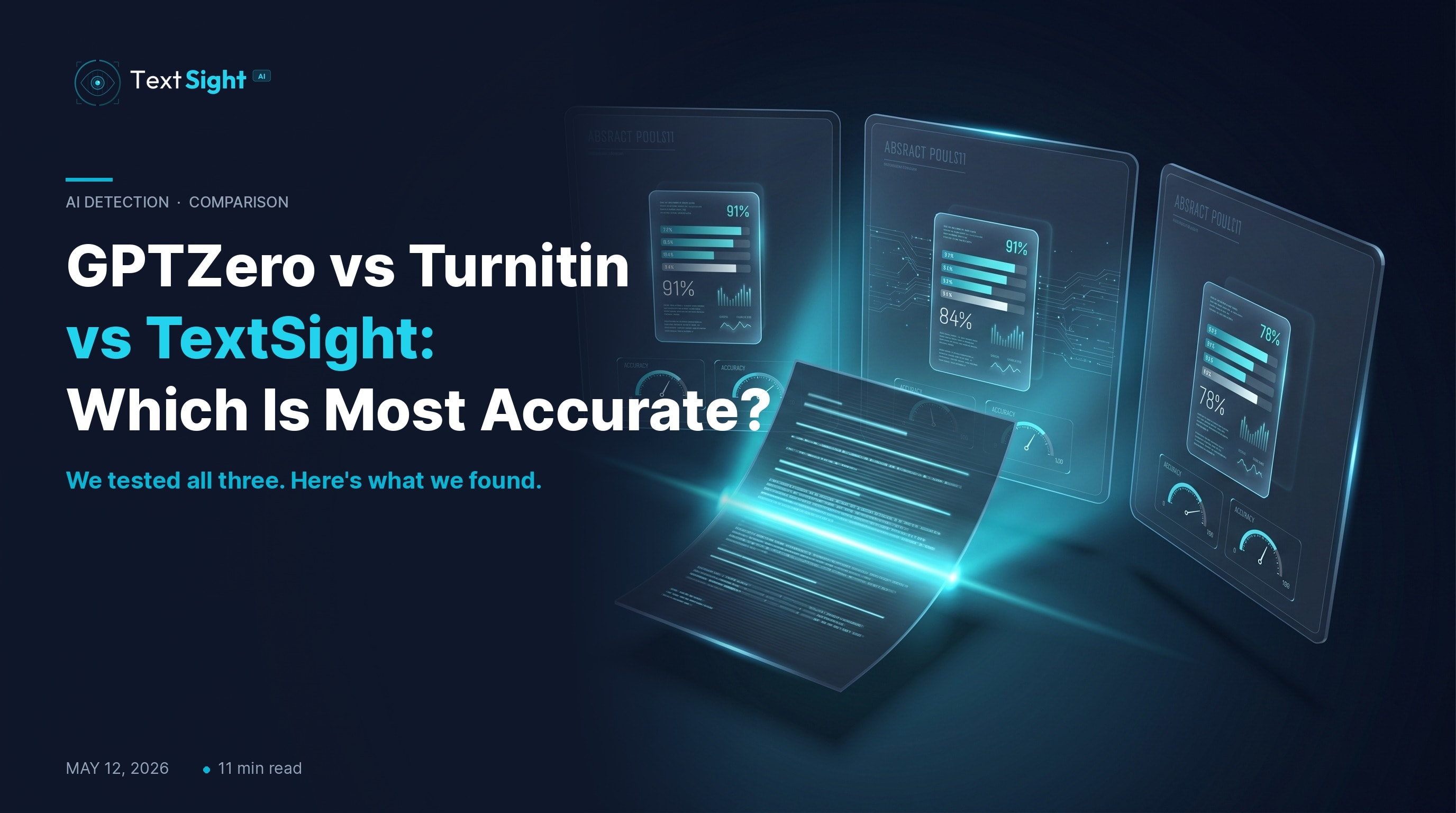
We ran the same 20 texts — pure AI, pure human, and mixed — through GPTZero, Turnitin, and TextSight. Here's exactly what each tool caught, what it missed, and which one you should actually trust in 2026.
Clients are rejecting deliverables that flag as AI — even when you wrote them yourself. Here's the survival guide every freelance writer needs in 2026: why it's happening, what triggers false positives, and a 7-minute workflow that protects your invoice.
You wrote the LinkedIn post yourself, but it scores 23/100 humanization. Here's why your own writing now sounds like AI, the 5 patterns detectors flag, and a 5-minute fix that takes any draft from 'reads robotic' to 'reads human.'
31% of US recruiters now run cover letters through AI detection software before a human ever reads them. Here's how to score yours, what triggers false positives, and the 30-second pre-submit ritual every job seeker needs in 2026.
Most humanizer tools strip your voice along with the AI patterns. Here's how to actually humanize ChatGPT text — keep what makes it sound like you, fix only what makes it sound like a robot.
You wrote your essay yourself, but a detector flagged it as AI. Here's why false positives happen, what to do right now, how to prove your work is yours, and how to write so it doesn't happen again.
We ran 12 ChatGPT essays through Turnitin. Here's exactly what it flagged, what it missed, and what that means for students and teachers in 2026.
Does Google penalize AI-written content? We break down Google's actual policy, what the Helpful Content Update really targets, and how to use AI safely without risking your rankings.
Wondering if an essay, email, or article was written by ChatGPT? Here are 5 reliable ways to detect AI-generated text — including a free tool that takes seconds.

We tested 8 AI humanizer tools to see which ones actually bypass AI detection in 2026. Here's what worked — and what didn't.
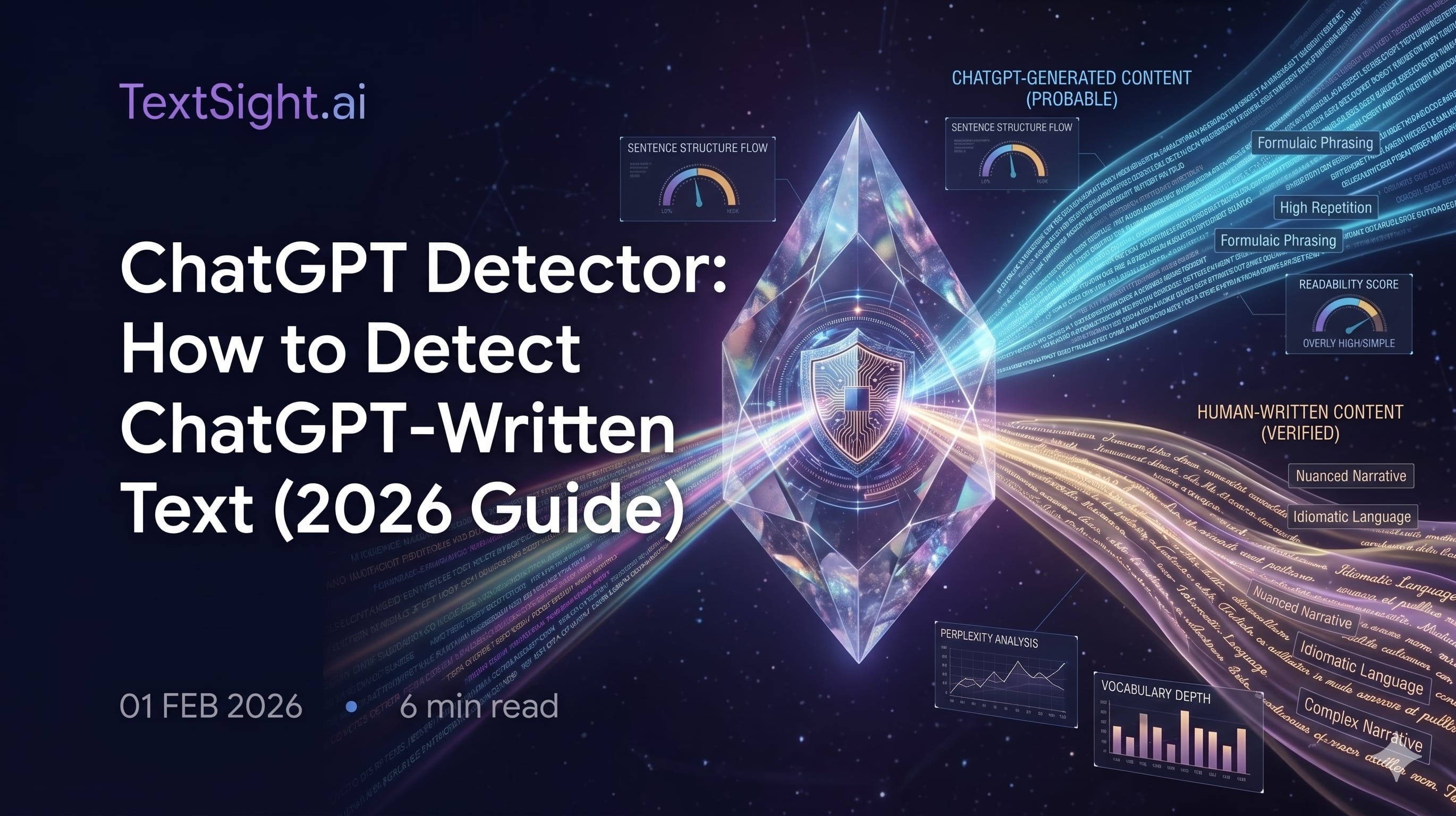
Looking for a free ChatGPT detector? This guide explains how ChatGPT detection works, which tools are most accurate, and how to spot AI text without any software.

How should teachers handle AI-generated student work? This guide covers the best AI detection tools for educators, how to use them fairly, and what policies work.

AI content detection is the technology that identifies whether text was written by an AI or a human. Here's how it works, how accurate it is, and why it matters.