There's a word for the feeling you get reading AI text. It reads fine. The sentences make sense. The logic holds. But something feels... off. Like listening to a cover band that plays all the right notes in the wrong order of feeling.
That quality has a name. It's called AI rhythm.
What AI Rhythm Actually Is
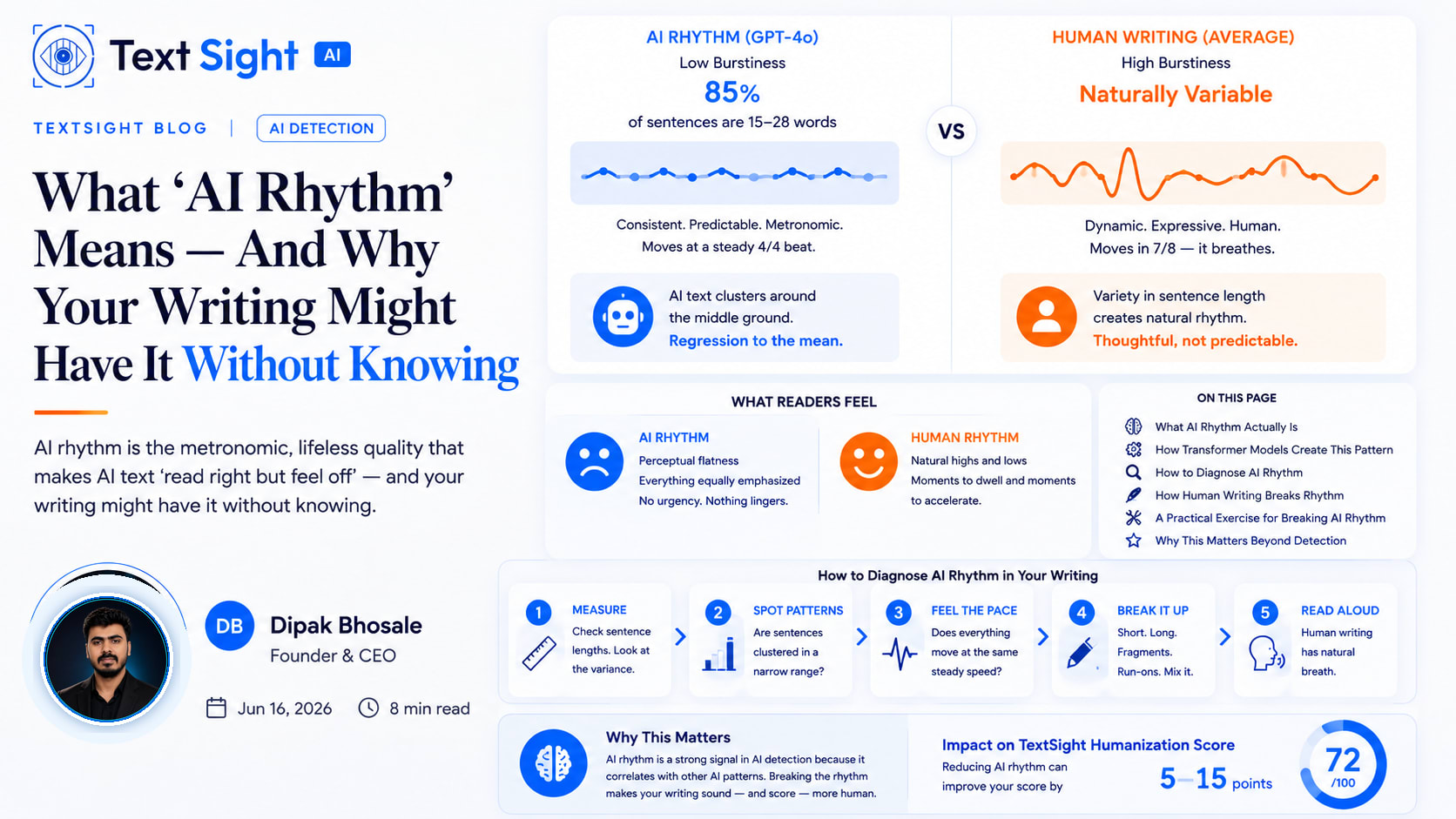
AI rhythm is the mechanical, metronomic quality of text generated by language models. It shows up as consistent sentence lengths, predictable stress patterns, and no natural acceleration or slowdown through a piece of writing.
In NLP research, the technical term is low burstiness. Burstiness measures how much sentence length varies within a piece of writing. Human text tends to be "bursty" — short punchy sentence. Then a longer one that builds on it with more complexity and qualification. Then another short one. Then a paragraph-length monster that runs and runs and loops back on itself in ways that feel genuinely exploratory.
AI text clusters. GPT-4o generates approximately 85% of its sentences in the 15–28 word range. Pick any ten sentences from a ChatGPT response and measure them. They'll be remarkably close in length. Not identical — but close enough that the variance is visibly narrow compared to how humans write.
The result is text that moves at a steady 4/4 beat when human writing is in 7/8.
How Transformer Models Create This Pattern
This isn't a flaw in the model. It's a consequence of how it works.
Language models predict the next token based on statistical probability. The "most likely" continuation of a sentence tends to be a medium-length, syntactically complete thought. Long sentences require the model to maintain complex grammatical structures across many tokens — doable, but statistically less probable. Very short sentences (fragments, punchy two-word thoughts) require the model to deliberately cut off when more continuation is probable.
The result is regression to the mean. Sentence after sentence lands in the middle ground because that's what the training distribution rewards.
There's also what researchers call semantic saturation at work. AI models are trained on enormous corpora of competently-written professional text — articles, reports, essays. That writing style has its own regularity. The model learns that rhythm as the baseline of "good writing" and reproduces it relentlessly.
Here's the thing: the rhythm isn't wrong. It's just too consistent. A metronome is accurate. It's also dead.
What It Feels Like to a Reader
You've read text with AI rhythm. You might not have labeled it, but you've felt it.
It's the sensation of reading something that moves at exactly the same pace for the entire duration. No moments where the writing slows down to dwell on something important. No sudden short burst to land a point. No run-on sentence that mirrors the anxiety of the thought it's expressing.
Good writing modulates. A skilled writer speeds up in list sections and narrative moments. Slows down when they want you to feel the weight of something. Uses a one-sentence paragraph like a punch. Then comes back with three hundred words to unpack why that punch mattered.
AI rhythm produces what I'd call perceptual flatness. Everything is equally emphasized. Nothing is urgent. Nothing lingers. Even when the content is interesting, the rhythm drains urgency from it.
Readers perceive this without being able to name it. In a 2024 study, participants accurately identified AI-generated text at rates significantly above chance — even when they had no training in AI detection and even when they couldn't explain why. AI rhythm was one of the strongest predictors.
The Types of Writing Most Likely to Accidentally Have AI Rhythm
Not everyone who has AI rhythm used an AI. This is the part that gets people in trouble.
Formal academic writing has natural AI-rhythm tendencies. Academic style training pushes writers toward complete sentences, topic-sentence-first paragraphs, and consistent structural patterns. Spend three years writing research papers and your own prose will start to cluster in the 18–25 word range. I've seen this pattern repeatedly in graduate students whose work flags in detectors despite being entirely their own.
Technical documentation is even more prone to it. Technical writers are trained to be consistent, to use parallel structures, to avoid rhetorical variation that might confuse. That discipline produces low burstiness. If you write documentation for a living and then try to write a blog post in the same register, the AI rhythm is unmistakable.
ESL writers face the starkest version of this problem. When writing in a second language, most people default to syntactic structures they're confident in. That creates repetition — not of words, but of sentence architecture. The same clause structure appears in sentence after sentence. Detectors flag this pattern heavily, which is why ZeroGPT's false positive rate on ESL essays is documented at 61.3%. The writing pattern matches AI's statistical output, not because AI was used, but because both ESL writers and AI models are doing the same thing: reaching for familiar, safe constructions.
Highly edited text can develop AI rhythm through the editing process. When you edit away all your "tics" — the run-on sentences, the fragments, the conversational tangents — you can inadvertently remove the human variation that made the writing feel real.
How to Diagnose AI Rhythm in Your Own Work
Here's a practical test. Take any 500-word sample of your writing. Count the words in each sentence. Write down the numbers.
If most of your numbers cluster within a 10-word range (say, 15–25 words), you likely have AI rhythm. Human writing, by contrast, typically ranges from 4 to 55+ words with no strong central cluster.
A second test: read your writing aloud. AI rhythm is even more obvious in spoken form because your ear is a better detector than your eye. Does every sentence feel like it ends at the same point in your breath? Does nothing surprise you — no sudden rush, no long trailing thought, no emphatic short statement?
A third test: look at your paragraph lengths. AI paragraphs tend to run 4–6 sentences of similar density. If all your paragraphs are roughly the same length, that's structural AI rhythm even if your sentence-level variation is fine.
Tools like TextSight will surface this pattern explicitly via the Humanization Score — a 0–100 rating where rhythm and burstiness are among the underlying signals. A score under 40 is a strong indicator of AI rhythm problems regardless of whether you actually used AI.
How Human Writing Breaks Rhythm Naturally
Human writers break rhythm for reasons. The variation isn't random noise — it's tied to what the writing is doing.
Short sentences land punches. They create emphasis. A long sentence, on the other hand, can carry a reader through a building chain of logic — holding off the conclusion, piling on qualifications, making the reader hold their breath until the period finally arrives.
Fragments work differently. They're raw. Unfinished. They can express genuine hesitation or deliberate curtness in ways complete sentences can't.
Questions change rhythm entirely. They're the only sentence type that ends on a rise rather than a fall. Where is the argument going? The question creates a beat that structured statements never can.
Real writers also accelerate and decelerate for emotional reasons. The section where something went wrong reads faster. The moment of realization gets space. This is emotional rhythm — the writing mirrors the internal experience of the thought. AI doesn't have internal experiences, so it can't mirror them.
AI Rhythm in Different Types of AI Models
Not all AI models produce the same rhythm. This matters when you're trying to understand what you're looking at.
GPT-4o has a distinctive rhythm that tends to peak around 19–22 words per sentence. It's tighter than older GPT versions — the sentences are slightly shorter on average, but even more consistent in their clustering. Reading GPT-4o output aloud, you get something close to a news anchor cadence: authoritative, measured, never rushing.
Claude models produce slightly longer average sentences — clustering more around 22–28 words — with a little more variance than GPT-4o, but still dramatically less than human writing. The rhythm is a bit more like a consulting report: complete, qualified, thorough. Readable. Still flat.
Gemini Pro is interesting because it produces what I'd call paragraph-level rhythm rather than sentence-level rhythm. Individual sentences vary somewhat, but paragraphs are nearly all the same length. You get 4–5 sentences per paragraph, every time, almost without exception. The burstiness is slightly higher at the sentence level but lower at the paragraph level.
None of these models produce the kind of genuine rhythm variation that human writing has — the acceleration into a tense section, the long winding paragraph that's working something out, the short punchy statement that interrupts the flow. But the signatures are different enough that if you're editing AI output, knowing which model you're dealing with helps you target your rhythm edits more precisely.
A Practical Exercise for Breaking AI Rhythm
Take 300 words of your own writing — or AI-generated text you're editing. Then do this in sequence:
Step 1: Find your three longest sentences. Break each one. Not into equally-sized halves — break them asymmetrically. Cut at the moment of maximum tension and let the second half be much shorter than the first.
Step 2: Find your three medium-length sentences in a row. The ones that are 18–22 words each. Replace the middle one with a fragment or a question. "But does it work?" is a sentence. "Not exactly." is a sentence.
Step 3: Add one deliberate run-on. Find a place where you were being tidy when you should have let the thought unravel. Let it run. Connect it with "and" or "but" past the point where it feels grammatically comfortable. This is what urgency looks like on the page.
Step 4: Read it aloud. If it still sounds like a metronome, you didn't break hard enough. Go back and find the sections that still move at exactly the same pace.
Step 5: Check your score. If you were working from flagged text, run it through TextSight's AI detector again after your edits. Genuine rhythm variation consistently produces score jumps of 8–15 points in our testing — because it's not just a detector trick. It's actually making the writing more human.
Why This Matters Beyond Detection
AI rhythm matters for detection. But it also just matters for writing.
Text with AI rhythm doesn't persuade. It informs — barely. It doesn't move people. The rhythm of good persuasive writing is one of its primary tools: the building of pace, the strategic slow-down, the short sentence that lands like a verdict after five hundred words of argument.
If you've trained yourself to write in a way that avoids this rhythm — whether because of academic conditioning, second-language caution, or just years of technical writing — you're not just risking a detector flag. You're writing less effectively than you could.
Breaking AI rhythm is good practice. Detection is just one of the reasons to bother.
Related reading:
- Sentence Length Variance: The One Pattern That Separates Human Writing From AI
- How to Humanize ChatGPT Text
- What Is AI Content Detection?
Try it on your own writing