Bulk scan client deliverables. White-label reports. Maintain high editorial quality standards. Built for agencies processing 50-500 articles/week.
Google's Helpful Content Update has reshaped what ranks. Pure AI-generated content — long-form, on-topic, technically optimized, indistinguishable from competent human writing — has lost 20-40% of its rankings year-over-year on most agency-managed sites. The penalty isn't direct AI detection. It's an indirect signal: Google's quality raters consistently flag AI-heavy content as low E-E-A-T (Experience, Expertise, Authoritativeness, Trustworthiness), and the algorithm picks up on that.
The result is that every agency now has a pre-publish AI audit step in their content workflow. The question is which tool you use. Originality.ai's API tier is $179/mo Enterprise — fine for agencies pushing 1.5M words/month, expensive overhead for everyone else. GPTZero's API is a paid add-on. Copyleaks' API requires a $74.99/mo Pro subscription. Winston AI's API is on the Advanced tier ($16/mo annual).
TextSight bundles detection + AI rewriter + API access into one product at one tier. Business at $29.99/mo annual includes 10,000 API calls per month, unlimited scans, the same AI rewriter your writers can use to fix flagged content, and white-label-ready PDF reports for client deliverables. For agencies processing under 1.5M words per month, this is typically 4–6× cheaper than the equivalent Originality stack.
And the AI rewriter matters. When a draft scores 70% AI, you have two choices: send it back to the writer for a manual rewrite (slow, expensive) or run it through an AI rewriter (fast). Other detection tools force you to a separate AI rewriter subscription. TextSight has both built in, in one workflow.
The Helpful Content Update prioritizes content with author expertise and specific viewpoints. Pure AI tends to lack both. Agencies that ship AI-assisted content are seeing 20-40% ranking drops year-over-year.
After one too many burned brands, clients run agency content through Originality.ai or GPTZero before paying. A 78% AI score = invoice dispute, sometimes contract termination.
Manual scanning isn't viable at agency scale. You need API access, bulk processing, and a way to get the score into your existing CMS or workflow.
For an agency processing fewer than 1.5M words/month, Originality's pricing forces you into Enterprise. Most mid-size agencies need a $20-50/mo API tier — which TextSight has.
Most detection tools don't support white-label PDF exports without an Enterprise contract. Agencies that brand reports for clients have to build their own export pipeline on top of an API.
API access at the Business tier — not Enterprise. 10,000 calls/month. Integrate into your CMS (WordPress, Webflow, Sanity), publishing pipeline (Make, Zapier), or QA dashboard.
Pro+ tiers support URL scanning (paste a published-article URL, get a score) and file upload (.docx, .pdf). Both useful for incoming client briefs and outgoing deliverables.
When a draft scores high on AI, the same tool offers a one-click AI rewriter. Other detection tools force a tab-switch to a separate AI rewriter (competitors charge $5-31/mo extra for the AI rewriter). TextSight bundles both.
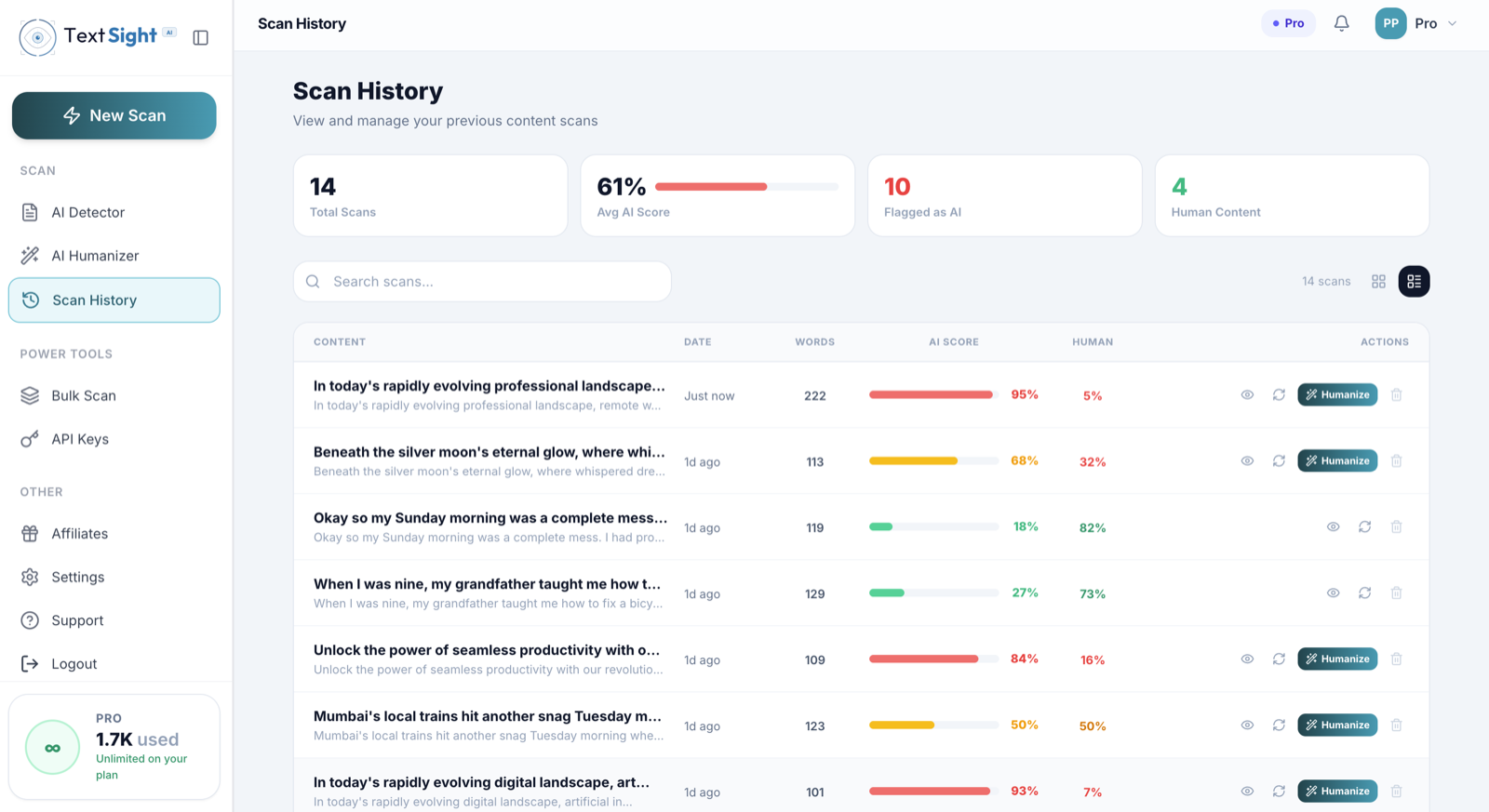
Every scan is saved. Export per-article PDF reports for client deliverables. Includes timestamp, score, and sentence-level breakdown — useful as proof-of-work.
billed $359.88/year
Enterprise $59.99/mo adds 10 seats + 50,000 API calls/month (for high-volume agencies)
Indirectly. Google's Helpful Content Update (2022, refined in 2024-2025) prioritizes content demonstrating author expertise, specific viewpoints, and original research. Pure AI-generated content typically scores low on these signals. The penalty is correlation, not direct detection — but the result is the same: AI-heavy content tends to lose rankings.
Yes. The Business tier includes 10,000 REST API calls/month. The endpoint accepts text or URL input and returns a JSON response with the AI score, sentence-level breakdown, and authenticity recommendations. See api.textsight.ai/docs for details.
PDF export is included in all paid tiers with TextSight branding minimal. For full white-label (your agency's logo, custom domain on share links), Enterprise tier or contact sales for agency licensing.
Yes, agency licensing is available. Contact sales for volume pricing if you're processing 1,000+ articles/month or onboarding multiple clients to white-labeled detection.
Yes, Pro+ tiers support URL scanning. Paste any public URL, TextSight fetches and scans the content. Useful for auditing already-published client work.
TextSight bundles an AI rewriter (Originality has none) and offers API access at $29.99/mo Business (Originality's API is Enterprise-only at $179/mo). For agencies processing under 1.5M words/month, TextSight is typically 4-6× cheaper.
Six capabilities that map to how an agency actually ships content at volume. None of these are upsells. They are part of the product on the recommended Business tier.
Drop a folder of drafts or paste a list of URLs and run the entire batch through detection in one pass. Built for the agency who closes a sprint on Friday and ships 30 articles across 8 clients.
Every scan exports as a branded PDF that you attach to a deliverable. The Business tier removes TextSight branding so the report reads as agency proof of work, not third-party software output.
The score is calibrated against the editorial signals Google rewards: specific viewpoints, varied sentence rhythm, original framing. So a low Authenticity Score reliably maps to the kind of content that loses rankings under recent updates.
Tag every scan with a client label so the history view filters cleanly per account. Useful when a project manager pulls a monthly QA log for one client without leaking another client's draft titles or scan results.
Wire detection directly into the content pipeline. A scan endpoint, an AI rewriter endpoint, JSON responses with sentence-level breakdowns. The Business tier ships 10,000 calls per month, which covers most mid-size agencies without forcing an Enterprise contract.
Editors do not need a single number, they need to know which paragraphs to rewrite. Each sentence is colour-coded so an editor can scan a 2,000-word article in under a minute and target only the lines that triggered.
Four tiers. For an agency processing client deliverables, Business is almost always the right choice because it is the first tier with API access, 5 team seats, and white-label PDF reports.
Best for: A first scan before you commit. Useful for a single deliverable check or for evaluating the detector against a piece you already shipped.
3 scans per day, no signup for the first scan, 10,000-character lifetime cap on the AI rewriter before signup.
Best for: A solo SEO consultant handling a handful of clients. Lightweight QA pass before publishing, no team handoff required.
20 scans per day, 20,000 AI rewriter words per month, Chrome extension, plagiarism risk indicator. No API and no team seats.
Best for: A senior content lead running 10 to 20 articles a week solo. Heavier AI rewriter budget and bulk URL plus file upload, but still single seat.
Unlimited scans, 50,000 AI rewriter words per month, file plus URL upload, priority support. No API and no team seats.
Best for: SEO agencies with 3 to 8 writers and at least one editor running consolidated QA. This is the tier where the workflow finally fits an agency.
100,000 AI rewriter words per month, REST API access, 5 team seats, white-label PDF reports.
Annual billing saves 25%, dropping Business to $29.99/mo and Pro to $14.99/mo. Full pricing →
Google has stated repeatedly that the helpful-content system rewards quality, not authorship. The system does not directly detect AI. It does, however, reward signals like specific viewpoints, varied sentence rhythm, fresh framing, and lived expertise. Pure AI drafts tend to score low on those signals because the underlying models default to neutral, balanced, hedged prose. So the practical answer for an agency is that you do not need to fear AI assistance, you need to treat the first AI draft as raw material that a human editor reworks into the kind of content the helpful-content system rewards.
On Starter and Pro, the PDF export carries TextSight branding in the footer, which works for internal QA but reads as third-party software output if a client opens it. On Business, the export is white-label by default, so the PDF shows only your agency name and the scan metadata. Cobranded mode, where a small TextSight credit sits beside your agency logo, is available on Business if you prefer a softer claim. Toggle it inside the workspace settings.
Every scan accepts a client tag at submission time, either through the UI dropdown or as a field in the API payload. The history view filters by tag, so when a project manager pulls a monthly QA log for Acme, the export contains only Acme scans, never another client's draft titles or scores. Writers can see only the tags they are assigned to. The 5 team seats on Business let you give one editor full visibility while writers stay scoped to their own client roster.
Yes. The Business tier ships REST endpoints for scan and rewrite, both of which accept either a text body or a URL. There is also an SSE streaming variant of rewrite for long drafts so your pipeline can show progress instead of blocking on a 30-second response. The included 10,000 calls per month covers an agency running roughly 500 articles a week through detection plus selective authenticity. Past that, contact us for higher rate plans before you build around a hard ceiling.
WordPress has a dedicated TextSight plugin that scans posts inside the WP editor before publish, so editors see the score next to the Publish button. Webflow and Ghost do not yet have native plugins, but both expose webhooks and content APIs that let you call the TextSight scan endpoint from your own middleware. The pattern most agencies use is a simple serverless function (Vercel, Cloudflare Workers, or a Make scenario) that fires on a publish event, sends the body to TextSight, then writes the score back to the CMS as metadata. The full integration is roughly half a day of work and we ship example payloads in the API docs.
No detector is the source of truth, including TextSight. Different detectors use different training data, different feature extraction, and different score normalisation, so scores will diverge on the same article. The honest framing for the client is that no single tool is ground truth. What you can defend is the sentence-level evidence. TextSight returns colour-coded sentences with the specific signals that flagged each line, and we recommend the editor walks the client through the highest-flagged 3 to 5 sentences so the conversation moves from a single contested number to a discussion of the actual prose. That is also the only conversation that scales when a client switches detectors next quarter.
Honest answer: it depends on the workload mix. Originality charges per-credit for detection and bills the API on an Enterprise tier that starts well above an agency's typical Business spend. TextSight bundles detection, AI rewriter, and API access into a single flat Business tier with 5 seats. For an agency running roughly 300 to 800 articles per month with selective authenticity, our Business plan is competitive on total cost at agency volume. We are not going to claim a fixed multiplier without knowing your exact mix, since that depends on your AI rewriter usage, scan frequency, and whether you also pay for a separate AI rewriter subscription today. The clean test is to price out your last 30 days of usage against the Business tier and compare line-by-line.
Most agencies on monthly retainers fold the TextSight cost into the QA line item of the retainer, the same way Grammarly or a plagiarism check is folded in. On a $3,000 to $8,000 monthly retainer, the Business tier at $29.99 to $39.99 represents under 1.5% of the contract value, which is small enough that you do not need a separate line item to the client. The white-label PDF report becomes a deliverable artifact attached to each invoice, which makes the QA work visible and defensible at renewal time. Agencies that bill per-article instead of per-retainer typically add a flat $10 to $20 QA fee per piece, which more than covers the per-article TextSight cost at Business pricing.
3 free scans/day, no credit card required.