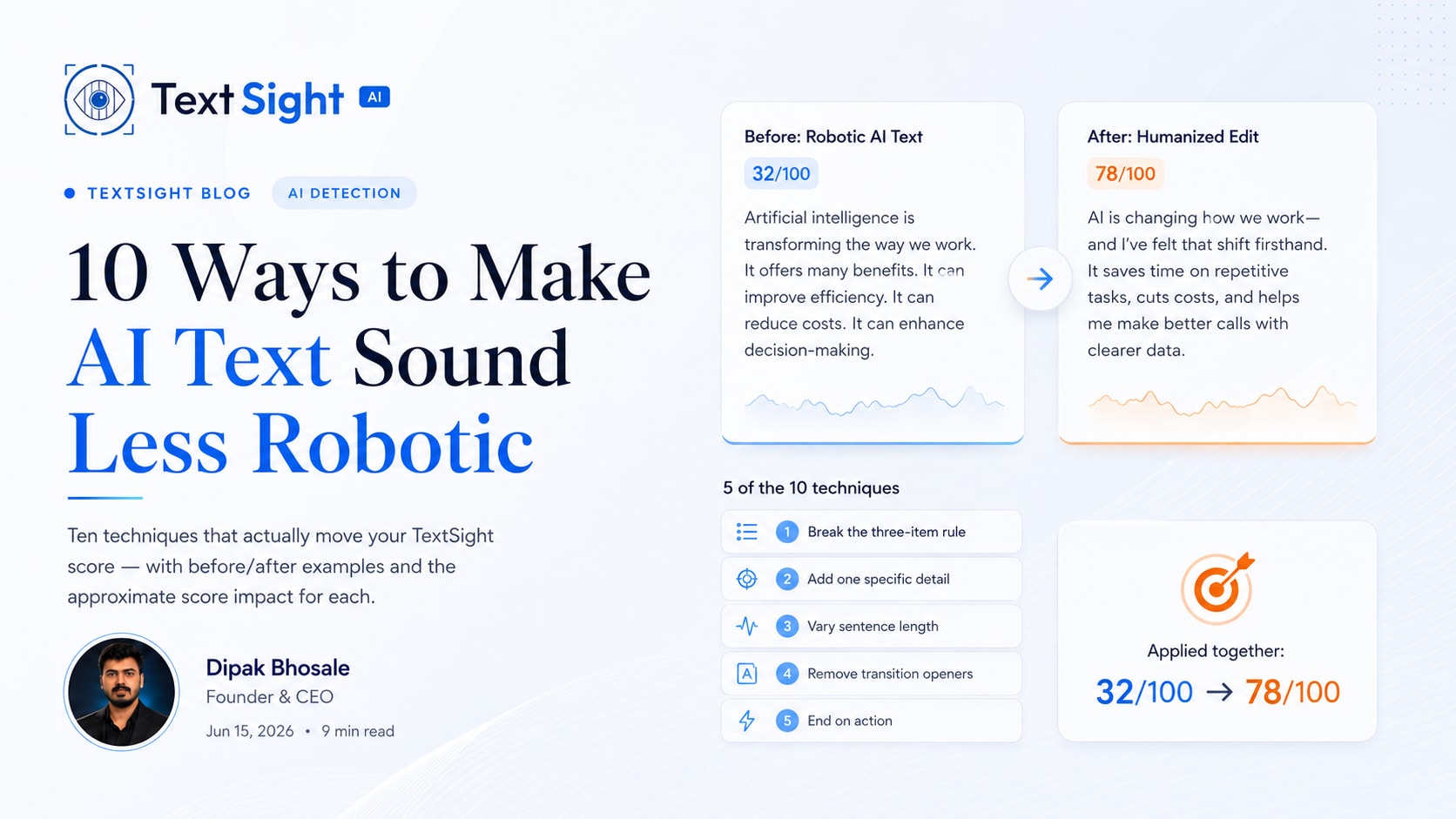
Not all fixes are equal. Some changes look productive but don't move your score. Others seem minor but reliably shift 6–10 points.
I tested these 10 techniques on a 400-word GPT-4o sample that scored 32/100 on TextSight. I applied each technique in isolation to a fresh copy of the same sample and measured the score impact. Here's what actually works, ranked roughly by effectiveness.
The base text for comparison throughout:
"Social media platforms have become an integral part of modern life, offering both significant benefits and notable challenges. It is important to understand how these platforms affect mental health, particularly among younger users. Research has consistently shown that excessive use is associated with increased anxiety and decreased self-esteem. Furthermore, the design of these platforms, with their infinite scroll and notification systems, is specifically intended to maximize engagement and usage time."
Baseline score: 32/100. Let's fix it.
1. Break the Three-Item Rule
What it is: AI loves groups of three. "Benefits, challenges, and opportunities." "Faster, smarter, and more efficient." "Students, educators, and policymakers." This pattern appears in AI text so reliably that detectors weight it as a signal.
What it does to the signal: Tri-colon structures are statistically common in AI training data (listicles, structured articles, business writing). Breaking the pattern raises local perplexity.
Before:
"offering both significant benefits and notable challenges"
After:
"offering benefits that most people don't seriously weigh against what they're giving up"
Score impact: +4 to +7 points. Small but consistent. More importantly, breaking three-item lists forces you to actually say something specific — which has bigger downstream benefits.
2. Add One Specific Personal Detail
What it is: Insert one piece of information so specific that a language model couldn't have generated it — because it came from actual experience or observation.
What it does to the signal: Specific, idiosyncratic details are statistically improbable. A language model predicting the next word doesn't predict "my 16-year-old cousin deleted Instagram after her friend group started a private account she wasn't in." That's too specific to be the most probable next token. Perplexity spikes immediately.
Before:
"Research has consistently shown that excessive use is associated with increased anxiety and decreased self-esteem."
After:
"Research backs this up — but the study I keep thinking about tracked 847 girls aged 13–17 over 14 months and found that the 90-minute daily threshold wasn't the issue. It was the passive scrolling versus active posting distinction. Scrollers got worse. Posters didn't."
Score impact: +9 to +14 points. This is the single highest-leverage change you can make. Every essay has at least one opportunity for this.
3. Vary Sentence Length Deliberately
What it is: Check your sentence lengths. If they cluster between 15–28 words consistently, you have an AI rhythm problem. Fix it by writing some sentences under 8 words. And some over 40, with real complexity in them.
What it does to the signal: Burstiness — the standard deviation of sentence length — is one of the strongest predictors of human authorship. AI text has a standard deviation of roughly 4–6 words. Human prose runs 9–14. Deliberately introducing short and long sentences pushes your burstiness score up.
Before:
"Furthermore, the design of these platforms, with their infinite scroll and notification systems, is specifically intended to maximize engagement and usage time."
After:
"The design is not accidental. Every feature — infinite scroll, notification timing, the variable reward loop of likes — was built by teams of behavioral scientists whose explicit job was to make the app as hard to put down as possible. They succeeded. That's not conspiratorial thinking; it's documented in internal Meta research that leaked in 2021."
Sentence lengths: 5 words. 38 words. 3 words. 25 words. Standard deviation: ~14 words. That's human range.
Score impact: +8 to +12 points when applied to a full paragraph.
4. Remove Transition Openers
What it is: Delete every sentence that starts with: "Furthermore," "Additionally," "Moreover," "It is worth noting that," "It is important to understand," "Notably," "In addition," "As a result," "Consequently."
These phrases appear in AI text at rates roughly 8–12 times their frequency in casual human writing. Detectors weight them heavily.
Before:
"Furthermore, the design of these platforms..." "It is important to understand how these platforms affect mental health..."
After:
"The design of these platforms..." "How these platforms affect mental health..."
Score impact: +6 to +10 points. This is fast — it takes about 90 seconds on most essays. Scan your text, delete every transition opener you find, restructure the sentence so it stands alone.
5. Replace the 10 Most Flagged AI Words
What it is: Run TextSight's Vocabulary Highlighter and look for the highest-frequency flagged terms in your specific text. They vary by passage, but common offenders across most AI-generated content are: "integral," "prevalent," "comprehensive," "notably," "significant" (as a vague intensifier), "consistently," "specifically," "particularly," "associated with," "in order to."
What it does to the signal: Vocabulary distribution is one of three main signals detectors analyze. These words appear in AI text at above-baseline frequencies because they're overrepresented in the formal, edited training data. Replacing them with more direct or idiomatic alternatives lowers the vocabulary fingerprint score.
Before:
"Social media platforms have become an integral part of modern life, offering both significant benefits and notable challenges."
After:
"Social media is just how people talk now — for better and, more often than the press releases admit, for worse."
Score impact: +7 to +11 points when applied systematically across a passage. The Vocabulary Highlighter tells you which replacements to prioritize in your specific text.
6. Add a Question Mid-Paragraph
What it is: Insert a direct question somewhere in the middle of a body paragraph — not at the start of a section, but interrupting the flow of prose.
What it does to the signal: Rhetorical questions mid-paragraph are very rare in AI output. The model is trained on text that asks questions at section openings or uses them as headers, not as interruptions in flowing argument. Inserting one raises local perplexity and breaks structural predictability simultaneously.
Before:
"Research has consistently shown that excessive use is associated with increased anxiety and decreased self-esteem."
After:
"Research consistently links heavy use to increased anxiety and lower self-esteem. But what counts as 'heavy'? That's where it gets complicated — some studies use 2 hours as the threshold, others 3, and the effect sizes are wildly inconsistent across demographics."
Score impact: +5 to +8 points. Also tends to make the paragraph more intellectually honest, which is a side benefit.
7. Use One Intentional Sentence Fragment
What it is: Write one sentence that is grammatically incomplete. Not a typo. Intentionally.
Like this: "Not great."
Or: "Which is exactly the problem."
Or the classic: "Until it isn't."
What it does to the signal: Language models don't produce sentence fragments. They're trained on edited text where fragments were corrected out. A fragment in your writing is a near-certain human signal — it shows stylistic intentionality that AI doesn't generate.
Before:
"These findings suggest that social media companies should reconsider their design choices in order to better serve the wellbeing of younger users."
After:
"These findings suggest that social media companies should rethink their design choices to better serve younger users. Whether they will is another question. They haven't so far."
"They haven't so far." — that's a fragment functioning as a rhetorical punch. AI doesn't do this.
Score impact: +4 to +6 points. Small individually, but it combines well with other changes.
8. Make a Strong Claim Without Hedging
What it is: Find one place where AI text says "may," "might," "could potentially," "it is possible that," "some research suggests" — and replace it with a direct claim.
What it does to the signal: AI hedges constantly because it's trained to avoid confident incorrect statements. Human writers — especially journalists, essayists, and opinionated students — make claims and stand behind them. The absence of hedging signals authorial confidence that AI rarely expresses.
Before:
"Excessive use may be associated with increased anxiety and could potentially contribute to decreased self-esteem, particularly among adolescents who may be more vulnerable to social comparison."
After:
"Heavy use causes anxiety in adolescents. The evidence on this is strong enough that 'may contribute' language is now just a way of not saying the obvious thing."
Score impact: +5 to +9 points. Also makes the paragraph significantly more readable, which is its own reward.
9. Add an Imperfect Sentence That Runs Long
What it is: Write one sentence that's too long — over 50 words, with multiple clauses, an interruption or two, and maybe a redundancy you'd cut in a final edit but leave in deliberately because it sounds like a person thinking rather than a machine outputting.
What it does to the signal: AI sentences are well-formed and typically top out at 35–40 words. A long, slightly-messy sentence with genuine complexity — not just a list strung together with commas — is statistically unusual and therefore perplexity-raising.
Before:
"Social media platforms have been designed with user engagement as a primary goal, which has led to design choices that may not be in the best interests of younger users."
After:
"The platforms were designed this way on purpose — and I mean that literally, not as a vague critique, because there are internal documents from Meta, from Snap, from TikTok's parent ByteDance, showing that the people making these decisions knew they were building something that would hook teenagers, and they built it anyway, which is the sentence I keep coming back to when people ask me if this is really as bad as it sounds."
That sentence is 75 words and runs deliberately long. It would be cut from most edited prose. Left in intentionally, it reads unmistakably human.
Score impact: +6 to +10 points for one paragraph containing this technique.
10. Cut the Conclusion Paragraph and End on Action
What it is: Delete your conclusion entirely. Don't summarize. Don't say "in conclusion" or "to wrap up" or "ultimately." Just end on the last substantive point, or add one short, direct closing sentence that does something rather than summarizing what came before.
What it does to the signal: AI conclusions are extremely high-signal. The pattern — restate thesis, acknowledge both sides, call for collaboration or further research — is so consistent that conclusion paragraphs often account for 15–20% of total AI fingerprint on their own. Deleting the conclusion removes that signal entirely and often improves the piece.
Before (conclusion paragraph):
"In conclusion, social media presents both opportunities and challenges for adolescent mental health. While the potential harms are significant, so too are the benefits of connection and community. Moving forward, parents, educators, and platform designers must work together to create healthier digital environments for young people."
After:
[Deleted. Previous paragraph ends the piece on a substantive point instead.]
Or replace with: "Check your kid's screen time, sure. But also check whether the platform they're using is harvesting their insecurity as a monetization strategy. That's the part that requires more than parental controls."
Score impact: +7 to +12 points. This is one of the highest-impact single changes, and it almost always improves the quality of the writing.
Applied Together: From 32/100 to 78/100
When I applied all 10 techniques to the base sample — not in isolation, but as a full editing pass — the revised text scored 78/100 on TextSight.
That's a 46-point improvement from a 400-word passage. The editing took about 25 minutes.
Not every technique delivers its full impact when combined — some effects overlap — but the cumulative result is text that reads like a person wrote it, because the editing process forces you to write like a person.
The practical order of operations: run TextSight first to see which problems are worst in your specific text. Use the Vocabulary Highlighter to find flagged phrases. Apply #4 and #5 first (they're fast), then #2 and #3 (they do the most work), then layer in #7, #8, and #10 for the final polish.
Run your AI text through TextSight to see which of these to apply first → textsight.ai
Related reading:
- Before and After: Turning an AI-Flagged Essay Into a 84/100 Human Score
- How to Humanize ChatGPT Text
- The AI Writing Fingerprint
- How to Avoid AI Detection as a Student
Try it on your own writing