Here’s the situation: you wrote your essay. You spent four hours on it. You maybe used ChatGPT to help outline your argument or check your grammar — the same way students used spell-checkers and writing tutors before AI existed. You submitted it. And your professor flagged it as AI-generated.
Or you used AI to draft a first version, rewrote most of it in your own voice, and still got flagged.
Or you didn’t use AI at all, but you’re a non-native English speaker who writes in clean, precise sentences, and the detector read that as “low perplexity” and flagged you anyway.
All three of these situations are happening at scale in 2026. Washington State University terminated its Turnitin AI detection contract after 1,485 false positives in a single semester. Students at Yale and the University of Michigan have filed lawsuits. Stanford HAI found that 19% of legitimate TOEFL essays were unanimously flagged as AI-generated by all seven detectors tested.
The AI detection problem isn’t just about cheating. It’s about writing that reads AI-like — whether it was or wasn’t. And the solution, in both cases, is the same: understand what detectors actually measure, and write in a way that scores higher on the human-to-AI scale.
This guide covers exactly that.
What AI Detectors Are Actually Measuring
Most students think AI detectors work by comparing your text to a database of AI outputs and looking for matches. That’s not how they work.
AI detectors measure statistical patterns in your writing, primarily two things:
Perplexity — how predictable your word choices are. AI models are trained to choose the most statistically probable next word at every step. This makes AI text “low perplexity” — the vocabulary is predictable, the transitions are smooth, the word choices are safe. Detectors flag low-perplexity text as likely AI.
Burstiness — how much your sentence length varies. Humans write unevenly: short punchy sentences mixed with long flowing ones. AI tends to produce sentences of similar length clustered in a narrow range. Low burstiness = likely AI.
Here’s why this matters for you: if your writing is naturally formal, precise, and well-structured — as many good students write, and as many ESL students write — it can trigger both of these signals without any AI involvement. Clean, careful writing can look AI-generated to a detector that’s only measuring statistics.
This is why “I didn’t use AI” is not always a sufficient defense. What matters is not whether you used AI — it’s where your text sits on the human-to-AI spectrum. And that’s something you can measure and improve before you submit.
The Tools Professors and Universities Are Using in 2026
Before you can navigate this landscape, you need to know what’s scanning your work.
Turnitin is the most widely used institutional tool. It’s built into most university learning management systems and runs automatically when you submit. It flags text as a percentage — “32% AI-generated” — and highlights which sentences it believes were machine-written. Its detection rate on raw AI essays is around 92%, but its false positive rate on non-native English writers can reach 10–15% in some studies.
GPTZero is used by many individual professors as a secondary check. It’s publicly accessible, free at basic tier, and returns a percentage with sentence-level highlighting. Detection rate on raw AI: ~89%. False positive rate: ~9%.
Copyleaks is growing in institutional adoption as an alternative to Turnitin. Slightly lower detection rate (~79%) but lower false positives (~5%).
ZeroGPT is widely used by students to self-check — but many professors use it too because it’s free and requires no signup. Its results are less reliable than the paid tools (68% detection on GPT-5) but it’s extremely common.
The important thing to know about all of these: they disagree with each other regularly. A text that scores 91% AI on GPTZero might score 43% AI on ZeroGPT. Multiple universities have publicly stated that AI detection scores alone cannot be used as evidence of academic misconduct precisely because of this disagreement.
Why False Positives Are a Bigger Problem Than Most Students Know
A 2023 landmark study found that AI detectors incorrectly flagged an average of 61.3% of essays written by non-native English speakers as AI-generated. Sixty-one percent. That number hasn’t significantly improved in 2026.
If you write in clear, standardized English — careful grammar, consistent vocabulary, formal sentence structure — you are statistically more likely to trigger a false positive, regardless of whether you used AI.
This disproportionately affects:
- ESL and EFL students whose writing is precise but formal by necessity
- Students who write clearly and carefully — good academic writing actually looks more AI-like to detectors than loose, informal writing
- Students from countries where English writing education emphasises structure — India, East Asia, Eastern Europe, the Middle East
- Students writing about technical or scientific topics where formal register and precise vocabulary are standard
If you’re in any of these categories, you’re not doing anything wrong. But you need to understand that your risk is elevated, and you need to take steps before submitting — not because you cheated, but because the detector doesn’t know the difference.
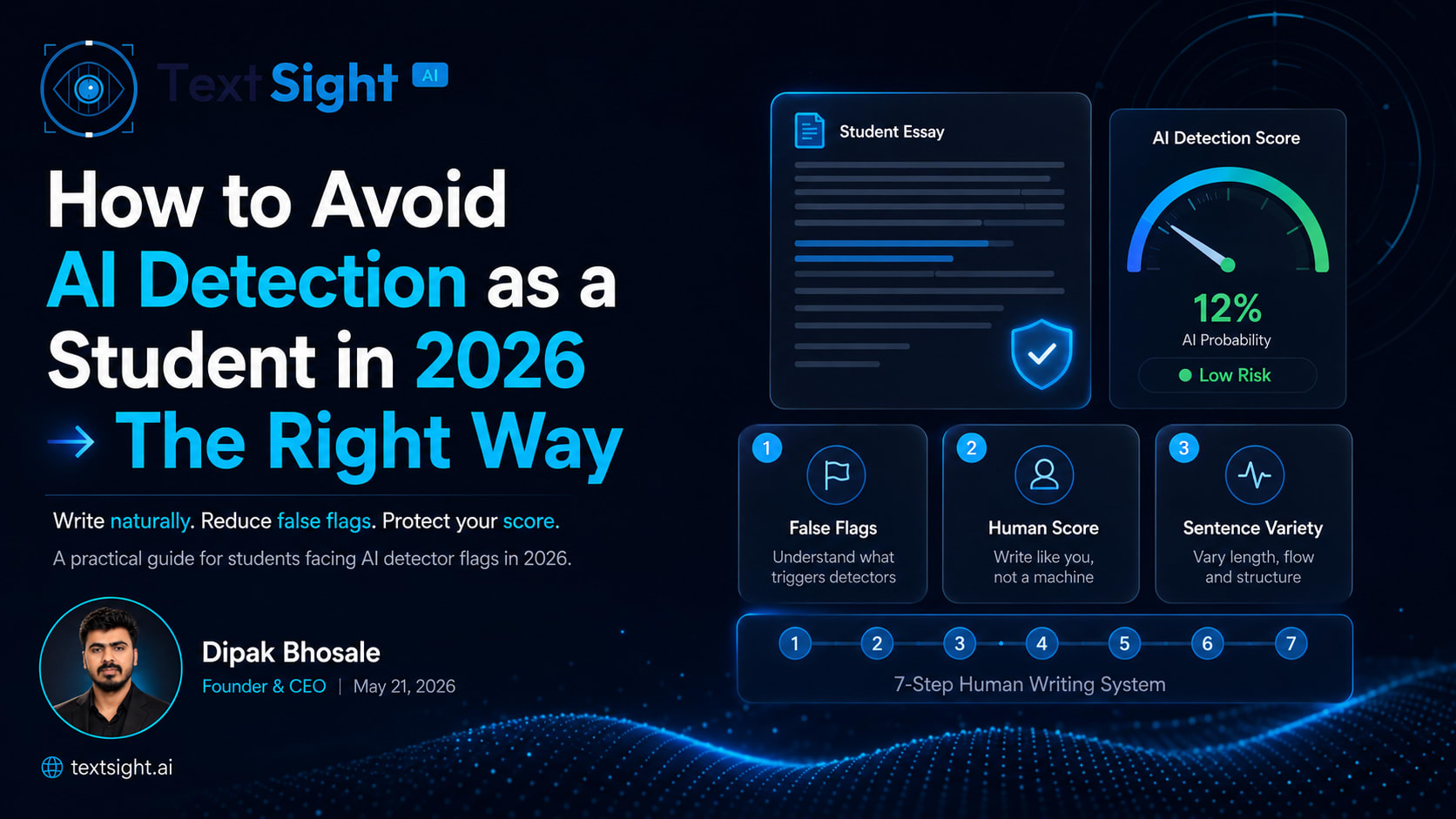
The 7-Step System: Write So Detectors Don’t Flag You
This is the practical guide. These steps work whether you used AI (ethically) to assist your writing or wrote entirely yourself.
Step 1: Run your draft through TextSight before you submit
Before you change anything, know your score. TextSight gives you a Humanization Score from 0–100. Below 60 means you’re at high risk of being flagged. Above 75 means you pass most detectors. Above 85 means you’re in the strongly human range.
The score also shows you exactly which sentences are pulling your score down — so instead of rewriting your entire essay blindly, you fix the three or four specific sentences that are actually the problem. This saves hours and gets you better results.
Run your draft, note your score, and identify the flagged sentences before you do anything else.
Step 2: Vary your sentence length deliberately
Read your essay out loud. Count how many sentences in a row have similar length. If more than three consecutive sentences are roughly the same length, you have a burstiness problem.
Fix it by mixing deliberately: after two long sentences, write a short one. Like that. After a short sentence, let the next one run longer, adding a clause or two that builds on the previous thought. You don’t need to rewrite everything — just break the pattern at regular intervals.
This single change often moves a TextSight score by 10–15 points.
Step 3: Remove the vocabulary tells
Certain words and phrases are statistically overrepresented in AI writing and will flag your score regardless of your sentence structure. Remove these from your drafts:
- It is worth noting that / It is important to note
- Furthermore / Moreover / Additionally (at paragraph starts)
- In today’s fast-paced world / In the modern era
- Delve into / Delve deeper
- Leverage (in any context)
- Robust / Seamless / Comprehensive (as adjectives)
- In conclusion / To summarise / Ultimately
- Shed light on / Shed new light
- Navigating / Navigate the complexities of
- It goes without saying
These aren’t bad words — they’re just words that detectors have been trained to flag because they appear at statistically high rates in AI output. Replace them with plain language that says the same thing more directly.
Step 4: Add one specific personal or observed detail per section
The thing AI consistently gets wrong is specificity. A detector can’t always prove this algorithmically, but human reviewers (your professor) can spot it immediately. AI writes: “Many students struggle with time management.” A human writes: “In my third year, I once submitted an assignment at 11:59 PM after realising at 8 AM that I’d misread the deadline.”
For each major section of your essay, add one detail that is specific to you, your course, your reading, or your observation. It doesn’t have to be long. One sentence is enough. But it should be something that could only come from you — not from a language model predicting the most likely next word.
This is especially important for the introduction and conclusion, which are the sections professors read most carefully.
Step 5: Break paragraph structure predictability
AI writes paragraphs in a predictable structure: topic sentence → three supporting points → concluding sentence. Every paragraph. Without variation.
Human writing isn’t that orderly. Some paragraphs make a point and stop. Some start with a question. Some are two sentences long. Some start mid-thought and let the argument develop as you write.
Add at least two paragraphs in your essay that break the standard structure. One very short paragraph (two or three sentences that make a single sharp point). One paragraph that starts with a question or an observation rather than a declarative topic sentence. These breaks signal variance to detectors and authenticity to human readers.
Step 6: Re-score after edits
After making changes, paste your revised draft back into TextSight and check your new score. You should see a 15–25 point jump from fixing sentence variance and vocabulary. If you’re still below 70, use the Vocabulary Highlighter to identify what’s still flagged and work through those specific sentences.
Repeat until you’re consistently above 75. That’s your safe submission threshold for most institutional detectors. For high-stakes submissions (final exams, dissertation chapters), aim for 80+.
Step 7: Save your drafts and writing process
This isn’t a detection fix — it’s your defence if you are flagged despite a good score. Keep every version of your essay from first draft to final. Keep your notes, your research bookmarks, your outline. If your work is ever challenged, the ability to show your writing process — how the argument developed, what you changed, where your ideas came from — is more powerful than any score.
Several universities have started asking students to reproduce key sections of their work in supervised settings when flagged. The students who struggle aren’t the ones who used AI lightly — they’re the ones who can’t explain what they wrote or why.
If You’re Already Flagged: What to Do Right Now
Being flagged is not the same as being found guilty. Here’s what to do:
Request the specific evidence. Ask your professor or institution exactly which tool flagged your work and at what score. A single tool flagging at 43% is not evidence of anything — and many institutions now have explicit policies that AI detection scores alone cannot trigger academic misconduct proceedings.
Show your process. Pull out your drafts, notes, browser history of research, any previous conversations with tutors or writing centres about this assignment. Process evidence is more compelling than any counter-argument about detector accuracy.
Challenge the accuracy of the tool. This is legitimate and increasingly well-supported in academic literature. Research on AI detector false positive rates (particularly for ESL students) is published and citable. Universities that have terminated Turnitin AI contracts have done so because of this evidence.
Contact your student union. Most universities with academic integrity processes now have student advocates who are specifically trained on AI detection disputes. This became necessary in 2025 when the volume of false positive cases increased sharply. Use the resource.
Do not confess to something you didn’t do. Some students, faced with a professor’s certainty, agree to a penalty just to make the process stop. This is a long-term record that follows you. If your work was genuinely yours, the process exists to protect you — use it.
The Honest Conversation About Using AI in Your Studies
This guide has focused on students who are falsely flagged or who have used AI ethically as a tool. But it’s worth being direct about the full picture.
Using AI to generate an essay you submit as your own work is academic dishonesty. It’s not because AI detection exists — it’s because representing someone else’s work as yours (whether that “someone” is a person or a language model) undermines the purpose of education. Your grade is supposed to reflect your ability to think, analyse, and communicate. AI-generated work represents the model’s ability, not yours.
But there’s a large, legitimate middle ground that most AI policies in 2026 now explicitly permit:
- Using AI to help brainstorm and outline your argument
- Using AI to find gaps in your reasoning before you write
- Using AI to improve grammar and clarity in writing you produced
- Using AI to check whether your argument is missing evidence or counterarguments
In all of these uses, the thinking is yours. The writing is primarily yours. The AI is a tool, not a ghostwriter.
The goal of the seven steps above is not to help you cheat — it’s to help you write in a way that accurately represents your thinking and doesn’t get falsely flagged for pattern-matching reasons that have nothing to do with academic integrity.
Check your essay’s Humanization Score free at TextSight → Paste your draft, get a 0–100 score, see exactly which sentences are flagged. No signup required. Know where you stand before you submit.
Quick Reference: Score Thresholds
| TextSight Score | What it means | Action |
|---|---|---|
| 0–40 | High AI probability — will be flagged by most tools | Major rewrite needed |
| 41–60 | Medium risk — may pass some tools, flagged by others | Targeted edits using Vocabulary Highlighter |
| 61–74 | Lower risk — passes most tools but some will flag | Fine-tune sentence variance and vocabulary |
| 75–84 | Passes most institutional detectors | Safe for most submissions |
| 85–100 | Reads strongly human | Safe for all high-stakes submissions |
Related reading:
- My Essay Was Flagged as AI But I Wrote It Myself — What to Do
- Can Turnitin Detect ChatGPT? We Tested It (2026)
- GPTZero vs Turnitin vs TextSight: Which Is Most Accurate?
- Can GPT-5 Be Detected? We Tested It Against 5 AI Detectors
Try it on your own writing