The question sounds simple. It isn't.
"Is using AI cheating?" depends entirely on what you mean by "using AI," what the assignment is asking for, what your institution's policy actually says, and — most importantly — what you're representing as your own work.
Treating all AI use the same way is like treating "using the internet" as a single behavior. Googling a fact is different from buying a completed essay. Using ChatGPT is the same kind of spectrum.
Here's my honest take: the "cheating" label gets applied too broadly, which makes it useless as an ethical guide. Let's look at what the spectrum actually looks like, what universities are saying in 2026, and where the genuinely hard cases sit.
The Spectrum of AI Use in Coursework
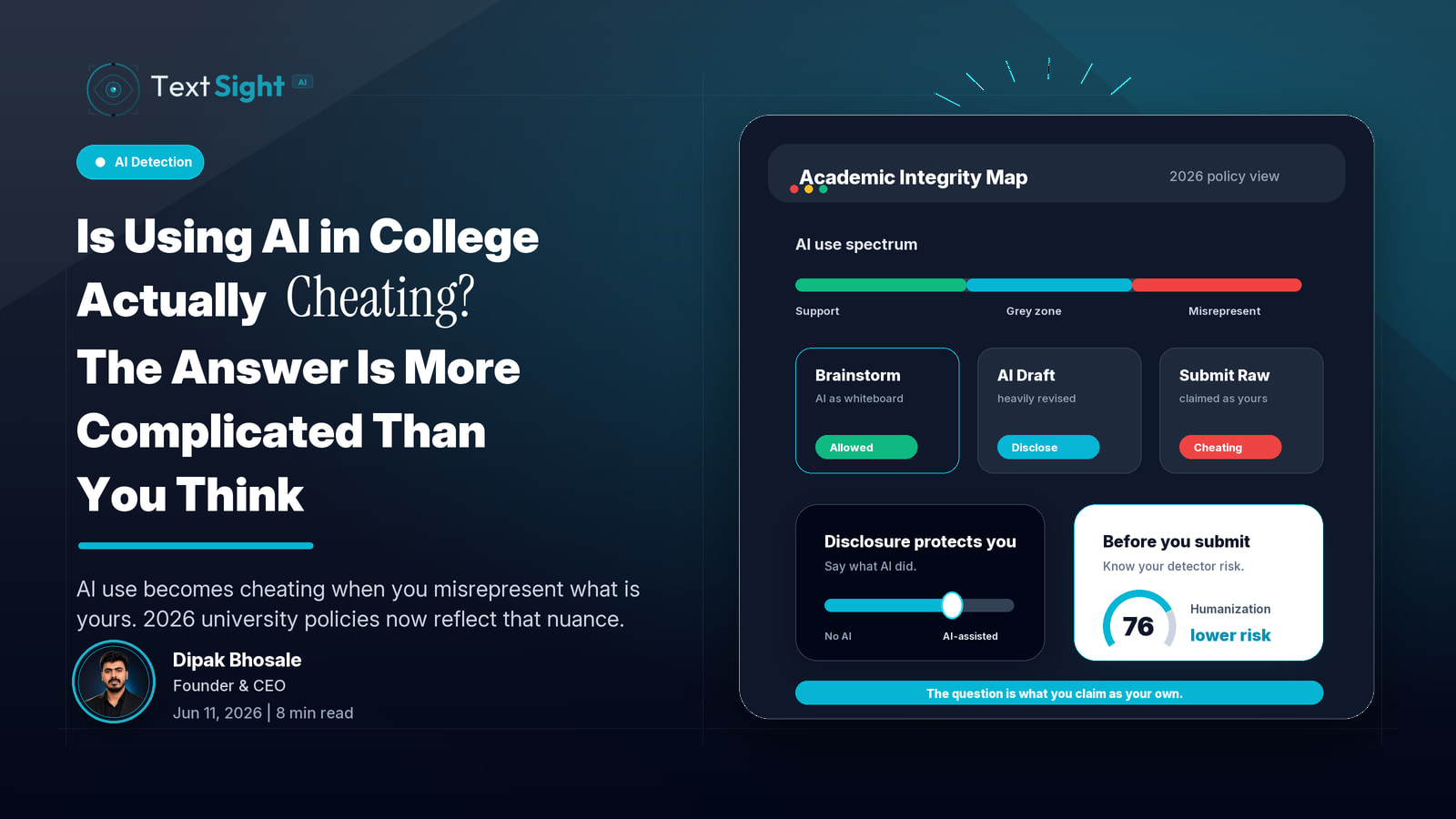
There's not one thing called "using AI in college." There are at least six distinct behaviors that get lumped together, and they're not morally equivalent.
1. Fully AI-generated submission. You paste the assignment into ChatGPT, copy the output, and submit it with your name on it. This is misrepresentation. You're claiming authorship of work you didn't produce. Almost every institution's academic integrity policy prohibits this explicitly, and it did before AI existed — the offense is misrepresentation, not AI use per se. This is clearly dishonest and has been for decades under different names.
2. AI-drafted, heavily edited. You use AI to produce a first draft, then spend 3–4 hours rewriting, restructuring, adding your own examples and arguments, cutting sections that don't represent your views, and revising until it sounds like you. How much of the final product is "yours" is genuinely debatable. This is the grey zone.
3. AI-assisted outlining. You describe your argument to ChatGPT and ask it to suggest a structure. You write every sentence yourself. This is essentially using AI as a whiteboard. It's hard to see how this differs from talking to a classmate about your paper structure, or visiting a writing center.
4. AI grammar and style editing. You run your finished draft through AI to check grammar, clarity, and word choice — the way you'd use Grammarly, except more capable. Nearly every university that has addressed this explicitly has said it's permitted, often recommending it.
5. AI for research and summarization. You use AI to summarize a dense academic paper or generate an overview of a topic before diving into primary sources. This is different from using AI to write your paper. It's a research aid, the way library databases and abstracts always were.
6. AI for brainstorming and feedback. You share a draft with AI and ask "what's weak about this argument?" or "what counterarguments am I missing?" This is equivalent to peer review, except your peer is infinitely available at 2 AM.
Only #1 is clearly dishonest on any framework. The rest exist on a spectrum, and where you draw the line legitimately depends on what the assignment is meant to assess.
What 2026 University Policies Actually Say
The landscape has changed dramatically from the 2023 panic response, when most institutions issued blanket AI bans because they didn't know what else to do.
By 2026, the majority of research universities have moved toward what's being called "contextual AI policies" — policies that distinguish between different types of AI use and different assignment contexts rather than treating all AI as prohibited.
MIT's current policy, updated in early 2026, explicitly permits AI use for brainstorming, research assistance, grammar checking, and feedback on drafts. It prohibits submitting AI-generated text as student work "without substantial revision and transparent disclosure." The key word is "substantial" — and yes, that requires judgment.
Stanford's policy distinguishes by course type. In courses where writing is the primary assessed skill (literature, expository writing, some social science courses), AI drafting is prohibited. In technical courses where writing is a secondary deliverable, AI drafting is permitted with disclosure. That's a sophisticated distinction that recognizes what different assignments are actually measuring.
University of Michigan's policy, revised twice since 2023, now includes an "AI disclosure statement" — students indicate at submission what role AI played in their work, on a standardized scale from "no AI use" to "AI-drafted, substantially revised." The disclosure doesn't penalize AI use. It just requires honesty.
This is where things are heading. Disclosure-based approaches. Context-dependent permissions. A recognition that the question "did you use AI?" is less important than "what are you claiming, and is that claim honest?"
The Double Standard That Nobody Wants to Talk About
Here's something that doesn't get said enough: professors use AI to write lecture notes, assignment prompts, and course materials. Academic publishers use AI for editing. Graduate program administrators use AI to draft feedback letters. University communications departments use AI constantly.
The idea that AI use is a student problem — a cheating problem — while the rest of academia integrates AI at every level is a double standard that's hard to defend on principle. Students notice it. They should.
This isn't an argument that students should be able to use AI without restriction. It's an argument that the framing of "AI use = cheating" is shaped partly by the power dynamics of who gets to use which tools, not purely by ethics.
A more honest framing: AI is a tool. Like all tools, what matters is what you're using it to do, and what you're representing about your own capabilities and work. A professor who uses AI to draft feedback isn't misrepresenting it as original scholarly insight. A student who submits AI output as evidence of their own analytical ability is doing something different.
The ethics are about representation, not tool use.
The Genuinely Hard Cases
I promised to address the grey zone. Here it is.
The heavily-edited draft. You spent two hours with ChatGPT getting a draft, then four hours rewriting it. How much of the thinking is yours? There's no clean answer. If the assignment was meant to develop your writing and argumentation skills, and you outsourced the initial drafting, you may have learned less than intended — even if the final product was heavily modified. Whether that constitutes "cheating" depends on whether you're representing the work as evidence of skills you don't actually have.
The ESL student. English is your third language. You write your argument in your first language, translate it into rough English, then use AI to smooth the grammar and phrasing substantially. Is this cheating? You did the thinking. The AI did linguistic translation work. This genuinely is grey, and some institutions have begun carving out explicit exceptions for AI grammar assistance for non-native speakers.
The learning disability accommodation. A student with severe dyslexia uses AI to convert their voice-recorded ideas into written text. The ideas are entirely theirs. The written form required AI assistance. This is also grey — and most institutions, when pushed, classify this as an accommodation rather than academic dishonesty.
The honest conclusion about the grey zone: intent and transparency matter more than tool use. A student who discloses AI assistance and explains what they actually contributed is in a fundamentally different moral position than one who submits AI output silently under their own name. The first student can be evaluated honestly. The second one can't.
The Practical Picture for Students Right Now
In 2026, here's what you're actually dealing with:
Most institutions permit AI for research, brainstorming, grammar checking, and writing feedback. Most prohibit submitting AI-generated prose without substantial revision and disclosure. A minority still have blanket bans — primarily smaller colleges and some professional schools where the integrity of demonstrated skill matters enormously (law, medicine, education programs).
If your course syllabus doesn't address AI policy — and this is still surprisingly common — you're in a gap. The safest move: email the professor directly and ask. This isn't incriminating. It demonstrates exactly the kind of transparency that distinguishes ethical AI use from dishonest AI use.
If your institution has a disclosure-based policy, use it. The disclosure protects you legally if there's ever a dispute. It also forces you to reflect on what you actually contributed, which is useful for your own development.
And if you're submitting work that was substantially AI-generated without disclosure, you're taking on real risk — not just of academic consequences, but of genuinely not developing the skills the degree is supposed to represent. That matters eventually, usually at the worst possible moment.
What About AI Detection?
Here's a practical reality: AI detectors are widely used and imperfect. Students who didn't use AI at all sometimes get flagged. Students who did use AI sometimes don't get flagged.
This creates a genuinely unfair situation where the detection technology determines consequences more than the actual behavior. A false positive on a 61.3% false positive rate for ESL writers (per Stanford's 2024 HAI study) means many students who did nothing wrong get accused of cheating. That's not a hypothetical — it's happened in documented cases at dozens of institutions.
Whether you used AI or not, knowing your score before you submit protects you. If you're a human writer who sometimes scores poorly on detectors because of your writing style — formal, ESL, academic — you can check your score on TextSight and understand your risk before submission, not after an accusation. → textsight.ai
The Actual Answer
Is using AI in college cheating? Here's where I land, after thinking about this seriously:
Using AI to misrepresent your capabilities — submitting AI output as evidence of your own analytical thinking, writing skill, or research ability — is dishonest, in exactly the same way that submitting purchased essays was always dishonest.
Using AI as a tool that supports your own thinking, while being honest about what you did, is not cheating by any definition that holds up to scrutiny.
The grey zone in between requires judgment, context, and transparency. Institutions are finally starting to write policies that reflect this. Students who engage honestly with those policies — disclosing what they did, using AI in ways the course permits, developing their own skills alongside AI assistance — are in a defensible position. Students who don't are not.
The question isn't really "did you use AI?" The question is "what are you claiming about yourself and your work?" That question has always been at the center of academic integrity. AI just made it harder to avoid.
Related reading:
- How to Avoid AI Detection as a Student
- My Essay Was Flagged as AI But I Wrote It
- Can Turnitin Detect ChatGPT?
- How Universities Are Actually Responding to ChatGPT in 2026
Try it on your own writing