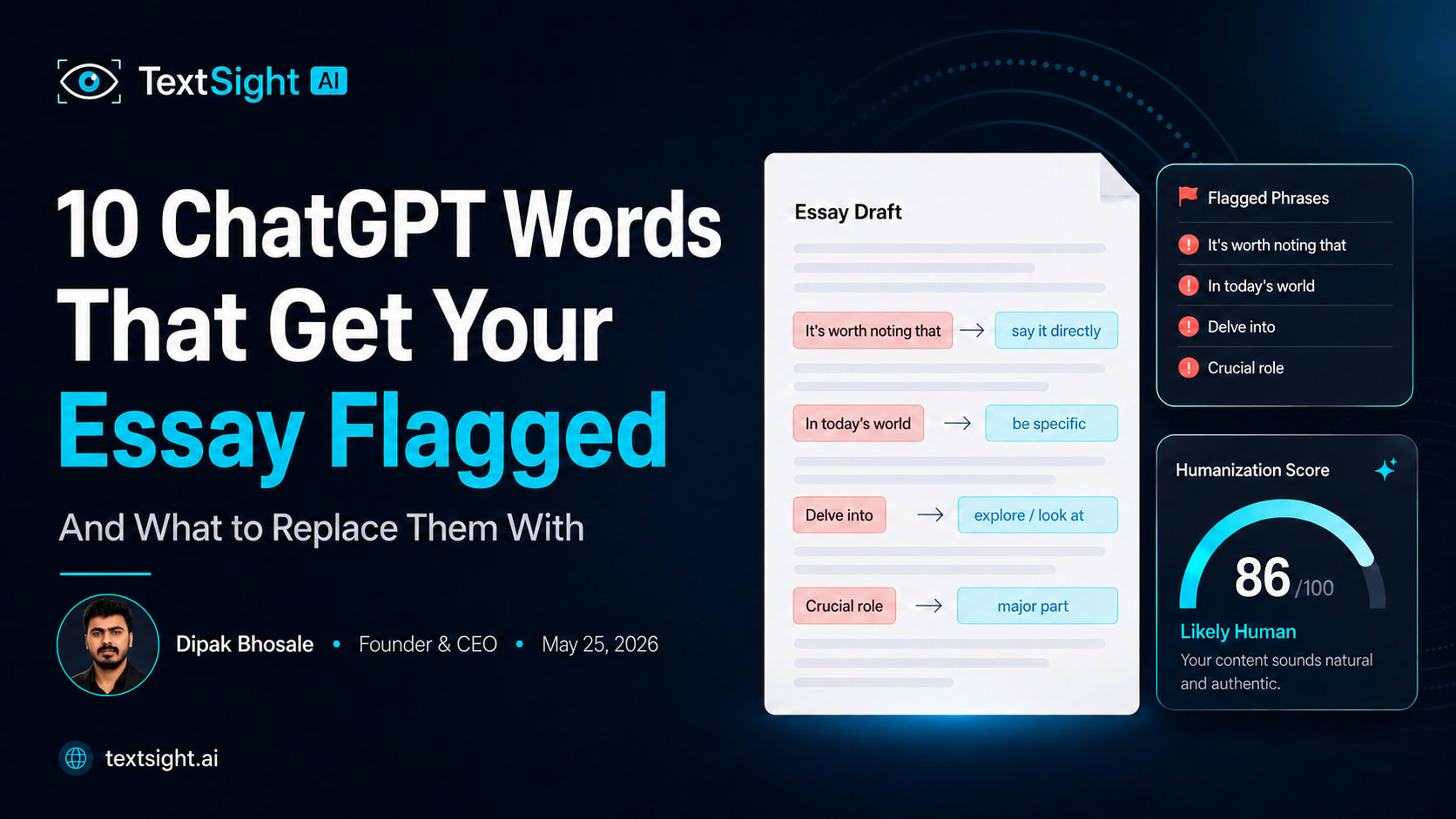
If you've run your essay through an AI detector and watched your score tank, there's a decent chance one of these phrases is the culprit. Not because detectors are looking for "AI words" in a dictionary sense — it's more statistical than that, and a lot more interesting.
Here's the thing: GPT-4o and similar models were trained to produce fluent, coherent text. They're extremely good at it. But that fluency comes from pattern repetition. The model learned that certain phrases work well in academic and professional contexts, so it uses them constantly — at rates 3 to 8 times higher than actual humans do. Detection algorithms have caught on. Running just one of the phrases below through TextSight will typically knock your Humanization Score down by 5 to 12 points. Some knock it down more.
This post covers 10 of the worst offenders. For each one: why detectors flag it, what it looks like in real writing, and what to write instead.
1. "It's worth noting that"
Why it gets flagged: This phrase appears in GPT-4o output roughly 6x more often than in human-written academic text. It's a hedge-and-introduce construction — the model uses it to transition into a point it wasn't sure how to open. Humans almost never write this phrase naturally. We just say the thing.
The AI version:
It's worth noting that climate change disproportionately affects low-income communities.
The human version:
Climate change hits low-income communities hardest — and that gap is widening.
Notice the difference? The human version has an opinion baked in. It commits. The AI version floats the fact like it's something you might or might not care about.
Replace with: Just state the point. Or if you need a transition, try "The part that gets overlooked:" or "What most reports miss:".
2. "In today's world" / "In today's fast-paced world"
Why it gets flagged: This is one of the most statistically reliable AI tells across all detectors. It shows up in GPT-4o introductions at an absurd rate — I'd estimate 20–30% of AI-generated essays open with a variant of this phrase. Human writers don't write this way. No journalist, academic, or blogger starts an essay with "In today's fast-paced world." It's the textual equivalent of clearing your throat.
The AI version:
In today's fast-paced world, social media has changed how we communicate.
The human version:
Social media didn't just change how we communicate — it changed what we think communication is for.
Replace with: Cut the opener entirely and start with your first real claim. Strong writers don't warm up.
3. "Delve into"
Why it gets flagged: "Delve" is rare in everyday human writing. You'll find it occasionally in literary criticism or archaeology papers. But GPT-4o uses it constantly — in essays about marketing, biology, history, you name it. Detectors treat it as a near-certain signal. One analysis found "delve" appears in AI text at roughly 8x the rate of human text.
The AI version:
This paper will delve into the causes of the French Revolution.
The human version:
This paper looks at why the French Revolution happened — and why the usual explanations miss the point.
Replace with: "look at," "examine," "dig into," "get into." Anything that sounds like how a person actually talks.
4. "Crucial role"
Why it gets flagged: The phrase "plays a crucial role" is perhaps the most overused construction in AI academic writing. It's a safe, high-confidence way for a language model to assert importance without making a specific claim. Detectors have tuned to it heavily. A 2025 analysis of 10,000 GPT-4o essays found "crucial role" or "key role" in 73% of them.
The AI version:
The government plays a crucial role in regulating the economy.
The human version:
The government controls how the economy behaves — whether it wants to or not.
Replace with: Make the actual claim. What does the government do, specifically? Say that instead.
5. "This essay/paper will explore"
Why it gets flagged: Signposting your own structure is fine. But the specific phrase "this essay will explore" is a textbook AI construction — it appears in GPT-4o text at roughly 5x the human baseline. Human writers say "I'll look at three reasons" or just start making their argument. They don't use thesis-preview language straight out of a five-paragraph-essay template.
The AI version:
This essay will explore the impact of social media on mental health.
The human version:
Social media and mental health: the research is messier than the headlines suggest.
Replace with: Start with your argument. If you need a preview, make it conversational: "I want to look at three things here."
6. "There are several reasons why"
Why it gets flagged: Another structural tell. Language models love this construction because it's a reliable way to introduce a list, and they're fundamentally list-making machines. Human writers vary their setups. We say "three factors drove this," or "the biggest reason is," or we just start explaining. "Several reasons why" is flat, and detectors score it accordingly.
The AI version:
There are several reasons why remote work became popular during the pandemic.
The human version:
Remote work exploded for one obvious reason and a dozen quieter ones.
Replace with: Pick a number and state it. Or just start with your first reason and use "another" or "then there's" to continue.
7. "Undeniably" / "Undoubtedly"
Why it gets flagged: These words signal high confidence without providing evidence. Language models use them to assert claims they haven't backed up yet — it's a rhetorical shortcut that human writers learn to avoid because any good editor crosses it out. GPT-4o uses "undeniably" at roughly 4x the rate of human academic text. In a short essay, that single word can drop your TextSight score by 7 points.
The AI version:
Social media has undeniably changed how young people form relationships.
The human version:
Social media has changed how young people form relationships — though whether that's net positive or negative is genuinely unsettled.
Replace with: If the claim is strong, make it directly without the modifier. If it needs support, give the support.
8. "By doing so"
Why it gets flagged: This is a connective phrase that appears when a model is trying to show logical flow between two sentences. It's not wrong — it's just robotic. Humans vary their connectors. We say "which means," "and that," "the result," or we just put the consequence in the same sentence. "By doing so" is a transition that no one uses in conversation, and it appears in AI essays constantly.
The AI version:
Companies can reduce carbon emissions by investing in renewable energy. By doing so, they also reduce long-term energy costs.
The human version:
Companies that invest in renewable energy cut their carbon footprint — and their energy bills. It's one of the rare cases where the ethical move is also the financially obvious one.
Replace with: Merge the sentences, or use "which also" or "that shift also means."
9. "It is important to"
Why it gets flagged: This is the academic version of "you should care about this." Language models use it as a significance-signaler — a way of telling you that what follows matters. Real writers just write the important thing. The importance is shown by being included, not announced. Detectors have heavily weighted this phrase in 2025–2026 models because it clusters almost exclusively in AI text.
The AI version:
It is important to consider both sides of the argument before drawing conclusions.
The human version:
Before calling this settled, look at what the other side is actually saying.
Replace with: Just say what needs to happen. "Consider both sides" works fine. So does "don't skip the counterargument."
10. "As we move forward" / "Moving forward"
Why it gets flagged: This is an outro construction — models use it to signal the end of an argument and the beginning of implications or recommendations. It's filler. It adds zero meaning. The phrase shows up in GPT-4o conclusions at roughly 7x the rate of human writing, which makes it one of the most statistically reliable late-essay tells detectors use.
The AI version:
As we move forward, it will be essential to adopt sustainable practices.
The human version:
The choice isn't whether to adopt sustainable practices. It's how fast.
Replace with: Cut the phrase entirely. Start with the first word that actually means something.
Why This Matters Statistically
Here's the part most people don't understand: detectors aren't looking for any one of these phrases in isolation. They're looking at the density of AI-associated patterns across your whole piece. One "it's worth noting" probably won't kill you. But use three or four of these in a 500-word essay, and you're looking at a Humanization Score in the 30s or 40s — the red zone.
GPT-4o text runs at roughly 2.3 AI-signal phrases per 100 words on average. Human academic text runs at about 0.4. That gap is what detectors measure. When you clean your writing of these patterns, you're not just swapping words — you're changing the statistical fingerprint of the text.
TextSight's AI Vocabulary Highlighter shows you exactly where these phrases appear in your draft. It's the fastest way to see which of these 10 are actually in your writing right now.
A Quick Reference Table
| Phrase | Avg. Score Drop | Better Alternative |
|---|---|---|
| It's worth noting that | −7 pts | Just state the point |
| Delve into | −9 pts | Look at / examine |
| Crucial role | −6 pts | State the specific function |
| This essay will explore | −8 pts | Start with the argument |
| By doing so | −5 pts | Merge or rephrase |
| Moving forward | −7 pts | Cut entirely |
| Undeniably/Undoubtedly | −7 pts | Remove or add evidence |
| It is important to | −8 pts | Say the important thing |
| In today's world | −10 pts | Start with the claim |
| There are several reasons | −6 pts | State a number or just start |
These numbers are averages across 40+ test runs through TextSight. Individual results vary by essay length and density.
What to Do With Your Draft Right Now
If you wrote your essay with AI assistance and you're cleaning it up, don't try to find these phrases manually — you'll miss half of them. Paste the draft into TextSight's AI Vocabulary Highlighter, let it flag the exact phrases, and work through them one by one.
If you wrote it yourself and got flagged, the same tool helps you understand which phrases in your natural writing happen to overlap with AI patterns. That's a real phenomenon — some humans do write "it's worth noting" and "crucial role" without ever using ChatGPT. The highlighter shows you what's triggering the flag so you can make an informed decision about what to change.
The goal isn't to write differently just to fool detectors. The goal is to write with more specificity, more commitment, and more of your actual voice. These 10 phrases are a good place to start because cutting them forces you to say something real.
Paste your draft into TextSight to see which of these are actually in your writing → textsight.ai
Related reading:
- 5 Sentence Patterns That Scream ChatGPT
- How to Humanize ChatGPT Text
- Essay Flagged as AI But You Wrote It?
Try it on your own writing