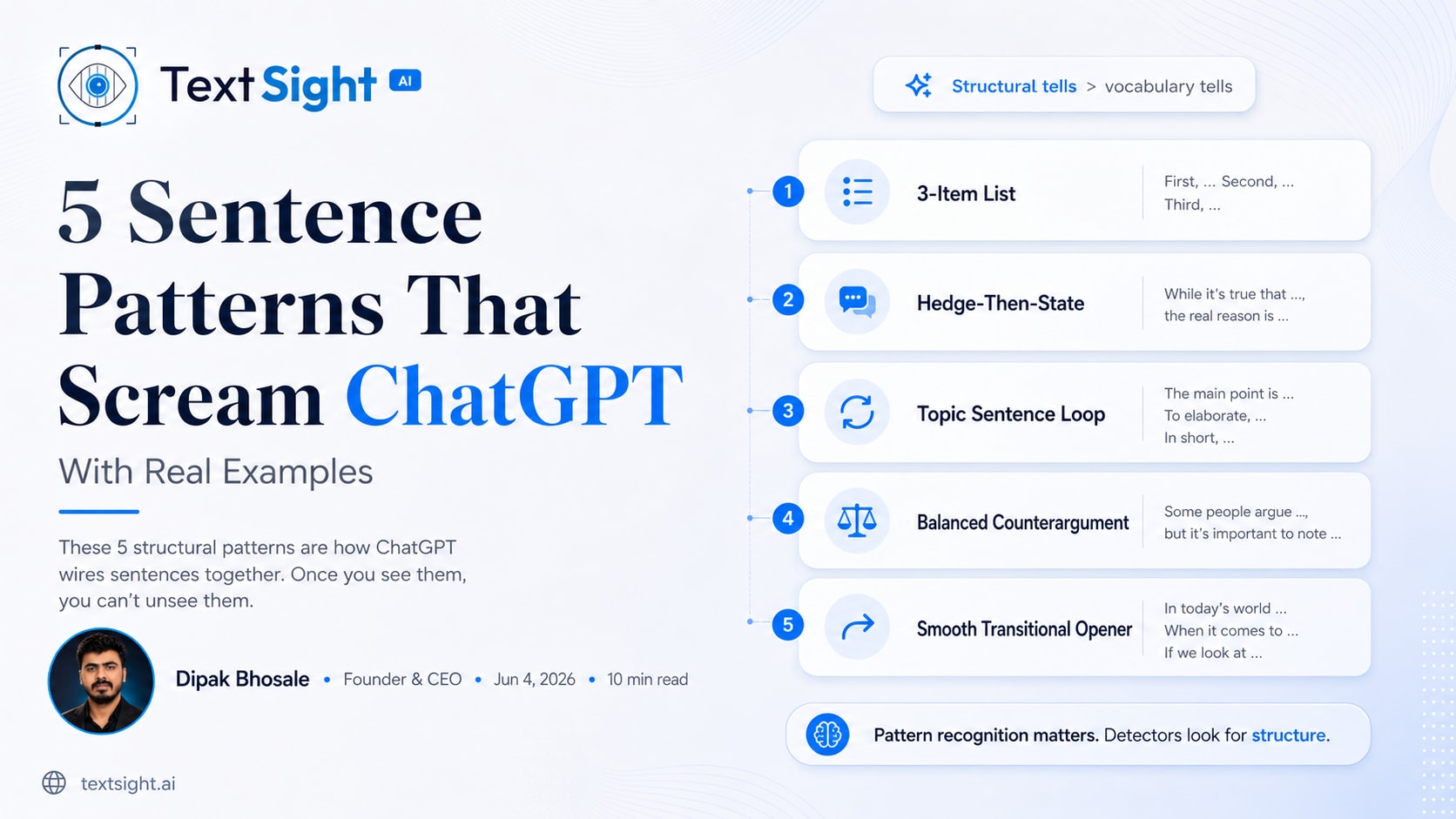
It's not just the vocabulary. Everyone knows about "delve" and "crucial role." The deeper tell — and the harder one to fix — is structural. The way ChatGPT connects sentences, builds paragraphs, and frames arguments follows patterns that come directly from how transformer language models predict the next token.
Understanding why these patterns exist makes it much easier to recognize and fix them. So for each of the 5 patterns below, I'll cover: what it looks like, why the model produces it, a real before/after example, and how to rewrite it.
These are structural patterns, not word choices. You can remove every "delve" from your document and still have writing that reads like ChatGPT because of how the sentences relate to each other.
Pattern 1: The 3-Item List That Always Has Exactly 3 Items
What it looks like:
Social media affects mental health in three key ways: increased anxiety, reduced attention span, and a distorted sense of social comparison.
Effective leadership requires three things: clear communication, consistent follow-through, and the ability to motivate a diverse team.
There are three main reasons why remote work became popular: flexibility, cost savings, and the technological infrastructure that made it possible.
Notice anything? It's always three. Not two, not four, not five. Three.
Why the model produces it: Three-item lists are the single most common structure in the training data. Academic writing, business communication, journalism, how-to content — everything defaults to three because the rule of three is the most taught rhetorical structure in English-language writing instruction. The model learned that when you need to enumerate things, three is correct.
The problem is that the real world doesn't have exactly three of everything. If you ask ChatGPT about the causes of World War I, it will identify three primary causes. Ask about the benefits of exercise, three benefits. Ask what's wrong with your marketing strategy, three things. The three-ness isn't analytical — it's structural. The model fills in whatever fits the three-slot container.
Human writers are messier. We might have two things that matter, or seven, or we'll say "the biggest factor, by a significant margin, is X" and barely mention the others. The commitment to three reveals the structure of the generation, not the structure of the argument.
The AI version:
This issue affects communities in three important ways: economically, socially, and politically.
The human version:
This issue hits communities economically first — and then the social effects follow from the financial strain, not separately. The political dimension is real, but it's downstream of the first two.
See how the human version collapses the three into a causal sequence? Because that's how it actually works, not three parallel equivalent factors.
Fix: Ask yourself: is there actually a natural three here, or did you (or the AI) manufacture three? If there are two things, say two. If there's one dominant thing and some secondary ones, say that. If there genuinely are five, list five.
Pattern 2: The Hedge-Then-State Construction
What it looks like:
While social media has its drawbacks, it also provides meaningful opportunities for connection and community building.
Although there are challenges associated with remote work, many employees find that the flexibility outweighs the downsides.
Despite some concerns about accuracy, AI detectors have become an important tool for educators seeking to maintain academic integrity.
The structure is: concessive clause ("While X...") → main clause that makes the actual point. The concession is always brief and nonspecific. The main point is always the one the model actually wanted to make.
Why the model produces it: ChatGPT was trained with RLHF (reinforcement learning from human feedback) that explicitly rewarded balance and nuance. Claims that acknowledged counterarguments were rated higher by human reviewers than unqualified claims. So the model learned to reflexively insert a concession before any potentially controversial statement.
The problem is that the concession is almost always content-free. "While X has drawbacks" acknowledges nothing specific. It's not engaging with the counterargument — it's performing the acknowledgment of a counterargument. After the "While," the point proceeds exactly as it would have without the concession.
Human writers either actually engage with the counterargument or they don't include it. We say "The case against this is stronger than people admit: [specific case]. But here's where it breaks down:" — or we just make our claim and explain why.
The AI version:
While automation causes job displacement, it also creates new opportunities in emerging industries.
The human version:
Automation does create new jobs — but the people whose jobs are displaced are rarely the ones who get the new ones. The net effect on employment might be positive and the human effect might still be devastating, and conflating those two things is a policy mistake.
The human version has an actual position on the counterargument. It's not just acknowledging the other side — it's saying something about the relationship between the two sides.
Fix: Either cut the concessive opener and start with your claim, or actually engage with the counterargument. "While X is true" should be followed by why X complicates or modifies your argument, not by "also, my original point."
Pattern 3: The Topic Sentence → Evidence → Restate Loop
What it looks like:
Social media has a significant impact on political polarization. Studies have shown that algorithms prioritize emotionally engaging content, which often means divisive content. This creates echo chambers that reinforce existing beliefs and increase political division. It's clear, therefore, that social media plays a major role in driving polarization.
Every paragraph. Same shape. Open with a topic sentence that makes the claim. Provide evidence in the middle. Restate the claim in the closing sentence with slightly different wording.
Why the model produces it: This is the five-paragraph essay structure applied at the paragraph level. It's in virtually every writing instruction resource on the internet, which means it's everywhere in the training data. The model learned that this is what a paragraph looks like.
The closing restatement is the biggest tell. Human writers rarely need to summarize what they just said at the end of each paragraph because we trust the reader to have read it. The restatement is a structural crutch — it's the model making sure it landed the point.
The AI version: (as above)
The human version:
Social media algorithms don't just show you what's popular — they show you what makes you feel something, because that keeps you on the platform longer. In practice, that means divisive content. Not because anyone decided "make users angrier," but because outrage gets more clicks than agreement. The result is an information environment where the most emotionally activating version of every political story is the one most people see.
No topic sentence. No restatement at the end. The paragraph opens with a specific mechanism and ends with the consequence. The structure follows the argument, not a template.
Fix: Write your paragraph, then delete the first sentence if it's just announcing what you're about to say, and delete the last sentence if it's just repeating what you said. Often what remains is the actual content, and it's better.
Pattern 4: The Balanced Counterargument Nobody Asked For
What it looks like:
In a persuasive essay arguing that remote work should be standard policy:
On the other hand, some employees prefer the social environment of an office and may struggle with isolation when working from home. Managers who value direct oversight may find it more difficult to assess productivity remotely. It's important to consider these perspectives when making decisions about remote work policy.
Nobody asked for the counterargument. The essay is making a specific case. But the model inserted two paragraphs of balanced perspective anyway, then qualified the main argument.
Why the model produces it: Same RLHF dynamic as Pattern 2, but at the essay level. The model was trained to produce balanced, fair content. In a news context, that's appropriate. In a persuasive essay with a clear thesis, it undermines the argument. The model doesn't adjust this behavior based on the context — it produces balance because balance scored highly in training.
This pattern is particularly recognizable because the counterargument section often feels detached from the main argument. It doesn't respond to anything specific in the essay. It just appears, makes generic points about the other side, and then the essay returns to its original position as if the counterargument didn't exist.
The AI version:
While remote work offers many benefits, it's also worth considering that some employees perform better in office environments. Individual preferences vary, and a one-size-fits-all approach may not be ideal.
(unprompted, in the middle of a pro-remote-work essay)
The human version: Either engage with the counterargument specifically — "The isolation problem is real for some people, and I'd argue hybrid is better than fully remote for that reason" — or cut it. Don't include it performatively.
Fix: If you're making a case for something, make it. If a counterargument genuinely complicates your position, address it specifically and explain where it does and doesn't apply. Don't include a balanced paragraph that your argument never responds to.
Pattern 5: The Smooth Transitional Opener
What it looks like:
Furthermore, it's important to consider the economic implications of this policy.
Moreover, the impact on local communities cannot be overlooked.
Additionally, there are several factors that must be taken into account when implementing this approach.
In conclusion, it is clear that this issue requires immediate attention.
"Furthermore." "Moreover." "Additionally." "In conclusion." These four words are almost extinct in natural human prose. You'll find "furthermore" in legal documents and some academic journals. You won't find it in journalism, business writing, student essays written by actual students, or basically any other modern written form.
Why the model produces it: These words appeared constantly in the formal writing corpora the model was trained on — older academic texts, legal documents, formal reports. The model learned that formal = these transitions. But modern human formal writing has largely moved away from them. They sound dated and robotic to contemporary readers, which means they read as AI immediately.
The deeper issue is what these transitions do structurally: they announce a new point is coming without connecting it to the previous point. "Furthermore" says "here's another item in the list." A human writer would either show the connection — "The economic problem makes the social problem worse, because..." — or use no transition at all and trust the logic to hold.
The AI version:
Furthermore, the social implications of this policy extend beyond economic concerns. Moreover, community engagement is essential for successful implementation. Additionally, stakeholder consultation should be prioritized in the planning phase.
Three consecutive paragraphs, three smooth transitions, zero actual connection between the ideas.
The human version:
The economic pressure doesn't exist in isolation. When families can't afford housing, the social effects follow: schools destabilize, local businesses lose customers, community institutions lose donors. By the time you're trying to "engage the community" for a policy rollout, you've already lost them.
No transitions because the argument has a shape. Each sentence follows from the last.
Fix: Delete every "Furthermore," "Moreover," and "Additionally" in your document. Then look at each paragraph that started with one of these. Ask: does this paragraph actually follow from the previous one, and if so, how? Write that connection into the opening line of the paragraph. If the paragraph doesn't connect, either connect it or move it.
Why These Patterns Are Hard to Fix (And How to Fix Them)
The reason these patterns are persistent isn't that people don't know about them. It's that they're architectural. They're not phrases you can find-and-replace — they're the shape of how the text is organized.
The fastest approach:
-
For Pattern 1 (forced threes): Count your lists. Anything with exactly three items — ask whether the three-ness is real or manufactured.
-
For Pattern 2 (hedge-then-state): Search for "While," "Although," and "Despite" at the start of sentences. Decide whether to cut the concession or actually engage with it.
-
For Pattern 3 (topic-sentence-restate): Delete the last sentence of each body paragraph. Delete the first sentence if it just announces the paragraph's topic. What's left is usually the actual content.
-
For Pattern 4 (unprompted counterargument): Find any "on the other hand" or "some argue" sections. Either connect them to your argument specifically or cut them.
-
For Pattern 5 (smooth transitions): Delete every "Furthermore," "Moreover," "Additionally," and "In conclusion." Rewrite the openings of the affected paragraphs to show logical connection instead of announcing sequence.
After these fixes, run your draft through TextSight to see where your Humanization Score lands. You'll typically see the score move 10–20 points just from structural changes, even without touching the vocabulary.
Check your score and see which patterns are still showing → textsight.ai
Also worth reading: 10 ChatGPT Words That Get Your Essay Flagged — the vocabulary equivalent of this structural analysis.
Related reading:
- 10 ChatGPT Words That Get Your Essay Flagged
- How to Humanize ChatGPT Text
- How Teachers Spot AI Writing in 5 Seconds
Try it on your own writing