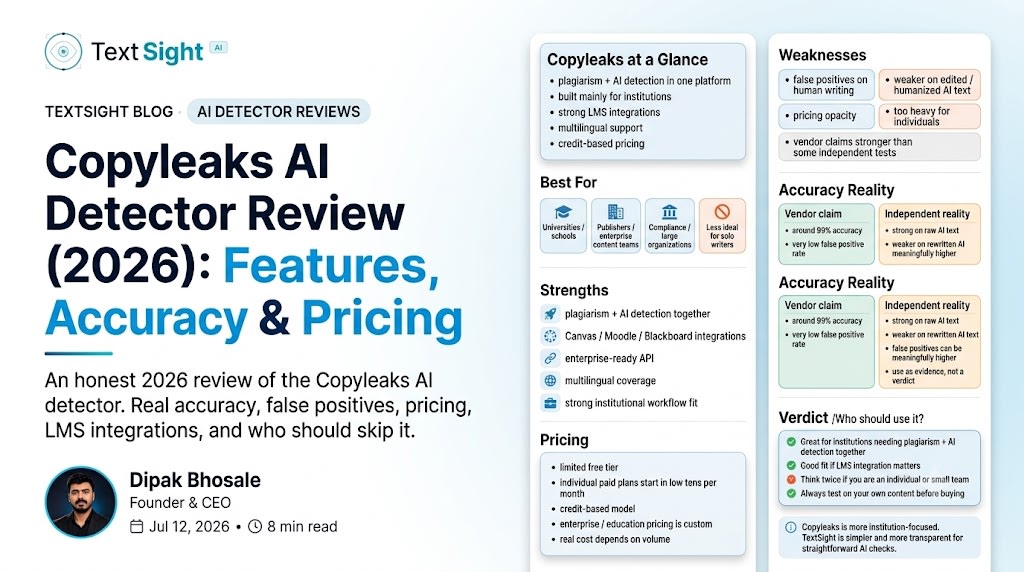
Copyleaks is one of the most recognizable names in content authenticity. It started life as a plagiarism checker, and over the past few years it has grown into a combined plagiarism and AI detection platform aimed squarely at schools, universities, publishers, and larger businesses. If you are deciding whether it belongs in your workflow this year, this review walks through what it actually does, how accurate it is in practice, what it costs, and where it falls short. We have kept the numbers honest and attributed the disputed ones, because content detection is a field where confident marketing claims and real-world results often diverge.
What Copyleaks is
At its core, Copyleaks does two things in one product. It checks text against a large index of published and web sources for plagiarism, and it runs a separate machine learning model that estimates whether a passage was written by a human or generated by an AI system such as ChatGPT, Gemini, or Claude. Bundling both into a single scan is the headline selling point. Instead of buying a plagiarism tool and an AI detector separately, an institution gets one report that flags copied passages and probable AI-generated passages side by side.
Around that core, Copyleaks has built the connective tissue that enterprises and education buyers expect. There is a documented API, browser and file support for formats like PDF and Word, and, notably, native integrations with major learning management systems. According to their site and third-party reviews as of 2026, Copyleaks connects with Canvas, Moodle, and Blackboard, which lets instructors run checks inside the grading flow they already use. That LMS depth is genuinely a differentiator, and it is a big part of why the product shows up so often in university procurement conversations.
Who it is for
Copyleaks is built for organizations, not primarily for individuals. The clearest fit is education, where a department or an entire institution needs to check large volumes of student submissions, wants results inside an LMS, and needs an audit trail. The second clear fit is enterprise content operations, such as publishers, agencies, and compliance teams that need both plagiarism and AI signals at scale through an API.
An individual writer, a freelancer, or a single blogger can use Copyleaks, and there is an entry-level plan for that. But the product's design center is the institutional buyer, and you feel that in the pricing structure, the onboarding, and the feature set. If you just want to spot-check a few pages a month, the tool works, but you are paying for a platform built for bigger jobs.
How it works
You submit text, a file, or a URL, and Copyleaks returns two things. First, a plagiarism report showing matched sources and the percentage of text that overlaps with existing material. Second, an AI detection result that estimates how much of the text appears to be machine-generated, usually expressed as a percentage or a probability with highlighted passages.
The AI model is trained to recognize statistical patterns typical of large language model output. Copyleaks supports AI detection across multiple languages, with reporting of roughly 30 or more languages in independent write-ups and their marketing as of 2026, which is broader than many English-only competitors. The platform also offers sensitivity controls in some configurations, letting reviewers lean toward fewer false alarms or toward catching more lightly edited AI text. That trade-off is worth understanding, because it is exactly where accuracy gets complicated.
Accuracy and the false-positive reality
This is the part that deserves the most care. Copyleaks markets very high accuracy. Public claims have included figures around 99 percent accuracy and a false positive rate near 0.2 percent, drawn from the company's own large-scale internal testing. Those are the vendor's numbers, and they describe controlled conditions.
Independent testing in 2025 and 2026 paints a more moderate picture. Across various third-party benchmarks, real-world AI detection accuracy for Copyleaks has been reported in a range from roughly the high 70s to the low or mid 90s percent, depending heavily on the test set and methodology. On raw, unedited AI text, performance tends to be strong, often in the low 90s. On text that has been rewritten, paraphrased, or run through a humanizer, detection can drop sharply, in some tests to a fraction of its headline rate. This pattern is not unique to Copyleaks. It is a structural limitation of AI detection in general, and it is why we are cautious about any tool's "undetectable-proof" positioning.
The false positive question matters most for education. The vendor claims a false positive rate well under one percent. Several independent tests have found meaningfully higher rates on genuine human writing, with published figures commonly landing in the mid to high single digits, and some student-style samples measuring higher still. If independent estimates around six to nine percent hold for your content, that means a non-trivial share of authentic human essays could be flagged. For a classroom, even a low single-digit false positive rate translates into real students being wrongly accused, which is why every responsible reviewer, including Copyleaks itself, frames the score as a signal for human review rather than proof. We take the same position with our own detector, and you can read exactly how we test and report on our accuracy methodology page.
The honest summary: Copyleaks is a capable detector that performs well on obvious AI text, weakens on edited AI text, and, like its peers, produces false positives on real human writing more often than its headline numbers suggest. Treat the percentage as evidence, not a verdict.
Pricing
Pricing is where Copyleaks gets harder to pin down, and that opacity is a fair criticism. As of 2026, published figures across their site and third-party listings vary, which is partly because plans are structured around a credit system. In the common model, one credit covers a set amount of text, often described as up to 250 words per credit, and plans allocate a monthly page or credit budget.
There is a limited free tier, typically a small monthly allowance suitable only for occasional spot checks. Paid individual plans start in the low tens of dollars per month for modest volumes. From there, business plans scale up to higher monthly commitments, and API pricing is handled separately on a volume basis. The plans that most institutions actually need, education and enterprise, are quoted custom and require going through a sales and onboarding conversation rather than a public price. Annual billing generally carries a discount over monthly.
Two practical takeaways. First, the exact dollar figures shift over time and between listings, so confirm current numbers directly on their pricing page before you budget. Second, the credit model means your real cost depends on volume and word counts, not a simple flat fee, so estimate your monthly page load carefully. For a large organization this is standard. For an individual, it can feel opaque and expensive relative to lighter tools.
Strengths
Copyleaks does several things genuinely well.
- Two tools in one. Plagiarism and AI detection in a single scan and a single report is a real workflow win, especially for academic integrity teams that care about both.
- LMS integration depth. Native connections to Canvas, Moodle, and Blackboard put results where instructors already work. Few competitors match this breadth.
- Enterprise readiness. A documented API, format support, and reporting make it a serious option for organizations that need to embed detection into existing systems at scale.
- Multilingual coverage. Support reported across roughly 30 or more languages is a meaningful advantage for international student bodies and global content teams.
- Education focus. The product is built for institutions, with the account structure, controls, and support to match.
Weaknesses
The limitations are equally worth stating plainly.
- False positives on human writing. Independent tests suggest real-world false positive rates above the vendor's headline claim, which is a serious concern in high-stakes academic settings.
- Weakness on edited or humanized text. Like all detectors, accuracy drops when AI text is paraphrased or rewritten, so it is not a reliable catch-all.
- Pricing opacity. The credit model plus custom enterprise and education quotes make it hard to know your true cost without a sales conversation.
- Complexity for individuals. For a solo writer who just wants a quick check, the platform is heavier and pricier than the job requires.
- Headline claims outrun independent results. The gap between marketed accuracy and third-party benchmarks means you should verify against your own content rather than trust the number on the box.
How TextSight compares
If Copyleaks feels too heavy or too enterprise-priced for your needs, TextSight is one alternative worth a look, and we will be honest about the trade-offs. TextSight is English-focused, so if you need genuine multilingual AI detection across dozens of languages, Copyleaks has the edge and we will say so. TextSight also does not bundle a full plagiarism index the way Copyleaks does; our focus is AI detection with transparent scoring. What we prioritize is honest, published methodology, no "undetectable" or "guaranteed" marketing, and no fabricated accuracy numbers. We make no false-positive-proof promises, because no detector can. If your main need is a straightforward, transparent AI check without an institutional platform on top, compare the two directly on our Copyleaks alternative page.
Verdict
Copyleaks is a strong, mature product for the audience it was built for. If you are a university, a school district, or an enterprise content team that needs plagiarism and AI detection together, deep LMS integration, an API, and multilingual coverage, it is one of the most complete options available in 2026, and its LMS depth is hard to beat.
Who should think twice: individuals and small teams who only need occasional AI checks will likely find it more platform, and more cost, than they need. And every buyer, especially in education, should go in clear-eyed about false positives. The independent evidence says the tool flags real human writing more often than its headline numbers imply, and it struggles with edited AI text. Use it as a well-built signal that supports human judgment, never as automated proof of misconduct. Confirm current pricing on their site before you commit, and test it against your own sample content first.
FAQ
Is Copyleaks accurate? It is reasonably accurate on raw AI text, with independent benchmarks in 2026 commonly landing anywhere from the high 70s to the low 90s percent depending on the test. Its vendor-claimed 99 percent figure reflects internal testing, and independent results tend to be lower. Accuracy drops on paraphrased or humanized text.
Does Copyleaks produce false positives? Yes. Copyleaks claims a very low false positive rate, but independent tests have reported meaningfully higher rates on genuine human writing, often in the mid to high single digits. That is why results should support human review, not replace it.
How much does Copyleaks cost? It uses a credit-based model with a limited free tier, paid individual plans starting in the low tens of dollars per month, separate volume-based API pricing, and custom quotes for education and enterprise. Confirm current numbers on their pricing page, as figures change.
Is Copyleaks better than other detectors? For institutions needing plagiarism plus AI detection, LMS integration, and multilingual support, it is among the strongest choices. For individuals wanting a simple, transparent AI check, a lighter English-focused tool like TextSight may be a better fit. Compare them on our Copyleaks alternative page.
Try it on your own writing