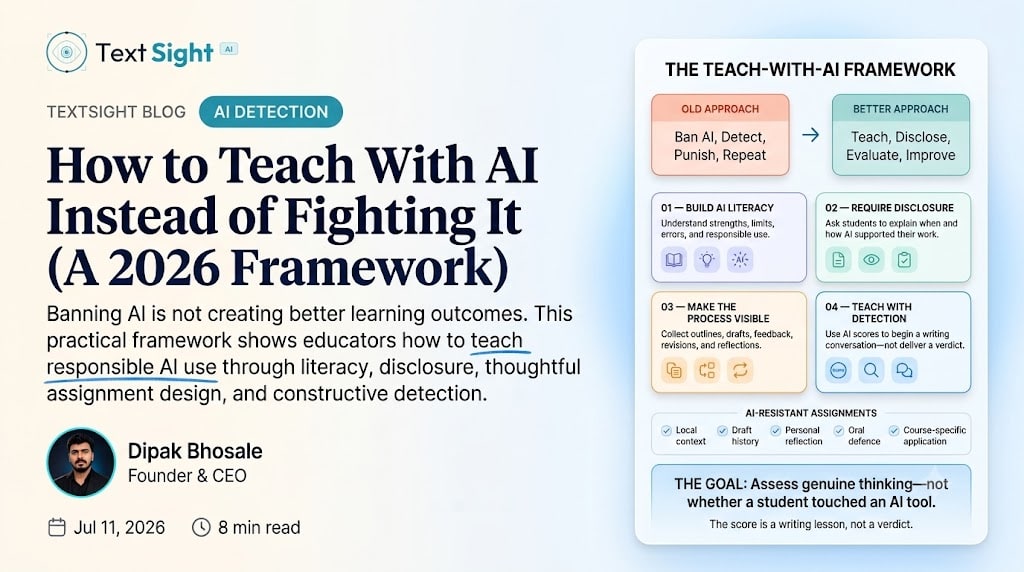
The ban isn't working. You know it. Your students definitely know it.
For the past three years, schools and universities have cycled through the same playbook: announce an AI policy, detect violations, punish students, update the policy, repeat. Meanwhile, AI models have gotten better, students have gotten better at using them, and the gap between "what we can detect" and "what students are actually doing" has never been wider.
There's a better approach. It requires changing what you're trying to accomplish in the first place.
The Arms Race Nobody Wins
Let's be direct about what "ban AI" has produced.
Detection tools are flagging students who didn't use AI. Non-native English speakers are getting hit hardest — their writing patterns sometimes look more uniform than native speakers', not because they used ChatGPT, but because they learned English in structured, formal contexts. That's not a bug in the detection system. It's a feature of how these tools work. And it's producing false accusations at scale.
At the same time, students who are using AI have learned to work around detection. Run through a humanizer, change a few phrases, resubmit. The tools flag less obvious outputs less reliably. So the students being caught are disproportionately the ones who made minor use of AI with less sophisticated technique, while heavier users with more practice slip through.
That's a terrible outcome by any measure.
The arms race framing treats AI use as the enemy. But AI isn't going away, and students who graduate without knowing how to use it — critically, ethically, with judgment — are going to be at a disadvantage in every workplace they enter. Treating AI competency as something to be suppressed doesn't serve students. It just protects a familiar grading structure.
What Forward-Thinking Educators Are Doing Instead
1. AI Literacy as a Required Skill
The most progressive educators in 2026 have stopped asking "did they use AI" and started asking "do they understand what they produced?"
AI literacy means students can answer: What does this tool do well? What does it get wrong? How do I evaluate its output? When is using it appropriate and when isn't it? What does it sound like, and how does my writing differ from it?
This is genuinely valuable knowledge. Understanding that ChatGPT writes at a certain register, favors certain transitions, and produces consistently structured paragraphs is useful information for a writer. It teaches you something about what makes your own writing distinct.
One practical approach: have students run their own work through a tool like TextSight and explain what the score means. What's the Humanization Score? Which phrases got flagged? Why might the AI Vocabulary Highlighter tag "it's worth noting" or "in today's world"? Suddenly the tool isn't surveillance — it's a writing lesson.
2. Disclosure-Based Policies
Some institutions have moved from prohibition to disclosure. The policy isn't "no AI" — it's "tell us how you used it and reflect on that use."
This has several advantages. It creates a paper trail that's more honest than hoping detection works. It encourages students to think critically about their use rather than just trying to hide it. It produces actually interesting assignments — "describe how you used AI assistance in this paper and evaluate the quality of what it produced" requires more critical thinking than the paper itself sometimes does.
It also treats students as adults making judgments rather than suspects being surveilled. That shift in relationship matters.
3. Assignment Design That Makes AI Assistance Visible
Some assignments are naturally AI-resistant. Not because they're impossible to complete with AI help, but because AI assistance leaves visible evidence when the assignment requires something AI can't provide.
Process documentation is the clearest example. If students submit their outline, their rough draft, their revision notes, and their final paper, you can see how their thinking developed. AI doesn't produce that development trace. A student who genuinely worked through the writing process has artifacts. A student who prompted ChatGPT and polished the output has a polished output and not much else.
Personal reflection assignments require specific lived experience. "Describe a time you changed your mind about something important" can't be answered generically without it showing. AI can produce a plausible-sounding answer, but it doesn't have your students' actual experiences to draw from. The specificity — or lack of it — is informative.
In-class writing removes the AI option entirely for that piece. It also gives you a comparison point for out-of-class work. If someone writes at a Grade 7 level in class and submits a Grade 12 paper at home, that's worth a conversation.
Oral defenses — even informal ones — require students to talk through their work. Students who genuinely engaged with an argument can discuss it. Students who submitted text they don't fully understand can't. A five-minute "explain your thesis and your main counter-argument" conversation is more diagnostic than any detection tool.
4. Using Detection as a Teaching Tool, Not Surveillance
This is the frame shift that matters most.
AI detection tools exist. Your students know they exist. You can use that fact punitively, or you can use it educationally.
The educational use: have students check their own work before submission. Make it part of the assignment. "Submit your final draft along with your TextSight Humanization Score and a paragraph explaining what it means."
This accomplishes several things at once. Students who used AI heavily and haven't edited it will see a low score and have to deal with it themselves before submitting. Students who wrote their own work will see a high score and gain confidence. Students in the middle will learn what AI-sounding writing looks like and start editing differently.
The score becomes a writing lesson, not a verdict.
Assignment Types That Are Naturally AI-Resistant
Not every assignment can be redesigned overnight. But when you have design flexibility, these formats work:
Local specificity. Assignments that require knowledge of a specific context — your campus, your city, your classroom discussion, a specific in-class experiment — are harder to outsource. AI doesn't know what happened in your seminar on Tuesday.
Iterative drafting with feedback response. Require students to submit a draft, receive feedback, and write a reflection on how they incorporated it. The feedback response is personal. It requires the student to have actually read your comments and thought about them.
Contemporary events with recency requirements. Assignments that require engagement with events from the past two to four weeks are harder to complete with AI assistance, since models have knowledge cutoffs and won't have current information.
Discipline-specific application. "Apply this theory to this specific case study we've discussed in class" requires course knowledge that AI doesn't have unless the student provides it. The quality of application is diagnostic.
Comparative personal analysis. "Compare your initial view from Week 1 to your current position" requires course-specific intellectual development. There's no generic answer.
How to Have the AI Conversation With Students Honestly
Here's the version of this talk that actually works.
Don't lead with prohibition. Lead with context. Something like: "AI tools are part of how work gets done now. You're going to use them in your careers. My job is to make sure you're actually developing the skills this course is supposed to teach — and that means some of our work needs to be yours, specifically."
Then be explicit about what you're trying to assess. If the point of a paper is to develop your argumentation skills, AI assistance that produces the argument defeats the purpose — not because AI is forbidden, but because the student hasn't practiced what the assignment is designed to practice.
Students respond to this framing better than "because the rules say so." It treats them as people who can understand a reason, not subjects being governed by a policy.
Be honest about what you can and can't detect. Students know you're not omniscient. Pretending otherwise undermines your credibility. "I use detection tools and they're imperfect, and my goal isn't to catch everyone — it's to create conditions where your genuine work is both expected and valued" is a more honest and more effective position.
Why Understanding AI Writing Is Actually Valuable for Students
Here's the counterintuitive part: the students who understand what AI writing looks like become better writers.
When you know that AI overuses transition phrases, you start editing your own transitions more critically. When you know that AI produces suspiciously consistent sentence complexity, you start varying your own paragraph rhythm more deliberately. When you understand that AI vocabulary tends toward formal, generic phrasing, you start choosing more specific language.
TextSight's AI Vocabulary Highlighter isn't just a way to edit out AI-sounding phrases. It's a map of what generic, safe, mechanical writing looks like. Knowing what the AI Vocabulary does — and avoiding it — produces better writing.
That's worth teaching explicitly. Show students what the tool flags. Discuss why those phrases are characteristic of AI output. Then ask: what's the human alternative? What would you say if you were talking to someone instead of writing for a rubric?
The best writing comes from people who know what bad writing looks like. AI writing is an extremely consistent form of competent-but-bad writing. Understanding it is a legitimate part of writing education in 2026.
The Practical Framework
For educators who want a concrete starting point:
Week 1 of any writing-intensive course: Have students paste a paragraph into TextSight and look at the Humanization Score. Don't use their actual work — use a sample paragraph. Discuss what the score means and what the AI Vocabulary Highlighter flags.
For major assignments: Design at least one component that can't be completed without specific course engagement — a reflection on class discussion, an application to a specific case, a response to your feedback.
For your AI policy: Write it around intent and disclosure, not blanket prohibition. "Use AI to draft, not to replace your thinking" is more honest than "no AI" and more enforceable in meaningful ways.
For suspected violations: Run the document through multiple detection tools. Note disagreements. Use the score as a starting point for a conversation, not as evidence of guilt. Ask the student to explain their argument, walk through their process, discuss what sources they found interesting. The conversation is more diagnostic than the score.
Final Thought
The educators who navigate this well aren't the ones with the toughest AI policies. They're the ones who've thought clearly about what they're actually trying to teach and designed their assessments to require it.
AI can't replace a student's genuine curiosity about a topic. It can't produce the specific insight that comes from actually engaging with a text. It can't generate the intellectual development that happens over a semester of genuine work.
Build assessments that require those things and you don't need a perfect detection system. You need a clear idea of what genuine learning looks like — and assignments that demand it.
Related reading:
- Can Turnitin Detect ChatGPT in 2026?
- My Essay Was Flagged as AI But I Wrote It
- How to Avoid AI Detection as a Student in 2026
- An Honest Review of the AI Detector Market in 2026
Try it on your own writing