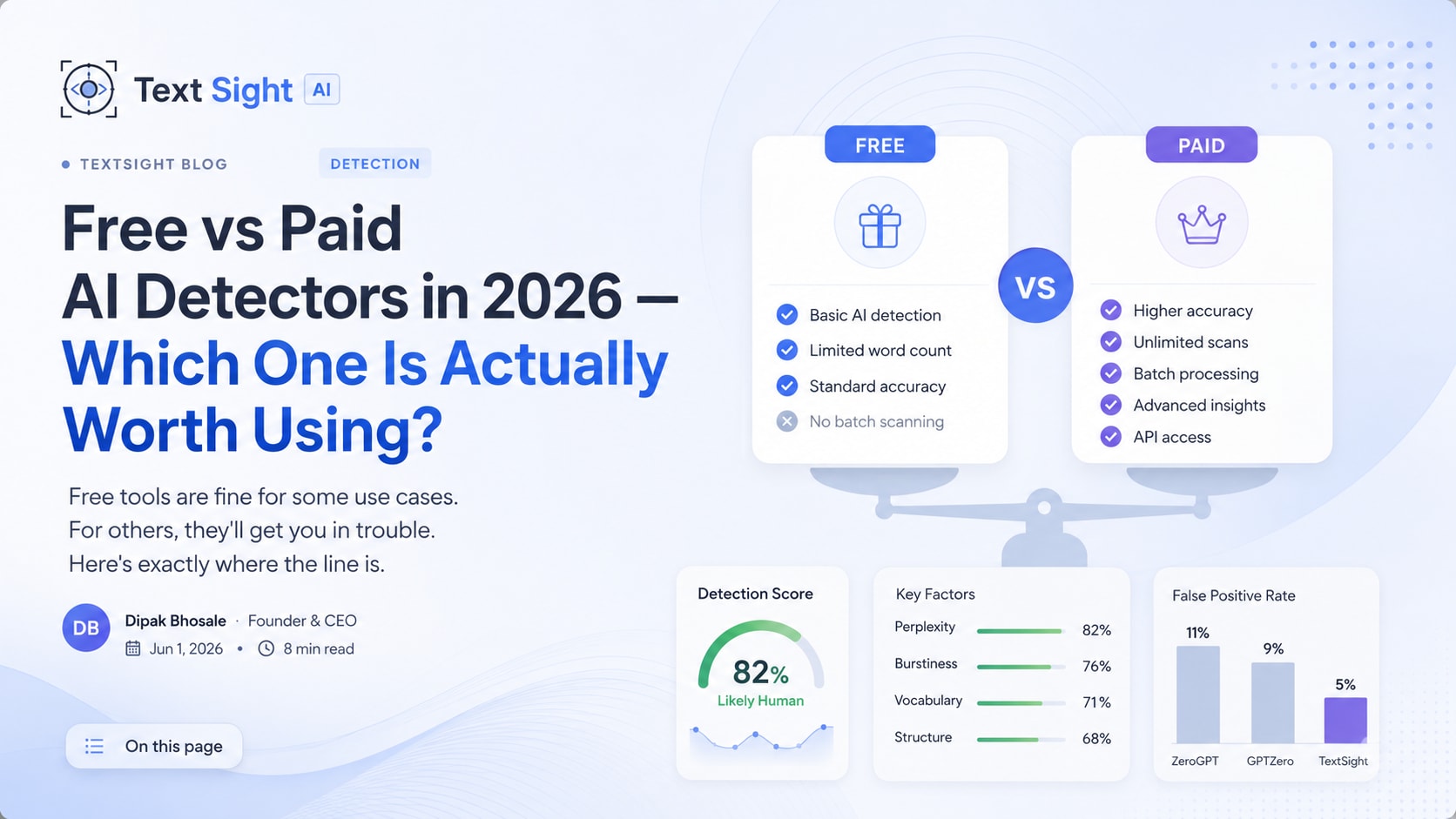
The honest answer: it depends entirely on what you're using it for.
That's not a cop-out — it's genuinely the right framing. A student checking their own writing before submission has completely different needs from an HR manager screening 400 job applications for AI-generated cover letters. Free tools can handle one of those situations reasonably well. They're a bad fit for the other.
This post breaks down what free tools actually give you, where the paid upgrade earns its keep, and what the real cost of a wrong call from a cheap detector looks like.
What You Get From Free AI Detectors
Let's be fair to the free tier first. There's a lot of solid functionality available at zero cost right now, and dismissing it entirely is wrong.
ZeroGPT (Free)
ZeroGPT's free plan gives you unlimited scans with no account required. That's genuinely useful. You can paste any amount of text and get a detection result immediately.
The tradeoffs are real, though. ZeroGPT has the highest false positive rate in this comparison — roughly 11% on human text in independent tests. On formal academic writing, that climbs to around 14%. And its GPT-5 detection rate is about 68%, which means nearly 1 in 3 AI-written documents gets through undetected. Unlimited scans with 68% accuracy is fine for casual checking. It's not adequate for anything with real consequences.
GPTZero (Free Tier)
GPTZero's free tier caps you at 5,000 words per month — enough for one medium-length essay, or a few short pieces. If you're a student checking your own work occasionally, that limit might be enough. If you're a teacher reviewing a class of 25 students, you'll hit the wall fast.
GPTZero's detection accuracy is better than ZeroGPT — roughly 76% on GPT-5 in 2026 — and its false positive rate of 9% is lower. It also gives you some sentence-level highlighting on the free tier, which is more useful than a simple verdict.
The model has held up reasonably well against GPT-4o. It struggles more with GPT-5 and Claude 3.7, which were specifically designed to produce less detectable output.
TextSight (Free Tier)
TextSight's free tier works differently from the others. You get 3 scans per day with no signup required. Each scan gives you a full Humanization Score (0–100) and access to the AI Vocabulary Highlighter, which flags specific phrases pulling your score down.
3 scans a day is enough for most students' daily needs — check a draft, fix it, check again, compare versions. It's not enough for bulk institutional use.
The key difference from ZeroGPT and GPTZero free tiers is the score model rather than a binary verdict. That matters when the text is in the grey zone, which is most real-world text.
What Paid Plans Actually Add
Paid AI detection tools aren't just free tools with the limit removed. The better ones offer genuinely different capabilities.
Higher word limits and batch processing
The most obvious upgrade. GPTZero's paid tier removes the monthly word cap and adds API access. Originality.ai charges by usage ($0.01 per 100 words) with no subscription option, which is economical for occasional heavy use but expensive for daily high-volume use. TextSight's Starter tier is $9.99/month, or $7.49 a month billed annually, and covers 20 scans a day at up to 45,000 characters each, with no per-word fees. Unlimited scanning starts at Pro, $19.99/month or $14.99 billed annually.
For anyone checking more than 10 documents a week, unlimited scanning changes the workflow. You stop treating each scan as a budget item and start using it as a routine step.
Accuracy improvements (sometimes)
This one's nuanced. Paid plans often include access to newer model versions that handle GPT-5 and the latest Claude models better than older detection engines. The gap matters: GPTZero's paid tier detects GPT-5 at roughly 80% versus 76% on the free tier, according to their own benchmarks.
That 4-percentage-point gap is real but not dramatic. If a 76% detection rate is adequate for your use case, the free tier handles it.
Better false positive handling
This is where paid tools genuinely earn their keep for institutional use. Some paid plans include confidence scoring, sentence-level attribution, and flagged-phrase context that helps distinguish borderline human writing from lightly edited AI. ZeroGPT's free tier gives you a verdict. Its premium tier gives you more of the reasoning.
TextSight's AI Vocabulary Highlighter is included in the free tier, which is unusual — most tools lock this level of detail behind a paywall.
API access and integrations
For organizations running AI detection at scale — LMS integrations, applicant tracking systems, content publishing workflows — API access is essential. None of the free tiers provide this at any real volume. Copyleaks and Originality.ai are the most common choices here, both at enterprise pricing.
The Feature Comparison Table
| Tool | Plan | Cost | Word Limit | Detection Rate (GPT-5) | False Positive Rate | Score vs Verdict | Highlights Phrases |
|---|---|---|---|---|---|---|---|
| ZeroGPT | Free | $0 | Unlimited | ~68% | ~11% | Verdict | No |
| GPTZero | Free | $0 | 5,000 words/month | ~76% | ~9% | Verdict + some detail | Limited |
| GPTZero | Paid | From $10/mo | Unlimited | ~80% | ~8% | Verdict + detail | Yes |
| TextSight | Free | $0 | 20,000 chars/mo | Score-based | Lower risk | Score (0–100) | Yes |
| TextSight | Paid | $9.99/mo ($7.49 annual) | 100,000 chars/mo | Score-based | Lower risk | Score (0–100) | Yes |
| Originality.ai | Paid | $0.01/100 words | Pay-per-use | ~81% | ~6% | Verdict | Limited |
| Copyleaks | Paid | Enterprise | Unlimited | ~79% | ~5% | Verdict | Limited |
When Free Is Enough
For the following situations, free tools handle the job adequately:
Students checking their own work. You're not making a consequential decision about someone else's document. You're checking whether your writing might get flagged, and if it is, getting guidance on what to fix. TextSight's free 5-scans-a-day tier is specifically designed for this. It's enough for a daily revision loop.
Casual content creators. Blog posts, social content, newsletter drafts — if you want a quick gut-check on whether a piece reads as too AI-heavy, free tools are fine. The stakes of a 68% detection rate on casual content are low.
One-off professional use. Writing a cover letter and want to make sure it doesn't read as AI-generated? A free scan is sufficient for that.
Testing and comparison. Trying to understand what detectors are flagging in your writing style? Run a few free scans across different tools, see how they disagree, and learn what triggers them.
When You Should Pay
Teachers reviewing student submissions regularly. If you're running more than 20–30 document checks a week, the monthly word limits on free tiers will constantly interrupt your workflow. More importantly, if you're making decisions with real academic consequences — grade impacts, honor code referrals — you need a tool with lower false positive rates and more detailed output. Pay for it.
HR and recruitment screening. I'd go further here: I don't think you should use AI detection tools for recruitment decisions without a paid plan that includes confidence scoring and phrase-level detail. An 11% false positive rate from ZeroGPT applied to job applications will unfairly screen out human candidates. That's a liability, not just an inconvenience.
Content agencies and SEO teams. If AI detection is part of your content QA process, you need volume. Starter at $9.99/month, or $7.49 billed annually, is low enough that this isn't really a cost discussion — it's a workflow discussion.
Anyone using AI detection in a policy-enforcement context. Schools, publishers, platforms with AI content policies. In these cases, the cost of a false positive (accusing a human writer) or a false negative (missing AI content that violates policy) can be significant. Pay for the better tools, use multiple of them, and document your process.
The Real Cost of Getting It Wrong
Here's the thing most people don't think about clearly: the cost of a wrong call from a free detector isn't zero.
A false positive — flagging a human-written document as AI — costs you in proportion to the stakes of the decision. For a student, it might mean an honor code meeting starting from a position of assumed guilt. For a job applicant, it might mean a rejection from a company that would have hired them. For a freelance writer, it might mean losing a client who now thinks they've been delivering AI content.
A false negative — missing AI content — has costs too. Professors who trust ZeroGPT's free tier at 68% accuracy are accepting that roughly 1 in 3 AI documents gets through. For an honors-code policy, that's a real gap.
These aren't reasons to avoid free tools entirely. They're reasons to match the tool to the stakes. Low-stakes daily use: free is fine. Consequential decisions about other people's work: pay for accuracy and document your methodology.
The Pricing Reality
Let's be direct about costs for a moment.
Originality.ai at $0.01 per 100 words sounds cheap. But if you're checking 50 student essays averaging 1,000 words each, that's $5 per batch — $50 for a 10-week course. A classroom subscription to GPTZero's educator plan runs $10–15/month. TextSight Starter, at $9.99/month or $7.49 billed annually, allows 20 checks a day; a teacher clearing a full class in one sitting wants Pro's unlimited scanning instead.
For individual users — students, freelancers, solo content creators — $7.49 a month billed annually is less than a coffee. The question isn't whether it's affordable. The question is whether your use case justifies a paid account over free, which for most individual users it probably doesn't.
The free tier covers most students' daily needs without paying anything. → textsight.ai
My Honest Recommendation
Use ZeroGPT free if you need quick, unlimited checks and don't care much about false positive rates. It's fine for casual use.
Use GPTZero free if you need something more accurate for occasional personal use and you can work within the 5,000 word/month limit.
Use TextSight free if you're a student or writer who wants a score rather than a verdict, needs phrase-level feedback, and checks your own work several times per day. The free tier fits this exact use case: 3 checks a day with no account at all, and a free account raises each scan to 13,500 characters, about 1,500 words, with no monthly cap.
Pay for TextSight Starter ($9.99/month, or $7.49 billed annually) if you're checking documents regularly, and step up to Pro ($19.99/month, or $14.99 billed annually) if you want unlimited scans without thinking about it.
Pay for Originality.ai or Copyleaks if you need institutional-grade detection with API access and enterprise reporting.
The free tools aren't bad. They're just optimized for a narrower set of use cases than most people assume.
TextSight's free tier covers most students' daily needs → textsight.ai
Related reading:
- AI Detection Accuracy in 2026 — The Honest Comparison
- GPTZero vs Turnitin vs TextSight
- The Humanization Score: What 0–100 Actually Means
Try it on your own writing