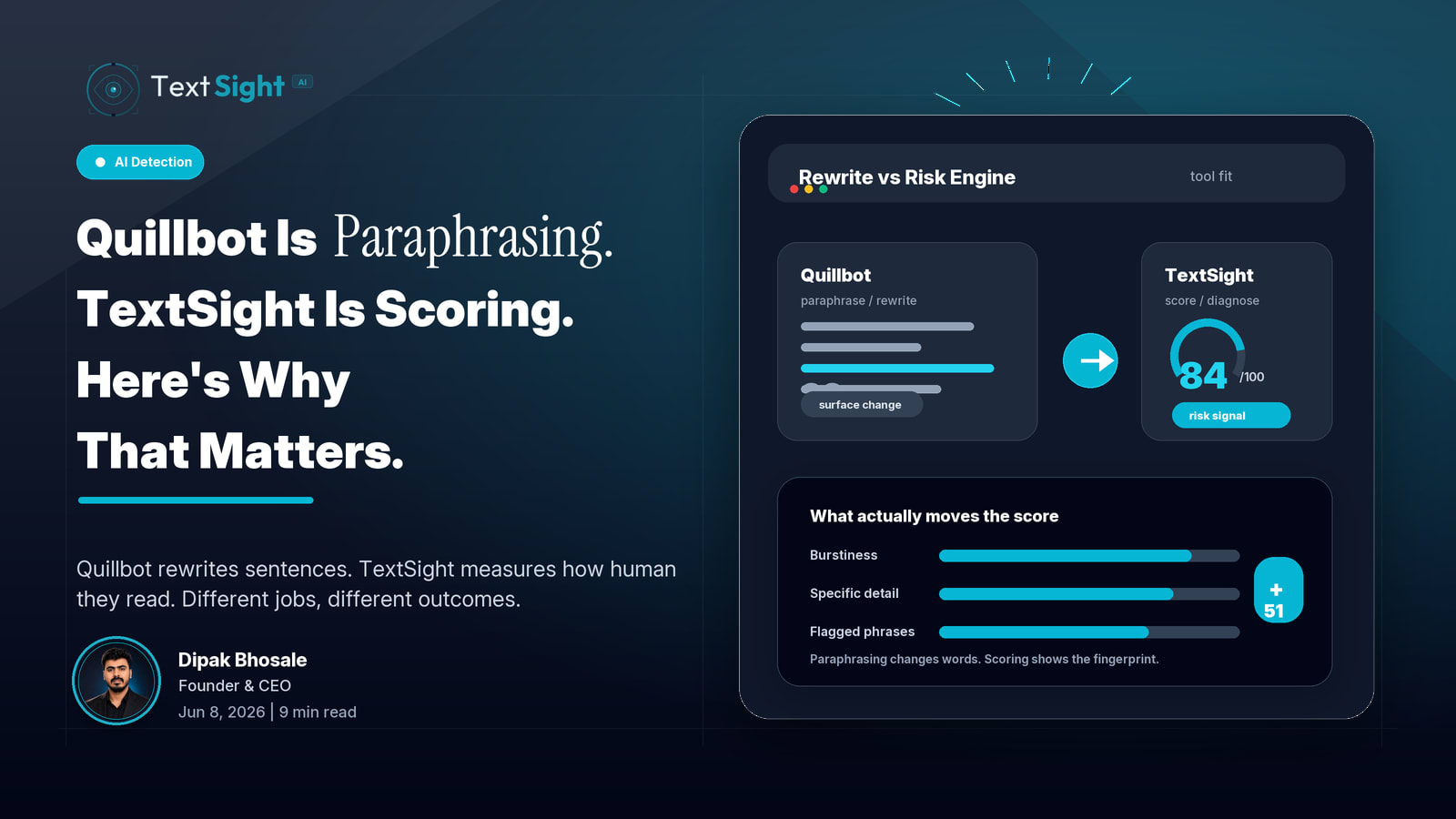
There's a workflow I see constantly in student forums: paste AI text into Quillbot, run it through the paraphraser, then submit and hope for the best.
It usually doesn't work. And the reason why tells you something important about how AI detection actually functions — and what these two tools are actually built to do.
Let me be direct upfront: this isn't a "Quillbot is bad" post. Quillbot is good at its job. The problem is that its job isn't the same as passing AI detection. A lot of people think it is. They're wrong, and it costs them.
What Quillbot Is Actually Doing
Quillbot is a paraphrasing engine. Its core job is synonym substitution and sentence restructuring.
Feed it "The government implemented new policies to address the economic crisis," and it might return "The administration introduced fresh measures to tackle the financial downturn." The meaning is the same. The words are different. That's paraphrasing.
This is genuinely useful for several things: reducing repetitive phrasing in a draft, simplifying overly complex sentences, hitting a word count, or restructuring awkward constructions. Quillbot's Fluency and Standard modes are decent tools for writers who want to clean up prose.
What Quillbot is not doing is changing the statistical fingerprint of the text. It's shuffling words around, not changing the underlying patterns that make AI text look like AI text.
Here's why that matters.
What AI Detectors Are Actually Measuring
AI detectors don't check whether the words match known AI outputs. They measure statistical properties of the text itself — primarily perplexity (how predictable the word choices are) and burstiness (how much sentence length varies).
Quillbot's paraphrasing doesn't meaningfully change either of these.
When GPT-4o writes a sentence, it chooses the most statistically probable next token at each step. The result is smooth, predictable prose with low perplexity. When Quillbot paraphrases that sentence, it substitutes synonyms — but synonyms, in context, tend to have similarly high probability. "Economic crisis" and "financial downturn" are both high-probability phrases in formal writing. Swapping one for the other doesn't introduce the kind of statistical surprise that raises perplexity scores.
Sentence structure gets slightly rearranged, yes. But Quillbot's restructuring tends to maintain the same sentence length ranges and the same smooth rhythm. The burstiness score barely moves.
I ran a direct test. A 400-word GPT-4o essay excerpt scored 29/100 on TextSight. I ran it through Quillbot's Standard mode. The result scored 33/100. Four points. Essentially noise.
Running it through Quillbot's Creative mode (the most aggressive setting) got to 41/100 — just into the grey zone. But the text had also become noticeably more awkward, with several phrases that didn't quite make sense. You'd gained a few points at the cost of coherence.
That's Quillbot's ceiling when used this way. It's not designed for this problem.
The Comparison Table
Here's how the two tools stack up across every dimension that matters:
| Feature | Quillbot | TextSight |
|---|---|---|
| Primary function | Paraphrase / rewrite text | Score how human text reads (0–100) |
| Changes your text | Yes | No |
| Identifies problem phrases | No | Yes (AI Vocabulary Highlighter) |
| Measures perplexity | No | Yes |
| Measures burstiness | No | Yes |
| Output | Rewritten text | Humanization Score + flagged phrases |
| Detects which AI model wrote it | No | Partial (GPT-4o, Claude, Gemini, GPT-5) |
| Free tier | Yes, limited | Yes, 3 scans/day no signup |
| Paid price | ~$8.33/month | $9.99/month ($7.49 billed annually) |
| Use case fit | Editing clarity, reducing repetition | Pre-submission risk check |
These tools aren't competing. They're addressing different problems in the same general space. Using only Quillbot without checking your score is like editing for grammar without checking whether the argument makes sense.
Why Synonym Substitution Doesn't Raise Perplexity
This is worth a short technical explanation, because once you get it, the Quillbot-for-detection strategy becomes obviously flawed.
Language models were trained on enormous amounts of human text. In that training data, the word "financial" appears near "crisis" many thousands of times. So does "economic." So does "downturn." All of these words have high conditional probability in that context. Swapping one for another doesn't change the fact that the phrase is statistically predictable.
What would raise perplexity? Using a word or phrase that almost never appears in that context. Writing "the fiscal catastrophe" instead of "the economic crisis." Or breaking the formal register entirely: "the whole system started coming apart." Or adding a specific, unexpected detail that forces the model to process something it couldn't predict: "the crisis that started, weirdly, with a grain futures dispute in August."
Quillbot can't generate that kind of specificity. It can only rearrange what's already there. That's a fundamental limitation of paraphrasing as a detection-evasion strategy.
What Actually Moves the Needle on Detection Scores
If paraphrasing doesn't help much, what does? Three things, consistently:
1. Sentence length variation (burstiness). This is the highest-leverage change most people can make. If you look at your text and every sentence is 15–25 words, you've got a burstiness problem. Deliberately write some sentences of 5 words or fewer. Then write one that runs to 50 words with multiple clauses. Mix them up. The statistical signal shifts almost immediately.
2. Personal, specific details. AI writes in generalities because it has no personal experience. "Many students struggle with deadlines" is an AI sentence. "I turned in my 4,000-word thesis at 11:58 PM after a printer broke at the library" is a human sentence. Specificity raises perplexity because it's unpredictable. Quillbot doesn't add specificity — it just restates what's already there.
3. Vocabulary replacement (the right kind). This is where TextSight's Vocabulary Highlighter is useful. It doesn't just flag "AI words" generically — it identifies the specific phrases in your text that are pulling your score down, which is different for every passage. Once you know which phrases are the problem, you can replace them with something more idiomatic, more specific, or more surprising. That's a targeted fix, not a blanket paraphrase.
How to Use Both Tools Correctly
Here's the workflow that actually works:
Step 1: Draft with AI (if you're using it). Doesn't matter which model. Get your ideas and structure out.
Step 2: Run TextSight first. Before doing anything else, check your score and see which phrases are flagged. This gives you a diagnostic — a map of exactly where the AI fingerprint is concentrated.
Step 3: Fix flagged phrases manually. Don't use Quillbot for this. Open a text editor and rewrite the highlighted phrases yourself. Replace the formal AI vocabulary with your own phrasing. Add a personal detail or specific example where the text is most generic.
Step 4: Use Quillbot for clarity, not detection. After you've manually addressed the flagged phrases, Quillbot is useful for cleaning up any awkward constructions you introduced during editing. It's a finishing tool, not a detection-bypass tool.
Step 5: Re-run TextSight. Check your score again. If you're below 75, you still have work to do. If you're above 75, you're passing most commercial detectors. Above 85, you're in very solid territory.
This workflow treats each tool as what it actually is. Quillbot is a writing aid. TextSight is a diagnostic instrument. They work well together when used in sequence for their actual purposes.
The Deeper Issue With the "Just Paraphrase It" Strategy
Beyond the technical limitations, there's a more fundamental problem with using Quillbot as an AI-detection fix: it doesn't change the fact that the core ideas and structure came from AI.
I'm not making a moral argument here. I'm making a practical one. If your essay's ideas are AI-generated, paraphrasing the sentences doesn't make the argument more yours. The reasoning is still generic. The examples are still bland. The position-taking is still absent. A professor who reads carefully will notice — not because the sentences look machine-written, but because the thinking feels hollow.
The students who genuinely succeed at this are the ones who use AI as a starting point and then actually engage with the material. They add their own examples. They push back on points they disagree with. They restructure the argument based on what they actually think. By the time they submit, the AI contribution is more like scaffolding than structure.
TextSight catches the surface fingerprint. Engaged professors catch the deeper one. Quillbot fixes neither.
One More Thing About Quillbot's Detection Claims
Quillbot recently added its own "AI Content Detector" to its platform. It's worth being clear about what that is: it's a separate feature that checks whether text reads as AI, added to compete with standalone detectors. It's not related to the paraphraser, and using the paraphraser doesn't improve your score on the detector.
Some users assume that Quillbot's paraphrased output, run through Quillbot's own detector, will score well — because why would Quillbot flag its own paraphrased text? That's not how it works. The detector measures statistical properties of the text, not its origin. A Quillbot paraphrase of AI text will typically score poorly on Quillbot's own detector too.
Use the right tool for the right job. Quillbot for readability. TextSight for risk assessment. They're both good at what they do.
When Paraphrasing Actually Helps (And When It Hurts)
Let me give Quillbot a fair shake here, because there are contexts where paraphrasing genuinely helps your detection score — and contexts where it actively makes things worse.
When paraphrasing helps: If your original AI text contains very long, complex sentences with multiple nested clauses, Quillbot's simplification can accidentally increase burstiness by breaking them into shorter units. This is a secondary effect, not the tool's intent — but it occasionally produces a modest score bump. Similarly, if AI text has a very dense cluster of formal vocabulary in one section, Quillbot's synonym substitution sometimes breaks that cluster up, which the Vocabulary Highlighter reads as slightly less fingerprinted.
These are marginal effects. We're talking 3–5 points, not 15–20. And they're unpredictable — you can't rely on them.
When paraphrasing actively hurts: Quillbot's Creative mode, in particular, can damage coherence in ways that are worse than the original AI text. I've seen passages that scored 29/100 before Quillbot processing and 24/100 after — because the paraphraser introduced syntactically awkward constructions and unusual word combinations that lowered coherence scores without raising perplexity in the right way. Incoherence and high perplexity are different things, and detectors can distinguish them.
There's also a specific failure mode with technical writing. If your AI text contains domain-specific terms — scientific, legal, or medical vocabulary — Quillbot sometimes replaces them with synonyms that are technically wrong or subtly off. The result is text that's both less accurate and doesn't score better. You've broken your essay's credibility without improving your detection risk.
The Misunderstanding That Starts Everything
Here's where the confusion originates: people conflate "AI detection" with "AI fingerprinting," as if detectors are checking whether specific words match an AI's known outputs.
They're not. Detectors are measuring statistical properties. Which means the question isn't "did AI write this word?" — it's "does this passage have the probability distribution of human or machine text?" Those are completely different questions.
Paraphrasing addresses the first question. Changing individual words. It does almost nothing to answer the second question — the distribution question — which is what actually determines your score.
This is also why some people are frustrated that "I rewrote everything" didn't help. They rewrote the surface. They didn't change the statistical shape. A house with new wallpaper has the same floor plan. The structure is still AI.
What changes the structure is changes in rhythm, specificity, and vocabulary distribution patterns — not synonym swapping. Those deeper changes require human judgment. A paraphrasing tool can't supply them.
Practical Verdict
Use Quillbot when you want cleaner prose. It's genuinely good at that. Fluency mode does a solid job of smoothing awkward constructions without substantially changing your meaning.
Use TextSight when you want to know your detection risk. Run it before submission. Use the Vocabulary Highlighter to find the specific phrases creating the AI fingerprint in your specific text. Then fix those phrases yourself.
Then — if you want — use Quillbot to clean up any awkwardness your manual fixes introduced.
That sequence works. The reverse doesn't.
And if you're currently sitting on an essay that scored 30/100 and wondering whether another Quillbot pass will fix it: it won't. Open TextSight, find the five biggest problem phrases, and rewrite them yourself. That's 20 minutes of real work that will do what three Quillbot passes couldn't.
Check your score at textsight.ai — 3 free scans a day, no account needed.
Related reading:
- What Is AI Content Detection?
- How to Humanize ChatGPT Text
- How to Avoid AI Detection as a Student
- My Essay Was Flagged as AI But I Wrote It
Try it on your own writing