There's a moment many teachers describe the same way. They pick up a paper, read the first paragraph, and know. Not suspected — know. Before they've run it through any tool, before they've even finished the introduction. Something is off.
That instinct isn't magic. It's pattern recognition built from years of reading student writing — work that varies, struggles, has a voice, makes mistakes in recognizable ways. AI-generated text looks right on the surface. But it doesn't feel right to someone who's spent a decade reading how a 19-year-old actually writes.
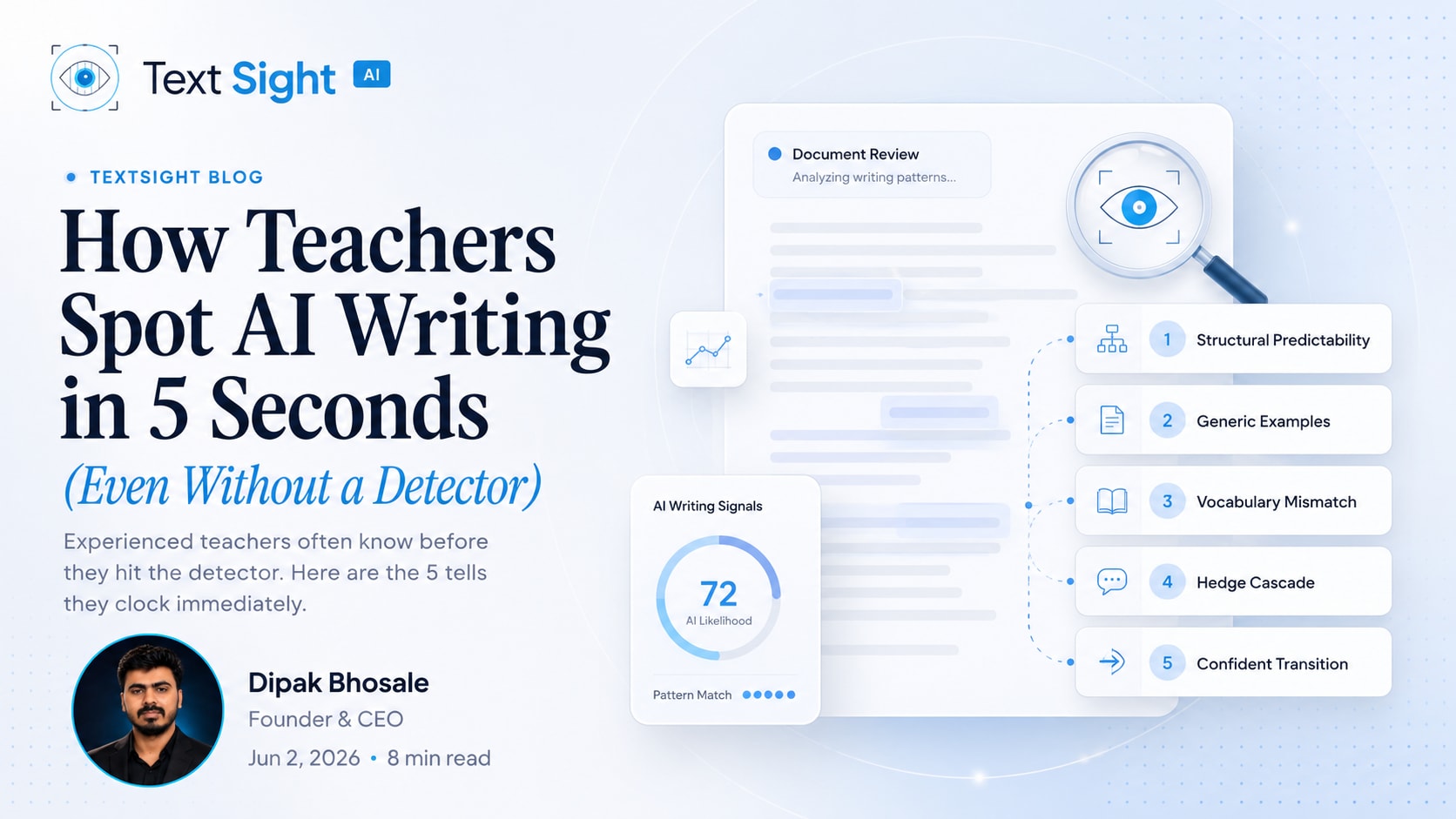
Here are the 5 tells that experienced teachers spot almost immediately — and what students can do so these signals don't appear in their work.
Tell 1: Structural Predictability
The fastest tell of all. AI essays have a predictable shape that's almost geometrically regular. Introduction that ends with a thesis. Three body paragraphs, each opening with a topic sentence, containing evidence, closing with a restatement. Conclusion that opens by restating the thesis and ends with a "bigger picture" observation.
This structure isn't wrong. Teachers literally teach it. But human students who've internalized this structure still deviate from it — they'll have a short second body paragraph because they ran out of ideas on that point, or their conclusion will trail off, or their introduction will open with a story from class. The imperfections are patterned in recognizable ways.
AI essays are structurally perfect. Every paragraph follows the template. Every transition word lands in the right place. It reads like someone who understood the assignment intellectually but has never felt the friction of actually trying to write an essay.
What this looks like in practice: A teacher opens an essay and sees five paragraphs of exactly equal visual weight, perfectly parallel structure, zero structural risk-taking. The essay has the shape of an essay but not the feel of one. That registers in about 4 seconds.
What students can do: Vary your structure intentionally. Start a paragraph with a question instead of a topic sentence. Let one paragraph run long because you had more to say. Write a conclusion that's a genuine response to your own essay, not a summary of it.
Tell 2: Generic Examples
Human writers use specific examples drawn from their actual experience, the news they've read, or the course material they've actually studied. AI generates plausible generic examples that fit the pattern of what an example should be, without being drawn from anything real.
Here's what I mean. In a paper about leadership, a student who did the reading might reference Jeff Bezos's 6-page memo culture or a specific case study from the course. An AI might write: "For example, a company that wants to improve employee morale might consider implementing a mentorship program."
That sentence is grammatically correct. It's logically relevant. And it says nothing. No company, no name, no detail, no tension. It's the textual equivalent of a stock photo — it fills the space where a real example should be.
Teachers who've read 80 essays on leadership in one semester have developed a sharp sensor for this. Real examples are specific, often imperfect, sometimes tangentially relevant in a way that reveals the student made an actual connection. AI examples are always perfectly relevant and completely empty.
What students can do: Every example in your essay should be something you could point to in the real world. "A company" should be a named company. "A study" should be an actual study with a date and a finding. "Many experts agree" should be two named experts who disagree slightly on the specifics.
Tell 3: The Vocabulary Mismatch
This one's subtle and worth understanding. AI-generated text has a vocabulary profile that's too consistent. It stays in a specific register — formal enough to seem academic, accessible enough to seem readable — without the natural variation that comes from how humans actually think.
Human student writing has vocabulary mismatches. A student who's genuinely engaged with a topic will use a specialist term they just learned, and it'll sit next to a casual phrase they'd use in conversation. A student writing about economics might write "price elasticity" in one sentence and "people just stop buying stuff" in the next. That inconsistency reveals a mind working something out.
AI text is consistently mid-formal. It rarely uses slang. It rarely uses highly technical terms unless asked. Everything sits at the same register for the entire essay. And then occasionally — especially with older models — it'll use a word like "delve" or "pivotal" that reads right but feels slightly off, like a word that nobody under 50 uses in casual conversation.
Experienced teachers feel this mismatch immediately. It's not the vocabulary level that's wrong. It's the absence of the natural register variation that human thinking produces.
What students can do: Don't perform vocabulary. Write in your actual voice first, then adjust for appropriateness. If you just learned a term in lecture, use it — and don't over-formalize the sentences around it.
Tell 4: The Hedge Cascade
AI models are trained to avoid making strong, potentially wrong claims. The result is a specific type of sentence construction that teachers call the hedge cascade: a statement that qualifies itself into near-meaninglessness by piling up modifiers.
Here's an example: "While social media may have some potential negative effects on certain aspects of youth mental health in some contexts, it's also possible that, for other groups, the impact might be more neutral or even positive in some cases."
That sentence is technically accurate. It's also completely uninformative. A human writer who thinks this way might write it, but they'd typically either commit to the argument or acknowledge their uncertainty more directly: "The research on social media and mental health is genuinely contradictory, and I don't think anyone has a clean answer yet."
The hedge cascade shows up most often in AI text when the model is trying to cover a topic it was trained to see as controversial. It knows what the different positions are. It doesn't want to be wrong. So it hedges everything simultaneously.
A human writer with the same uncertainty would handle it differently — they'd probably acknowledge the uncertainty directly, or pick a side and note the limitations.
What students can do: State your actual position. If you're uncertain, say so directly rather than piling up qualifiers. "The evidence is mixed here" is cleaner and more honest than a sentence with four "may be" constructions.
Tell 5: The Confident Transition
"Furthermore," "Moreover," "Additionally," "In conclusion" — these transitional words are almost exclusively used in AI-generated formal writing in 2026. Human writers use them occasionally, but AI uses them constantly and mechanically.
More specifically, AI uses smooth confident transitions to cover structural jumps that a human essay would handle differently. When a human essay moves from one point to the next, the transition often shows the logical connection: "This doesn't mean, though, that..." or "The other problem with this approach is..." AI transitions are confirmatory rather than connective — they say "here comes another point" rather than "here's why this point follows from the last one."
Teachers clock this within seconds of reading a transition-heavy paragraph. The "Furthermore" that begins a body paragraph is nearly a guaranteed tell in 2026.
What students can do: Kill most of your transitional openers. Start paragraphs with the argument, not the traffic signal. When you do need a transition, make it substantive: instead of "Furthermore," try "The bigger problem, though," or "What this also means:" or just a fragment that sets up what follows.
The Tells That Aren't in the Writing at All
All five tells above live in the prose. In practice the evidence that settles most cases sits outside it, and it is worth knowing in both directions: teachers rely on it, and students are usually surprised by how much of it exists.
Version history
If the assignment was written in Google Docs or Word online, the document records how it was built. File then Version history in Docs replays the whole composition. A paper written across five sittings looks nothing like one where 1,300 words appear in a single paste forty minutes before the deadline. This is the vector teachers find most persuasive, because it describes process rather than style, and style is exactly what a detector can be wrong about. It is still not proof on its own: people draft elsewhere and paste in, which is why the question that follows should be asked rather than assumed.
Citations that do not exist
Language models generate references that look correct and are not. Plausible author, plausible journal, plausible year, no such paper. Checking three citations takes a couple of minutes and either clears the submission or produces something far more concrete than a probability score. A fabricated source is also the one finding a student cannot really explain away.
Missing course context
A model does not know what happened in Tuesday's seminar. When a prompt asks students to connect a reading to class discussion and the answer engages with neither, that absence is information. It is also the cheapest defence available to anyone setting the assignment: prompts anchored to a specific session, dataset or local example are much harder to answer from a generic model.
Where the Turnitin AI score actually lives
If your institution uses Turnitin, the AI writing indicator sits inside the Similarity Report and is visible to instructors and administrators, not to students. That matters for both sides. Students cannot see the number that may be discussed with them, and teachers should know it is a separate reading from the similarity percentage next to it, measuring a different thing.
What Detectors Are Actually Measuring
Here's the important framing for both teachers and students: detectors aren't magic, either. They're measuring the same signals described above, but statistically rather than intuitively.
When an AI detector says "78% likely AI," it's essentially saying: "The structural patterns, vocabulary distribution, sentence length variance, and phrase frequency of this text are highly similar to AI-generated text in our training data." That's the same thing an experienced teacher is perceiving, expressed as a probability.
This also explains why false positives exist. Some human writers — particularly ESL students, writers who were taught a rigid five-paragraph essay structure, or people in highly formal professions — naturally produce text with AI-adjacent features. They write formally, they use structured paragraphs, they use transitions deliberately because they're thinking about the structure as they write. The statistics look like AI even though the person is human.
Teachers who know their students can distinguish these cases. A detector can't. That's why a low detector score should start a conversation, not end one.
Frequently Asked Questions
How do teachers check for AI?
Usually in this order: they read, they notice the submission does not match the student they know, and only then do they reach for a tool. After that it is the non-textual evidence above, version history, citations, whether the answer engages with the actual course. Detector scores tend to come in late and function as a prompt to look closer rather than as the finding itself.
Can teachers tell if you used ChatGPT?
Often, yes, but rarely from the text alone in the way people imagine. An experienced marker spots the flattening described above quickly. What turns that suspicion into something actionable is almost always process evidence: a paste in the version history, a citation that does not resolve, or a conversation where the writer cannot explain their own paragraph. Lightly edited AI with a real draft history behind it is genuinely hard to call.
Do schools have AI detector software?
Many do, usually bundled with the plagiarism checker they already license rather than bought separately. Turnitin's AI indicator is the most widely deployed in that form. Plenty of individual teachers also use free tools on their own initiative, which is a different situation, because an institutional tool comes with a policy and an appeals route and an ad hoc one generally does not.
Can teachers tell if you used Grammarly?
Grammar and spelling corrections leave very little for a detector to find. Grammarly's generative features are a different matter: asking it to rewrite a paragraph produces text with the same statistical flatness as any other model output. The line that matters is not which brand you opened, it is whether the sentences are still yours.
What should a teacher do with a high AI score?
Treat it as the start of an enquiry, not its conclusion. Compare the submission with earlier work from the same student, look at the version history, check a few citations, and talk to them about their argument. Weight the score lower for students writing in a second language, where false positives are documented across the whole industry. And write down what you did, because any formal process will ask.
For Students: What to Actually Do
If you're worried about being flagged — whether you used AI or not — there are concrete things you can do.
First, run your draft through TextSight before you submit. The AI Vocabulary Highlighter shows you exactly which phrases are pulling your score down. Fix those specifically; don't rewrite everything.
Second, look at your paragraph openers. If more than 2 out of 5 start with a transitional word or a topic sentence, vary them. Start one with a question. Start one with a specific example.
Third, check your examples. Replace every generic "a company" or "many experts" with a real reference.
Fourth, read it out loud. If it doesn't sound like how you'd explain this idea to someone in a conversation, some of it doesn't sound like you.
And fifth — and I want to be direct here — if you did use AI to write significant portions of this and you're worried about getting caught, the right move isn't to try to scrub the signals. The right move is to actually revise the content so it incorporates your thinking. The tools to detect AI are getting better every month. The margin for hiding it is shrinking.
If you're a student who wrote it yourself and got flagged anyway, check your score before the meeting → textsight.ai — it'll show you exactly what triggered the flag so you can walk in with an explanation.
For Teachers: Where to Be Careful
A few honest cautions for educators.
The gut feeling is valuable but not infallible. Teachers who've caught AI cheating by instinct are almost always right when they're confident. But the feeling of "something's off" can also be triggered by unfamiliar writing styles, non-native English, or unusually formal prose from a student who writes that way naturally.
Use detectors as a starting point for investigation, not as evidence on their own. The best process: if a document flags you, ask the student to talk through their argument in person. If they wrote it, they can. AI-generated essays often reveal themselves when the student is asked to explain a specific paragraph without looking at it — because they didn't write it, they don't know it the way a writer knows their own work.
Document your process. If you're using AI detection in any formal academic integrity capacity, note which tools you used, what they returned, and what else you considered. This protects both you and the student.
Related reading:
- Essay Flagged as AI But You Wrote It?
- How to Avoid AI Detection as a Student
- 10 ChatGPT Words That Get Your Essay Flagged
Try it on your own writing