You drafted your cold email in ChatGPT. Cleaned it up, added the prospect's name, hit send. No reply. You tried a slightly different variation. Still nothing.
Here's what's actually happening: by 2026, most experienced B2B buyers can feel an AI-written email within the first two sentences. The vocabulary is precise but weightless. The structure is logical but lifeless. And increasingly, the tools they use to screen vendor proposals and partnership pitches are flagging AI content automatically before anyone even reads it.
This isn't just a deliverability problem. It's a credibility problem. And the fix isn't to stop using AI — it's to understand exactly what makes AI-written email read like AI, and how to score it human before it goes out.
Why Cold Emails Get Flagged as AI in 2026
AI detectors — both human intuition and software tools — look for the same patterns. They're not magic. They work by identifying statistical regularities in how AI models write.
The 6 patterns that give AI emails away:
1. The "compliment opener" formula AI models default to the same email structure: generic opener → what you do → why I'm reaching out → CTA. Every email opens with something like "I came across your profile and was really impressed by your work on X." Real humans don't write like this. Real humans open mid-thought.
2. Overused vocabulary AI models in 2026 still over-rely on a predictable set of words: leverage, seamless, streamline, cutting-edge, excited to connect, I hope this email finds you well, solution, robust, tailored. If three or more of these appear in a single email, detectors — and humans — are going to notice.
3. Perfect parallel structure AI writes in threes. Every list has three items. Every benefit section has three bullet points. Every sentence in a paragraph is roughly the same length. Humans write unevenly. We write one long sentence and then a short one. Like that.
4. No specificity AI can't reference the podcast episode the prospect appeared on last Tuesday. It can't reference the exact line from their LinkedIn post that made you want to reach out. Generic "I loved your recent content" is an AI tell. Specific is human.
5. The passive value proposition AI tends to write value propositions from a feature angle: "Our platform helps businesses reduce time spent on X by up to 40%." Human sales writers write from the pain angle: "You're probably spending two hours a week on X. We cut that to 12 minutes."
6. The safety-first closing AI models hedge every closing: "I completely understand if this isn't the right fit for you right now, but if you do happen to have a few minutes..." Confident humans don't apologize for asking for a meeting.
What Detectors Actually Score
AI content detection tools score text based on two main signals: perplexity (how unpredictable the word choices are) and burstiness (how much sentence length varies across the text).
AI writing is low perplexity — it makes safe, statistically average word choices — and low burstiness — sentences tend to be uniform in length. Human writing is naturally higher on both.
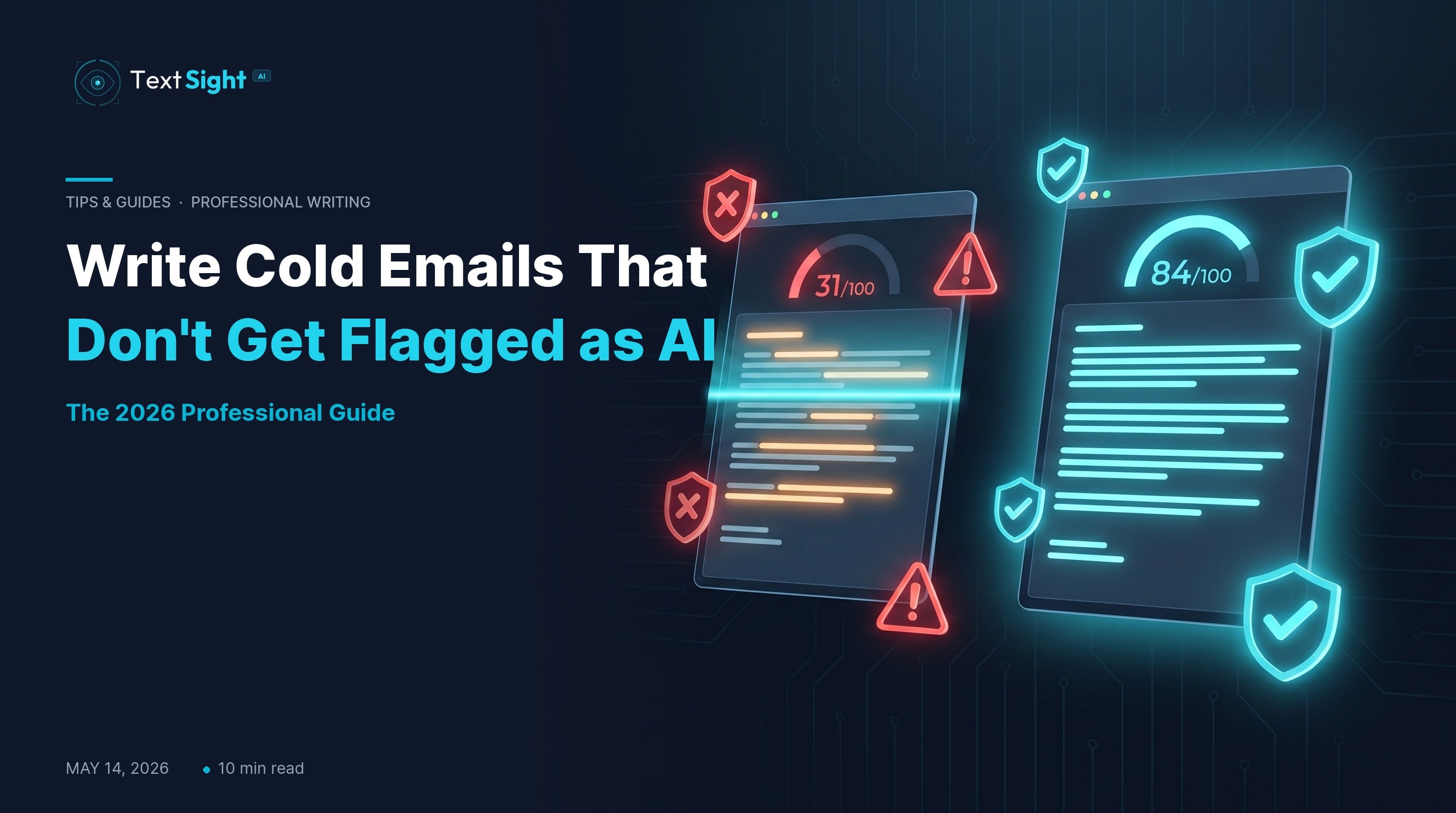
When you paste a cold email into TextSight, it returns a Humanization Score from 0–100. A raw ChatGPT draft typically scores in the 20–40 range. A score of 75+ passes most professional AI detectors. A score above 85 reads as strongly human.
The score also highlights which specific phrases are pulling your score down — so instead of rewriting blindly, you can see exactly which three sentences are the problem.
The 5-Step Cold Email Humanization Workflow
Step 1: Draft with AI, but prompt for specificity
Don't ask ChatGPT to "write a cold email to a SaaS founder." Give it the specific pain you're targeting, a specific detail about the recipient, and tell it to write in first-person, informal voice. The more specific the prompt, the less generic the output.
Better prompt: "Write a cold email from a content agency to a B2B SaaS founder who just raised a Series A and has a small team. They probably don't have a content person yet. Don't use any formal business language. No 'I hope this email finds you well.' Get to the point in the first sentence."
Step 2: Run your draft through TextSight first
Before you edit anything manually, paste the draft into TextSight and get your Humanization Score. See which sentences are flagged. You'll usually find it's 2–3 specific phrases doing most of the damage — not the entire email.
Step 3: Fix the opener — make it specific
Delete whatever opener AI wrote. Replace it with something that could only apply to this specific person. Reference something real: a post they wrote, a company milestone, a problem specific to their industry this month.
Before: "I came across your profile and was really impressed by the work you're doing at [Company]." After: "Saw your post about scaling content without a full-time hire last week — that's exactly the problem we built our service around."
Step 4: Break the structure
Read the email out loud. If it sounds like you're presenting slides, it's still too AI. Add one sentence fragment. Cut one of the three bullet points. Let one sentence run longer than it should. Let one be three words. This isn't bad writing — it's how humans actually write.
Step 5: Re-score and iterate
Paste the revised version back into TextSight. Your score should jump 20–30 points after fixing the opener and breaking the structure. If you're still below 70, the AI Vocabulary Highlighter will show you exactly what's still pulling it down.
High-Risk Phrases to Remove From Every Email
These are statistically overrepresented in AI-written email and will tank your score:
- I hope this email finds you well
- I wanted to reach out
- I would love to connect
- Leverage (in any form)
- Streamline your workflow
- Cutting-edge solution
- Tailored to your needs
- Excited to connect
- Please don't hesitate to reach out
- Best of luck with your endeavors
- It's worth noting that
- In today's fast-paced environment
If you see any of these in a draft, delete them before you even run the score. None of them appear in emails written by people who are actually excited about what they're pitching.
Beyond Cold Email: Other Professional Contexts Where This Matters
The same principles apply anywhere professional writing gets scrutinized:
Client proposals: Procurement teams at enterprise companies increasingly run vendor submissions through AI detection software before they go to the decision-maker. A proposal that reads 40% AI doesn't just get flagged — it signals that you didn't care enough to write it yourself.
Follow-up sequences: Most AI-written follow-ups use the same structure: reminder of the last email → new hook → CTA. After two follow-ups, anyone in sales can recognize the pattern. Breaking it — sending an unusually short follow-up, or one with a genuine personal observation — resets the reader's attention.
LinkedIn connection messages: LinkedIn's 300-character limit already filters out most long AI intros, but the patterns still show up. Short, specific, human. No "I'd love to connect and explore potential synergies."
Job application emails: If your cover letter scored above 80 on TextSight, your application email to the same company probably shouldn't score 20. Consistency in voice across every touchpoint matters.
The Bigger Problem With AI-Written Outreach
There's a reason everyone's inbox feels the same in 2026. Tens of millions of AI-generated cold emails are sent every day. The volume has made buyers more resistant, not less. Reply rates have dropped industry-wide even as email volume has increased.
The competitive advantage in outreach right now is not sending more — it's sending fewer, better, genuinely human emails. One cold email that reads like a real person wrote it, to a specific prospect, about a specific problem, will outperform fifty AI-generated variations every time.
AI is still useful in this workflow. Use it to draft, research, and structure. But the last mile — the part that crosses the human-to-AI boundary and actually lands — has to be done by you.
Check your email's Humanization Score free at TextSight →
No signup required. Paste your draft, get your score, see exactly what to fix.
Related reading:
- Why Your LinkedIn Posts Sound Like AI (And the 5-Minute Fix)
- Your Client Rejected Your Draft for 'Sounding AI' — Freelance Writer's Survival Guide
- Best AI Humanizer Tools in 2026 (Tested & Ranked)
Try it on your own writing