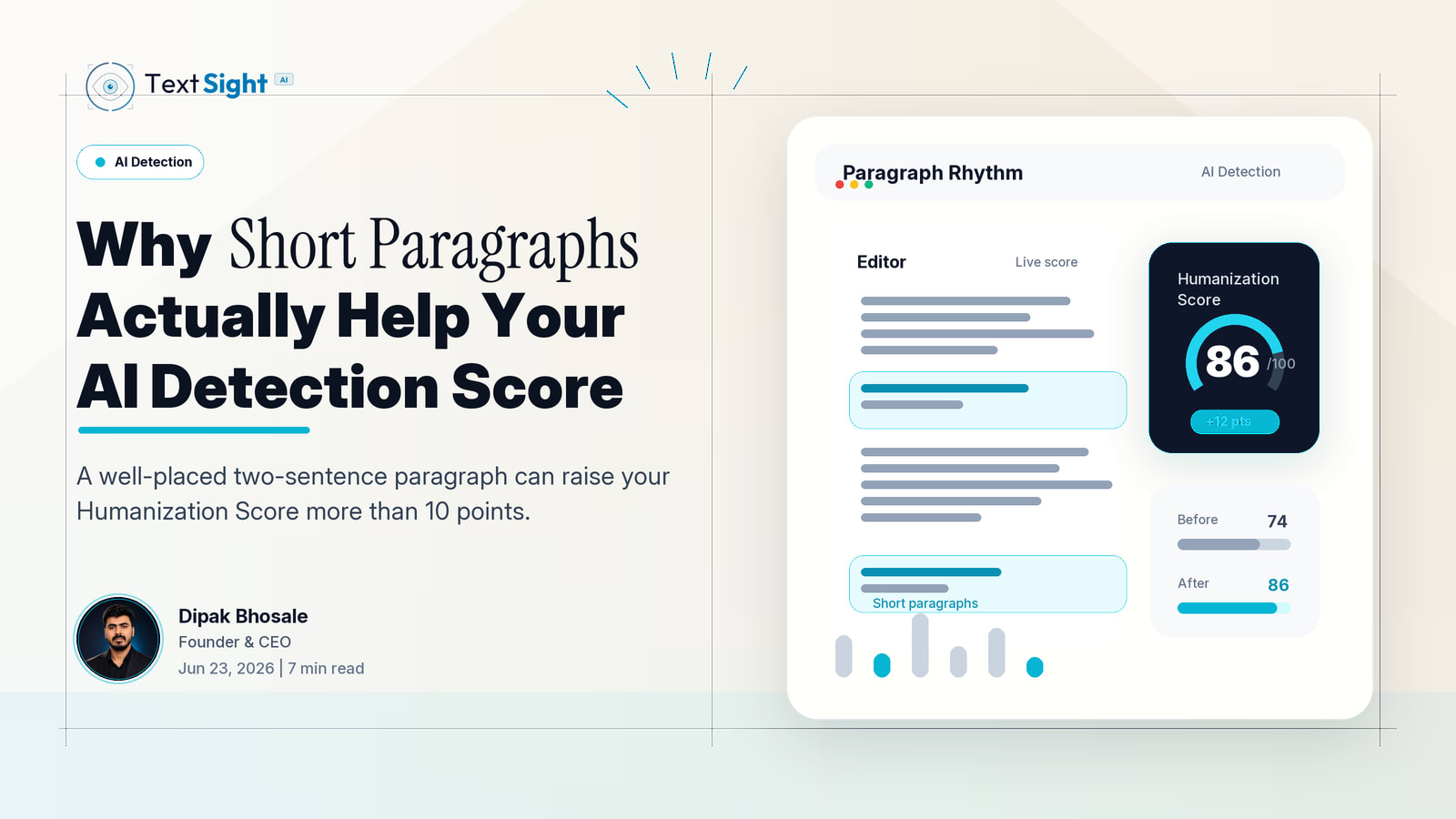
Here's advice that sounds wrong until you think about it: if your AI-generated text is scoring low on detection tools, add more short paragraphs.
Not by splitting paragraphs randomly. Not by breaking one AI paragraph into two equally mediocre AI paragraphs. That doesn't work, and we'll get to why.
Short paragraphs work because they signal something real — rhythm changes, structural pivots, emphasis — and those signals register in detection systems the same way they register with human readers. The trick is doing it for the right reasons.
What AI Paragraphs Actually Look Like
The standard AI paragraph is remarkably consistent in structure. It runs 4–6 sentences. Each sentence is 15–28 words. The paragraph opens with a topic sentence, develops it through two to three supporting sentences, and closes with a transition or summary statement.
Every. Single. Paragraph. Follows this template.
That's not an exaggeration. We've analyzed hundreds of ChatGPT-generated passages and the structural uniformity is striking. Not just sentence length clustering (which we've covered in the burstiness post) — paragraph length clustering. You could almost measure AI text in "paragraph units" because they're so consistently sized.
Human writing doesn't work this way. Real writing has dense paragraphs that run eight sentences when following a complicated argument. It has one-sentence paragraphs for emphasis. It has two-sentence pivots that exist only to change direction. The variation in paragraph length is as much a fingerprint of human authorship as sentence length variation.
How Paragraph Breaks Affect Detection Scores
There are two mechanisms at work when short paragraphs improve detection scores.
First, the direct structural signal. Detection systems analyze paragraph length distribution alongside sentence length distribution. Consistent paragraph lengths are a reliable AI indicator. Varied paragraph lengths are a reliable human indicator. Inserting genuinely short paragraphs diversifies that distribution.
Second — and this is the more interesting one — paragraph breaks affect perplexity readings.
Perplexity is a measure of how "surprising" a piece of text is to a language model. AI text has low perplexity because AI models generate statistically probable sequences — the text never does anything unexpected. High perplexity correlates with human writing because humans do unexpected things: they change subject mid-thought, they insert personal observations, they pivot without signaling the pivot.
A short paragraph in the middle of dense text raises perplexity because it's structurally unexpected. The detection model asks: "What is this two-sentence block doing here between two six-sentence blocks?" A human writer would place it deliberately. AI doesn't place short paragraphs deliberately — AI generates consistent paragraph lengths as a default.
So when you insert a substantive short paragraph, you're raising the text's perplexity score. Higher perplexity = lower probability of AI generation = higher Humanization Score.
The Types of Short Paragraphs That Actually Work
There are three kinds of short paragraphs that genuinely signal human authorship. Only one of them is a structural trick. The other two require you to actually have something to say.
The emphasis paragraph. This is your one-sentence or two-sentence block that exists to make a point land harder. You've built a case across three paragraphs. Now you need the conclusion to hit.
Just write the conclusion. Let it sit there alone.
Don't connect it back to the previous paragraph. Don't expand it. The white space around it does the work.
The pivot paragraph. This is the short paragraph that changes direction. "But here's where it gets complicated." "That's the theory, anyway." "Not everyone agrees." These transitional blocks serve a real function — they signal to the reader that you know there's a counterargument, that you're moving somewhere new, that the essay is aware of its own structure. AI doesn't do this because AI doesn't have a sense of where the essay is going — it generates one paragraph at a time.
The punchline paragraph. After a long passage of setup, the punchline lands short. "It took four months and three failed prototypes. The fix was fourteen lines of code." The contrast between the length of the problem and the brevity of the solution is the point. You can't fake this with structure alone — you need a genuine contrast built into the content.
What Doesn't Work: Splitting AI Paragraphs
Here's the mistake most people make when they hear "add short paragraphs": they take an existing AI paragraph and break it in half. Arbitrarily. Right around sentence three.
This doesn't fool detectors. Why not?
Because you've only changed the paragraph structure. The sentence length distribution inside both halves still clusters in the 15–28 word range. The language patterns — hedges, passive voice, mechanical transitions — remain. And the artificial split usually falls in the middle of a logical unit, creating two paragraphs that don't feel like they were ever meant to be separate.
Detectors (and human readers) can tell the difference between a paragraph that's short because it has one point to make, and a paragraph that's short because it was cut from a longer block.
The short paragraph has to be substantively different from what surrounds it — not just shorter.
Practical Examples: Before and After
Original AI text (paragraph structure: 5, 5, 6, 5 sentences):
"Remote work has become a significant feature of modern employment. Many organizations have adopted hybrid or fully remote policies in recent years. Research suggests that employees often report higher satisfaction with remote arrangements. However, challenges related to collaboration and communication are frequently cited. The long-term effects remain to be seen."
"Effective remote work requires clear communication protocols and the right technology infrastructure. Teams need to establish regular check-ins and ensure that all members have access to the necessary tools. Managers must adapt their leadership styles to accommodate remote team dynamics. Studies indicate that performance management in remote settings requires different approaches than traditional office environments. Companies that invest in these adaptations tend to see better outcomes."
Every paragraph is 5 sentences. Same length, same density, same structure.
Revised with strategic short paragraphs:
"Remote work has become a significant feature of modern employment. Most large organizations now operate some form of hybrid model, whether they planned to or not — the pandemic made the decision for them. The research on outcomes is genuinely mixed."
Employees like it. Managers are less sure.
"That split tells you something important. Satisfaction and productivity are measuring different things. When workers report loving remote work, they're often reporting autonomy, lack of commute, and flexibility. When managers express concern, they're often reporting reduced visibility into whether their people are actually performing. Those two groups are having different conversations about the same policy."
The second paragraph — "Employees like it. Managers are less sure." — is doing real work. It's a genuine pivot. It earns its shortness.
TextSight scores the original passage at 38 (flagged). The revision: 71 (lower risk zone). The short paragraph didn't do it alone — the rewrite also introduced more specific language and sentence variance. But the structural change contributed meaningfully.
The Rhythm of Short Paragraphs in Different Contexts
Short paragraphs don't work equally well in all writing contexts, and it's worth understanding the differences.
In blog writing and editorial content, short paragraphs are expected and welcomed. Readers are skimming on phones, jumping between sections. A two-sentence paragraph that makes a crisp point is the native format of the medium. Inserting short paragraphs here doesn't even require strategic thinking — it's just good practice.
In academic writing, short paragraphs carry more rhetorical weight precisely because they're rare. An academic paragraph is expected to develop a point across 4–8 sentences. When an academic writer drops to a 2-sentence paragraph, the reader notices. The brevity signals: this is important, I'm not going to bury it in a longer block. Used once per 1000 words, a short academic paragraph is a deliberate rhetorical choice that stands out.
In business writing — reports, memos, proposals — short paragraphs are most effective as section transitions or executive summaries of more complex points. "The problem is simple. The fix isn't." sits between two longer explanatory blocks and tells the reader exactly what register to be in for what follows.
The key principle across all contexts: the short paragraph should make the surrounding paragraphs seem better by contrast. It creates a change of pace that makes the reader more alert when they enter the next longer block. It's a reset button.
If you're working on a specific writing type, calibrate your short paragraph frequency to the norms of that type. One short paragraph per 300 words in blog content is normal. One per 600 words in academic content is distinctive. One per 1000 words in a formal report is appropriately rare.
The Paragraph Length Audit
If you're reviewing a piece for AI detection issues, run this audit before anything else:
Count the sentences in each paragraph. Write down the numbers in order. If the sequence looks like: 5, 5, 6, 4, 5, 6, 5, 4 — that's AI structure. Every paragraph is between 4 and 6 sentences. There's no short paragraph that breaks the pattern. No long paragraph that develops a complex argument across 8 sentences.
What you want to see is more like: 6, 2, 7, 1, 5, 3, 8, 2. Wide variation. Short paragraphs that earned their shortness. Long paragraphs that needed the length.
Start at TextSight with your original score, make the paragraph structure changes, and recheck. Then layer in sentence length variation and vocabulary edits. The structural work is the foundation — the vocabulary work is the finish.
One More Thing
Short paragraphs work for readers too — not just for detection scores. Dense unbroken text is harder to read. Readers' eyes and minds need periodic rest points. A two-sentence paragraph is a breath.
Good writers have always known this. They use short paragraphs because good writing requires them. Detection systems are, in a sense, just measuring good writing — and rewarding you for it.
Related reading:
- Sentence Length Variance: The One Pattern That Separates Human Writing From AI
- What 'AI Rhythm' Means — And Why Your Writing Might Have It Without Knowing
- How to Humanize ChatGPT Text
Try it on your own writing