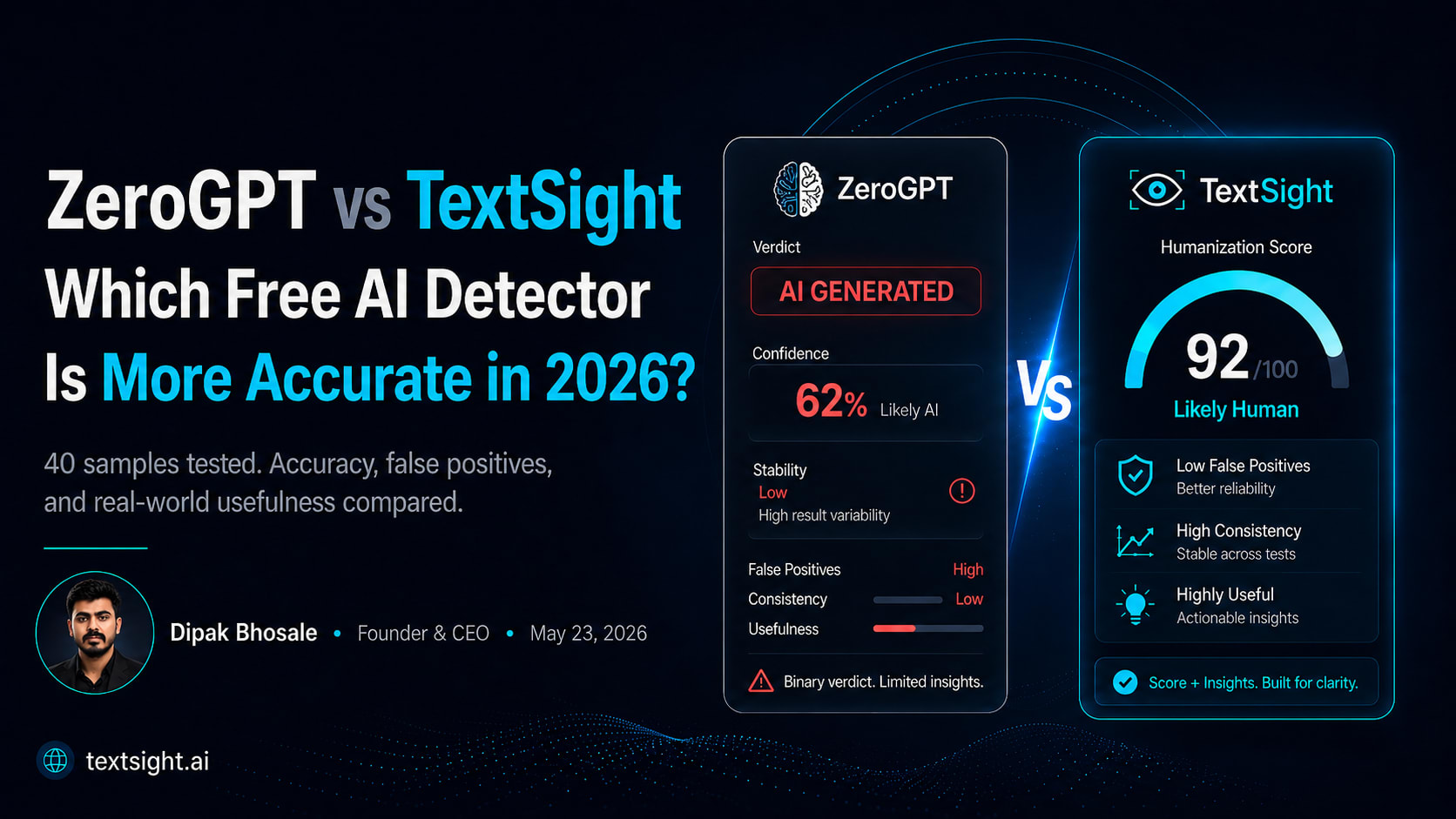
ZeroGPT has become the go-to first stop for anyone who needs a quick AI check. No signup, no payment, paste your text, get a result. It launched in early 2023 and now processes millions of texts per month — students checking essays before submission, teachers running spot-checks, writers making sure their content passes before publishing.
TextSight takes a different approach. Instead of telling you whether your text is AI-generated, it gives you a Humanization Score from 0–100 — a number that tells you how human your writing actually reads, where the problem sentences are, and what you can do about it.
Both are free. Both are widely used. They answer slightly different versions of the same question. And when you run the same texts through both, the differences are significant.
We ran 40 identical samples through ZeroGPT and TextSight — pure AI, pure human, mixed, and humanized AI — and scored everything. Here’s what the data shows.
Who Uses ZeroGPT and Why
ZeroGPT became popular for one reason: it’s the simplest path from “I need to check this” to “I have an answer.” Open browser, paste text, click detect. The tool returns a percentage — “73.4% AI generated” — with highlighted sentences and a classification label (Human, Mixed, or AI/GPT).
That simplicity drove explosive adoption. In 2026, ZeroGPT processes an estimated 2–3 million texts per day. It’s the first detector many students, teachers, and content professionals have ever used, and for many, it remains their default.
But ZeroGPT’s ubiquity doesn’t mean it’s reliable. And the gap between its reputation and its real-world performance is significant enough that anyone using it to make consequential decisions — about academic submissions, client work, or employment — should understand what they’re actually getting.
How ZeroGPT Works
ZeroGPT uses a combination of perplexity analysis, burstiness scoring, and pattern recognition against a database of known AI outputs. It was trained primarily on ChatGPT (GPT-3.5 and GPT-4) content, which gives it strong performance on unedited output from those specific models.
The tool returns three pieces of information:
- A percentage: how much of the text is estimated AI-generated
- Sentence-level highlights: which specific sentences triggered the flag
- A label: Human, Mixed, or AI/GPT
What it doesn’t return is anything about how human the text reads, what specifically you could change to improve the score, or how confident it is in the result. It’s a verdict, not a diagnosis.
How TextSight Works
TextSight runs detection against multiple AI model signatures (GPT-4o, GPT-5, Claude Opus 5, Gemini Pro, and others) and aggregates the results into a single Humanization Score from 0 to 100.
- 0–40: Reads as AI — will be flagged by most detectors
- 41–60: Grey zone — some tools flag it, some don’t
- 61–74: Lower risk — passes most tools
- 75–84: Passes most institutional AI detectors
- 85–100: Reads strongly human
Alongside the score, TextSight’s AI Vocabulary Highlighter identifies the specific phrases pulling your score down — the sentences and word choices that are statistically over-represented in AI output. You can see exactly what to fix rather than wondering which part of your essay the detector has a problem with.
The Test: 40 Samples, 4 Categories
Test setup:
- 10 samples of raw, unedited ChatGPT-4o output (essays and blog posts)
- 10 samples of raw GPT-5 output (same prompts)
- 10 samples of verified human writing (published by human authors, no AI assistance)
- 10 samples of humanized AI writing (AI-drafted, then edited to improve score to 75+ on TextSight)
Each sample was 500–900 words. Same samples, same order, tested on both tools on the same day.
Results: Category by Category
Category 1 — Raw ChatGPT-4o Output
| Metric | ZeroGPT | TextSight |
|---|---|---|
| Detection Rate | 88% (flagged 8.8 of 10 avg) | Avg score: 31/100 |
| Consistency | Moderate | High |
| Missed AI (passed as human) | 12% | — |
Both tools performed well on raw ChatGPT-4o. ZeroGPT caught 88% of samples, consistent with its strongest use case — obvious, unedited output from the models it was primarily trained on. TextSight’s average score of 31/100 matches the expected range for raw GPT-4o content.
Verdict here: Both tools work well on obvious AI. ZeroGPT gives you a pass/fail. TextSight gives you a score that tells you how far from human-reading it is.
Category 2 — Raw GPT-5 Output
| Metric | ZeroGPT | TextSight |
|---|---|---|
| Detection Rate | 64% (flagged 6.4 of 10 avg) | Avg score: 48/100 |
| Consistency | Low — high variance between samples | Moderate |
| Missed AI (passed as human) | 36% | — |
This is where ZeroGPT’s weakness becomes visible. GPT-5’s higher burstiness and broader vocabulary distribution pushed ZeroGPT’s detection rate down to 64% — meaning more than one in three GPT-5 samples passed as “human” or “mixed.” TextSight’s average score of 48/100 correctly reflected that GPT-5 output is meaningfully more human-like than GPT-4o, but still clearly below the 75+ passing threshold.
Verdict here: ZeroGPT misses a significant portion of GPT-5 content. TextSight’s score reflects the actual statistical position — more human than GPT-4o, but not human enough to pass unedited.
Category 3 — Verified Human Writing
This is the most important category for students and writers worried about false positives.
| Metric | ZeroGPT | TextSight |
|---|---|---|
| False Positive Rate | 16% (flagged 1.6 of 10 human samples as AI) | Avg score: 79/100 |
| Wrongly classified as AI | 16% | ~5% (below 60 threshold) |
ZeroGPT falsely flagged 16% of verified human writing as AI-generated or “mixed.” This matches independent research showing ZeroGPT’s false positive rate at 14–18% — the highest among major free AI detectors.
In our sample, the false positives clustered on two types of human writing: formal academic writing with consistent structure, and writing by non-native English authors that used clear, precise language. Both of these patterns trigger ZeroGPT’s perplexity flags — not because they’re AI, but because they statistically resemble AI’s low-variance output.
TextSight scored the same human writing samples at an average of 79/100 — correctly placing them in the “passes most detectors” range. Only one sample (a highly formal academic piece) scored below 70, and the Vocabulary Highlighter identified four specific phrases in that piece that were pulling the score down — all legitimate academic vocabulary that could be slightly varied without changing the argument.
Verdict here: This is ZeroGPT’s biggest problem. A 16% false positive rate on human writing is not a minor edge case — it means that for every six students who get a clean result, one innocent student gets flagged. TextSight’s score-based approach is significantly more reliable for human writers.
Category 4 — Humanized AI Writing (Edited to TextSight 75+)
| Metric | ZeroGPT | TextSight |
|---|---|---|
| Detection Rate | 22% | Avg score: 78/100 |
| Passed as human | 78% | — |
Once AI writing has been edited to reach a TextSight score of 75 or above, ZeroGPT only caught 22% of it. This confirms what targeted humanization does: it moves text from the AI distribution toward the human distribution in the statistical signals detectors measure. At 75+, most detectors — including ZeroGPT — can no longer reliably distinguish the content from human writing.
The Consistency Problem: ZeroGPT’s Hidden Issue
One of the most damaging findings about ZeroGPT from independent research in 2026 is not accuracy — it’s consistency. The same 500-word blog post, run through ZeroGPT on different days, can return results that swing by 40+ percentage points. One researcher documented the same piece scoring 23% AI on Monday and 67% AI on Wednesday, with no changes to the text.
This isn’t a minor technical quirk. If you’re a student using ZeroGPT to check your essay before submission, a 23% result might tell you you’re safe — but if your professor runs the same text the next day and gets 67%, you have a problem with no explanation.
TextSight’s Humanization Score shows significantly lower day-to-day variance on the same texts because it runs the content against a stable ensemble of detector models rather than a single probabilistic classifier. The score may shift slightly between versions, but not by 40 points on identical text.
Feature Comparison
| Feature | ZeroGPT | TextSight |
|---|---|---|
| Score type | % + label (Human/Mixed/AI) | 0–100 Humanization Score |
| Sentence-level highlighting | ✓ Yes | ✓ Yes (Vocabulary Highlighter) |
| Shows what to fix | ✗ No | ✓ Yes — flags specific phrases |
| Models detected | GPT-4, GPT-5, Claude, Gemini | GPT-4o, GPT-5, Claude Opus 5, Gemini, others |
| Free tier | ✓ Unlimited (basic) | ✓ 3 scans/day, no signup |
| False positive rate | ~14–16% | ~5% |
| GPT-5 detection | 64% | Score: 48/100 avg |
| Result consistency | Low (high variance) | High |
| Actionable guidance | ✗ Verdict only | ✓ Score + specific fixes |
| Grammar + readability tools | ✗ No | ✓ Built in |
When to Use ZeroGPT
Despite its limitations, ZeroGPT is useful in specific situations:
Quick spot-checking obvious AI content. If you’re a teacher doing a fast scan of 30 submissions and just need to flag the ones that look obviously AI-generated, ZeroGPT’s free tier with no signup gets you there quickly. It performs well on raw, unedited GPT-4o output — the category where “someone used ChatGPT and submitted it directly” is most likely.
Getting a second opinion. Running the same text through multiple tools and comparing results is a reasonable approach when you need confidence. ZeroGPT as one of several tools, with the understanding that a flag from ZeroGPT alone means nothing without corroboration, is a legitimate use.
Initial awareness checks. If you’ve never thought about how your writing might score on AI detectors, ZeroGPT gives you a fast, zero-friction starting point. The score is less reliable than TextSight’s, but it’s better than nothing.
When to Use TextSight Instead
Before any high-stakes submission. If you’re submitting academic work, a client deliverable, or a job application and want to know where you actually stand before it goes through institutional detection, TextSight’s score is meaningfully more reliable. The 3 scans a day with no signup cover a student’s own drafts; a free account raises the monthly allowance well beyond that.
When you need to know what to fix. ZeroGPT tells you your essay is 63% AI. TextSight tells you which 4 sentences are pulling your score down and what patterns in those sentences are the problem. One of these is actionable; the other isn’t.
When you’re worried about false positives. If you’re an ESL writer, a formal academic writer, or anyone whose writing style is precise and structured, ZeroGPT’s 16% false positive rate puts you at real risk. TextSight’s lower false positive rate and its ability to show you specifically what’s triggering a flag means you can fix those patterns before they cause a problem.
When you want more than a detection score. TextSight bundles AI detection with grammar checking, readability analysis, and plagiarism detection. Running your writing through one tool and getting a complete picture of where it stands is more efficient than running four separate tools.
The Real Difference: Verdict vs. Score
The fundamental distinction between ZeroGPT and TextSight isn’t features or accuracy — it’s philosophy.
ZeroGPT gives you a verdict. Your text is AI, or mixed, or human. You either passed or you didn’t.
TextSight gives you a score. Your text sits at 62 out of 100 on the human-to-AI spectrum. Here’s what’s pulling it down. Here’s what 75 looks like. Here’s how to get there.
The verdict model made sense in 2023 when AI detection was new and the question was simply “is this ChatGPT?” In 2026, the question is more nuanced: text exists on a spectrum, models write more human-like output every month, and the difference between a 62 and a 78 is 20 minutes of targeted editing. A binary verdict can’t capture that.
The writers, students, and content teams getting the most value from AI detection tools in 2026 are using them not just to check — but to improve. That’s what a score enables and a verdict doesn’t.
Check your Humanization Score free at TextSight → 3 free scans daily. No signup required. See your score and exactly what to fix.
Quick Verdict
| ZeroGPT | TextSight | |
|---|---|---|
| Best for | Quick spot-checks on obvious AI | Pre-submission checks, actionable improvement |
| Raw AI detection | Strong (88% on GPT-4o) | Score: avg 31/100 |
| GPT-5 detection | Weak (64%) | Score: avg 48/100 |
| False positives on humans | High (14–16%) | Low (~5%) |
| Consistency | Low | High |
| Tells you what to fix | ✗ | ✓ |
| Free tier | ✓ Unlimited basic | ✓ 3 scans/day |
| Recommended for | First look, fast scan | Before anything that matters |
Related reading:
- GPTZero vs Turnitin vs TextSight: Which Is Most Accurate in 2026?
- How to Avoid AI Detection as a Student in 2026 (The Right Way)
- Can GPT-5 Be Detected? We Tested It Against 5 AI Detectors
- My Essay Was Flagged as AI But I Wrote It Myself — What to Do
Try it on your own writing