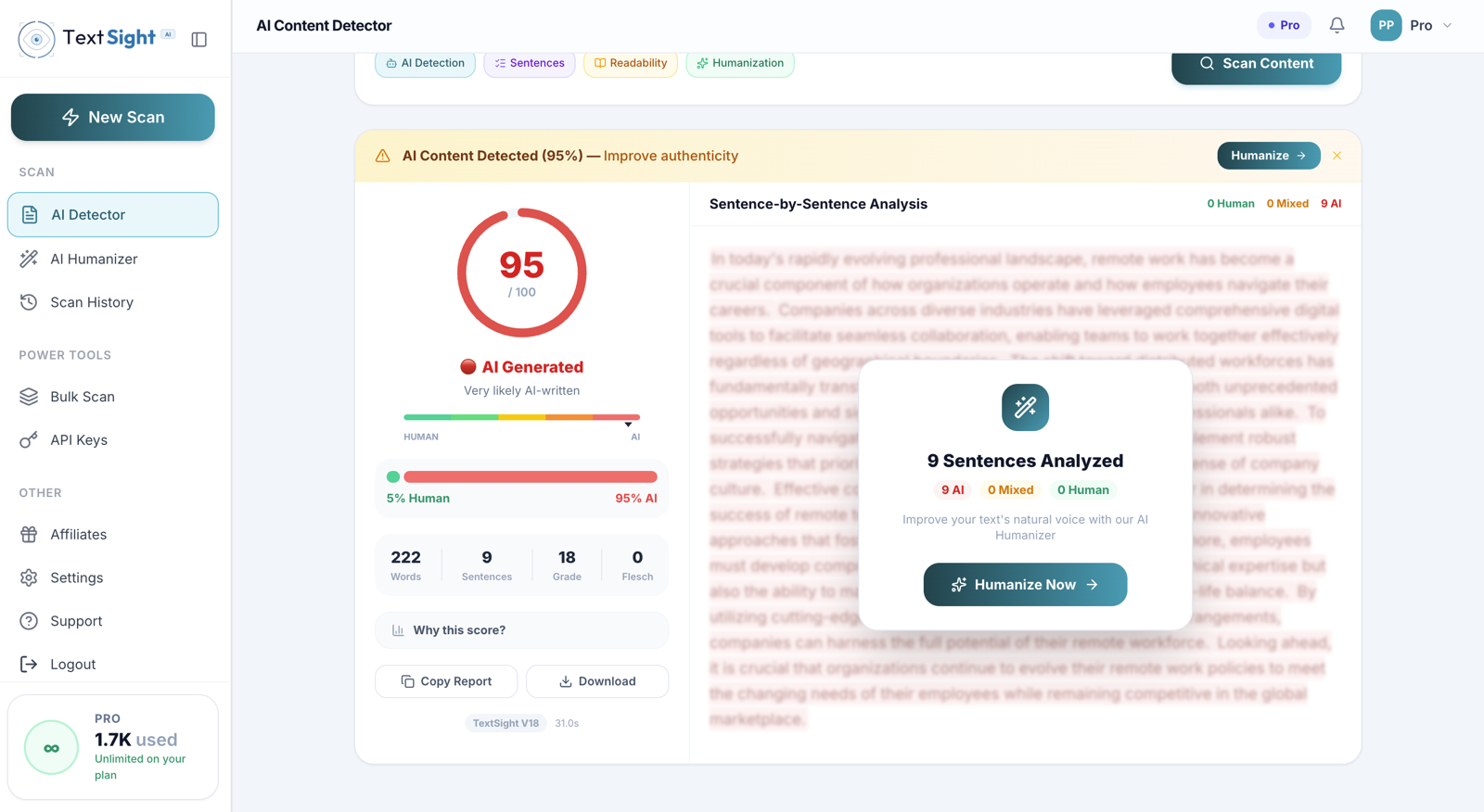
Paste your text and get a 0-100 ChatGPT-probability score, sentence-level highlights of GPT-fingerprinted phrasing, and an Authenticity Score that tells you how natural the text reads. Tuned for GPT-3.5, GPT-4, and GPT-4o output.
No credit card · No signup for your first scan · Up to 99.2% accuracy in our internal benchmark
Paste your draft, upload a PDF or DOCX, or point at a URL. We score it against GPT-3.5, GPT-4, and GPT-4o fingerprints — and ship a one-click AI rewriter in the same scan to rewrite the flagged sentences.
Open the ChatGPT Detector →Drop text directly, upload a PDF or DOCX file, or paste a URL. Anything under 5,000 characters runs free. Larger drafts run on paid plans.
50+ language signals — burstiness, perplexity, lexical patterns, and structural markers — tuned to recognize GPT-3.5, GPT-4, and GPT-4o output. Updated as new ChatGPT versions ship.
You get an overall AI-probability score, an Authenticity Score, sentence-level highlights ranked by suspicion, and a built-in AI rewriter that rewrites only the flagged sentences.
Run your draft before submission. See which sentences look AI-generated and rewrite them in the same scan — without uploading to a third-party AI rewriter first.
Check guest posts and agency-written drafts before publishing. The Authenticity Score gives you a measurable benchmark to track improvements as you rewrite.
Sentence-level highlights give you specific evidence to discuss with students — not a single overall score that's hard to defend.
Bulk-scan deliverables before they ship. API access on the Business plan ($29.99/mo) covers 10,000 calls/mo — about 6× cheaper than Originality.ai's Enterprise tier.
Up to 99.2% accuracy in our internal benchmark against GPT-3.5, GPT-4, and GPT-4o outputs. Results may vary with content type, writing style, model version, and editing level. AI detection is probabilistic — no detector is perfect, and we publish our caveats openly.
What works well: long-form English text (100+ words), unedited or lightly edited ChatGPT output, and content generated through the official OpenAI APIs or the ChatGPT web app.
Where to be cautious: short snippets (under 50 words), heavily human-edited ChatGPT output, custom-fine-tuned GPT models, non-English languages, and code (we don't currently detect AI-written code). We flag low-confidence scores in the result so you know when not to rely on them.
TextSight scores your text against signals trained on GPT-3.5, GPT-4, and GPT-4o output. It returns an overall ChatGPT-probability score (0-100), sentence-level highlights ranked by suspicion, and an Authenticity Score that tells you how natural the text reads. The scan typically completes in under three seconds.
Yes. The detector is tuned to recognize the lexical and structural fingerprints of GPT-3.5, GPT-4, and GPT-4o output. We update the training set as new ChatGPT model versions ship. Custom-fine-tuned ChatGPT models or heavily edited output may score lower confidence — we flag those cases.
Yes. The free tier gives you 3 scans per day with the same detector and Authenticity Score as the paid plans. No credit card and no signup are required for your first scans. Higher daily limits start at $9.99/mo on the Starter plan.
Up to 99.2% accuracy on our internal benchmark of GPT-3.5, GPT-4, and GPT-4o outputs. Results may vary with content type, writing style, model version, and editing level. AI detection is probabilistic — read /accuracy-methodology for our test setup, false-positive rate, and the caveats we apply to every score.
The ChatGPT detector is tuned to fingerprint OpenAI-specific patterns. Text from Claude, Gemini, or Llama will usually score AI-positive on the general detector but is less likely to score positive on the ChatGPT-specific score. For multi-model detection, use the general AI Detector page.
The detector is most accurate on unedited or lightly edited ChatGPT output. Heavy human editing can push the AI score down — sometimes legitimately, sometimes hiding the original source. Sentence-level highlights show you which specific sentences still read as AI-generated even after editing, so you can use those as evidence.
The detector is tuned for natural-language prose, not source code. Code detection requires different signals (syntactic patterns, comment style, idiom recognition) than what we run. We don't currently ship a code-AI detector.
The general AI Detector scores across all four major model families — OpenAI, Anthropic, Google, and Meta — and surfaces an overall AI probability. This ChatGPT-specific page focuses the same engine on OpenAI signals, which is what you want when you specifically need to flag GPT-written content (the most-used commercial AI for writing).
ChatGPT is the most common AI output in the wild, so the detector is calibrated hard against it. Here is what changes when we know we are hunting GPT specifically.
Our training set covers every public OpenAI text model since 2023. Older GPT-3.5 output is the easiest to flag because its phrasing patterns are the most stereotyped. GPT-4 and GPT-4o are harder, and we ship updated weights as new versions land.
The detector tracks em dash density, transition phrases like "moreover" and "furthermore," and the three-item list pattern ChatGPT defaults to ("first, second, and third"). Every flagged sentence is annotated with which signal triggered it so you can defend or rewrite that exact line.
Claude writes longer hedging clauses. Gemini hops between bullet lists and short declarative bursts. ChatGPT sits in the middle with steady prose rhythm and predictable transitions. The ChatGPT-specific score isolates OpenAI signatures so Claude or Gemini text does not get blamed on GPT.
ChatGPT has roughly 200 million weekly active users worldwide and is the default writing assistant in most schools and content teams. If you are running detection on submitted essays, blog drafts, or freelancer deliverables, the odds are heavily on OpenAI being the source. The ChatGPT-specific score gives you a confident answer instead of a generic verdict.
On 100+ word long-form English text we measure roughly 88 to 92 percent accuracy against GPT-4 and GPT-4o, and slightly higher against GPT-3.5. Short snippets under 50 words are harder for any detector, and we surface a low-confidence flag rather than guessing. Read our full methodology on the accuracy page.
When OpenAI ships a new model, we generate a fresh sample corpus, retrain the OpenAI-specific signals, and roll the update silently. Customers do not need to reinstall anything. The page footer always shows the most recent retraining date so you know exactly what version your scan is calibrated against.
Four tiers. The decision is usually obvious once you know how many ChatGPT drafts you check per week and whether you need API access.
Best for: Students sanity-checking the occasional ChatGPT-assisted draft. Anyone running a one-off scan before submitting. No card needed.
3 scans/day with the ChatGPT-specific score, sentence highlights, and Authenticity Score. 10,000-character lifetime cap on AI rewriter before signup.
Best for: Active students running 3 to 5 essays per week through ChatGPT-aware scans. Casual bloggers cleaning up GPT-4 drafts before publishing.
20 scans/day, 20,000 AI rewriter words/month, Chrome extension to scan ChatGPT output inline on any tab.
Best for: Newsletter writers, daily SEO writers, and freelancers shipping GPT-assisted content every day. Single seat, unlimited scans.
Unlimited ChatGPT-detector scans, 50,000 AI rewriter words/month, file and URL upload for long GPT-4 drafts, priority support.
Best for: Educators scanning whole-class submissions of likely ChatGPT essays. SEO agencies auditing contributor work. SaaS teams piping ChatGPT detection through the REST API.
100,000 AI rewriter words/month, REST API access, 5 team seats, white-label PDF reports with the ChatGPT-specific score.
Annual billing saves 25 percent, dropping Pro to $14.99/mo and Business to $29.99/mo. Full pricing →
On long-form English text of 100 words or more, our internal benchmark puts GPT-4 detection in the 88 to 92 percent accuracy range, and slightly higher on GPT-3.5 because its phrasing is more uniform. Short snippets under 50 words are not reliable for any detector, and the result panel marks those scans as low confidence so you do not over-trust the number.
Custom GPTs are still GPT-4 or GPT-4o underneath, so the base fingerprints survive. Where they get harder to flag is when a custom system prompt enforces a very specific voice (highly casual, very technical, or styled to mimic a known writer). The Authenticity Score on those scans tends to read mixed rather than clearly AI, and the sentence highlights show you which lines still carry the underlying GPT rhythm.
The detector returns a probability that the text came from the GPT family, not the specific version. Internally we track per-model confidence buckets, but we do not surface "GPT-4o vs GPT-5" as a public label because the difference between two adjacent OpenAI models is rarely reliable at the sentence level. If OpenAI ships a model that breaks the existing pattern signals, we retrain and ship updated weights within days.
Lightly fine-tuned models still produce text with the underlying GPT statistical signature, so detection holds up. Heavy domain fine-tunes (legal, medical, code-heavy) shift the lexical distribution enough that confidence drops, and we surface that as a low-confidence flag rather than a hard verdict. The sentence highlights are still useful because they show which lines retain the base-model rhythm.
Claude paraphrasing is a known detector workaround, and it does push the ChatGPT-specific score down. The general AI Detector picks the result up under the Claude signature instead, so the overall AI probability stays high. If your goal is "is this AI" then the general detector covers you. If your goal is "is this specifically ChatGPT" then a Claude paraphrase will read as Claude content with GPT-origin clues only in a few residual sentences.
The general detector returns one overall AI probability calibrated across GPT, Claude, Gemini, Llama, and Mistral. This ChatGPT-specific page focuses the same engine on OpenAI signatures and returns a GPT-probability score, which is what you want when you need to specifically attribute content to ChatGPT (the most common source in education and content workflows). You can use both in the same scan to compare attributions.
Formal English shares some surface features with ChatGPT output, especially uniform sentence length and frequent transitions. We hold the false-positive rate on hand-written graduate-level essays low. When the detector is unsure it tags the result as "Mixed" rather than firing a confident AI verdict, and the sentence highlights show you which specific lines are driving the score so you can defend the work line by line.
No. OpenAI retired its own AI Classifier in July 2023 due to "low rate of accuracy," and they have not shipped a replacement. That is part of why third-party detection still matters: the company that builds ChatGPT does not currently offer a public way to tell whether a piece of text was produced by ChatGPT. TextSight has been training against GPT output continuously since then and ships updated weights with every new OpenAI model release.
Detect GPT-written text. Fix what's flagged. One tool. 3 free scans/day.
Detect ChatGPT output wherever you work.