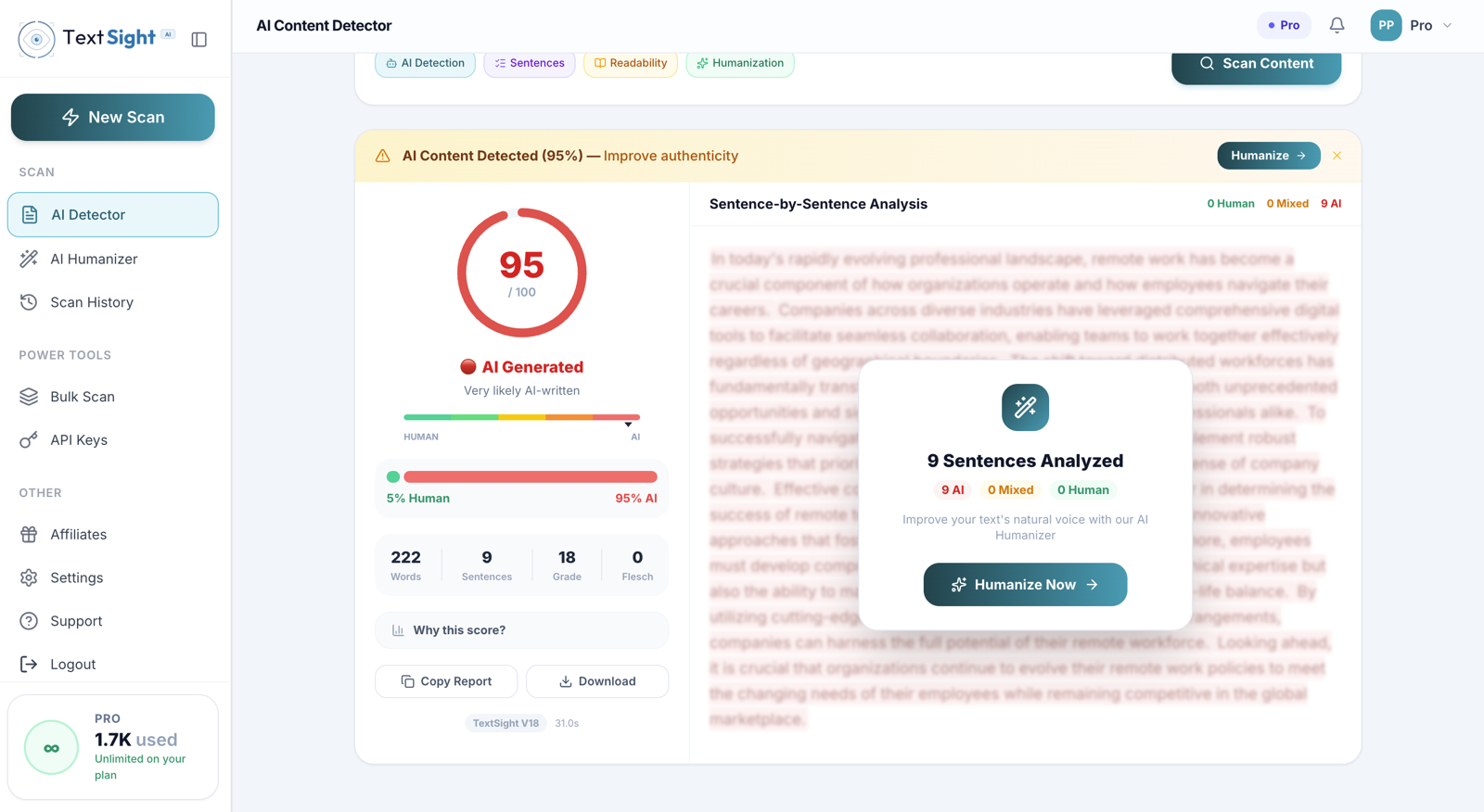
The Authenticity Score is the measurable benchmark on every TextSight output. Higher means more human-like. Lower means more AI fingerprints. Same number on every scan and every rewrite — so you always know exactly how far the draft is from where you want it.
Free · Shows on every AI Detector scan, every AI Rewriter rewrite, every output from 20+ free tools
Most AI detectors give you a single percentage — "78% AI" — and walk away. That number tells you the verdict, but not the gap. You don't know whether you're close to ready or three rewrites away.
The Authenticity Score is the inverse benchmark. Same 0-100 scale, but it measures how natural the text reads — so 35 is "definitely AI-flavored," 60 is "borderline," 75+ is "passes most reader review," and 85+ is "indistinguishable from a careful human author."
Every TextSight scan shows it. Every AI Rewriter rewrite recomputes it. The score climbs as you rewrite — so you can stop guessing and start measuring.
Most readers and detectors will flag it. Don't ship.
Some detectors flag, some don't. Run another rewrite pass.
Good for personal writing and most blog content.
Target for academic submissions and editorial content.
Hard to distinguish from a careful human author. Target for compliance, legal, journalism.
The Authenticity Score is a weighted blend of several language signals — none of them new individually, but combined into a single number you can act on:
Each signal contributes a weighted component to the final 0-100. Weights are tuned against a benchmark of human-vs-AI-authored content. The score is probabilistic — like every AI detection signal — so we publish the methodology, the benchmark setup, and the caveats openly.
Every scan returns the Authenticity Score alongside the AI probability and sentence highlights.
After each rewrite, the score is recomputed so you can see your progress in real time.
Every paraphrased output shows the score so you can decide which variant to keep.
Summaries are scored, so you can tell when a TL;DR is too obviously AI-styled.
Edits that "fix" grammar but make the text more AI-flavored are flagged by a score drop.
Every writing tool in /tools/ returns an Authenticity Score inline with its output.
It's not a third-party detector pass guarantee. The score is computed against TextSight's own detector. A high score correlates with passing most other detectors, but no single number guarantees a pass on Turnitin, Originality, GPTZero, or any specific tool. If you need to pass a specific detector, verify by re-scanning on that tool.
It's not infallible. Like every AI detection signal, the score is probabilistic. Heavily edited AI text can score high; deliberately stilted human writing can score low. We flag low-confidence scores on short or unusual text.
It's not a quality score. Authenticity is one dimension of text quality — not the whole picture. Well-organized, factually accurate, persuasive writing can score lower than rambling prose. Pair the Authenticity Score with the Readability Checker and the Fact-Checker for a fuller view.
A 0-100 measurement of how natural and human-like a piece of text reads. Computed by TextSight on every AI Detector scan and every AI Rewriter rewrite. Higher means more human-like; lower means more AI fingerprints.
A weighted blend of burstiness, perplexity, lexical diversity, structural patterns, and model-specific fingerprints. Weights tuned against a benchmark of human-vs-AI content. Read the full methodology.
Depends on the stakes. 60+ for personal writing, 75+ for academic submissions, 85+ for compliance / legal / journalism. Below 40, most readers and detectors will flag the text as AI-generated.
AI probability answers "how likely is this AI-generated?" (higher = more AI). Authenticity Score answers "how natural does this read?" (higher = more human). Usually inversely correlated but not perfectly — a sentence can be obviously AI-written and still flow well, or vice versa.
No. The score is computed against TextSight's own detector. A high score correlates with passing most other detectors, but no number guarantees a pass on any specific third-party tool. If you need to pass a specific detector, verify by re-scanning on that tool.
Yes. Like every AI detection signal, it's probabilistic. Heavily edited AI text can score high; deliberately stilted human writing can score low. We flag low-confidence scores on short or unusual text. Use it as a benchmark, not a verdict.
Every AI Detector scan, every AI Rewriter rewrite, and every output from the 20+ free writing tools at /tools/. Anywhere TextSight processes text, you get the score.
Every 0-100 score lands in one of five colour-coded bands. The band is the verdict at a glance. The number tells you how much rewriting still separates the draft from your target. Same labels on Free, Starter, Pro, and Business.
The writing carries the kind of variation, voice, and small surprises that come from a human author who actually thought about it. Safe to ship for academic submissions, journalism, legal copy, or anything that needs to read as authentically authored. Most third-party detectors will also clear text in this band.
Reads as natural prose with a few sentences that lean toward AI rhythm. Fine for blog posts, internal docs, marketing copy, and most general use. If you are submitting to a strict detector or an editor who looks at AI signals, rewrite the highlighted sentences and aim for the Original band.
Roughly half AI-flavoured, half human. Common after a single AI rewriter pass on raw GPT or Claude output. Some detectors will flag, some will not. Treat this as a checkpoint, not a finish line. Run another rewrite pass or edit the orange and red sentences by hand.
The text shows strong AI fingerprints: predictable transitions, repeated phrasing, even sentence rhythm, and the giveaway vocabulary models reach for. Most readers who read closely will sense it. Most detectors will catch it. Do not ship without a substantial rewrite.
Reads as raw model output. Uniform sentence length, predictable structure, and the full vocabulary stack ("delve," "moreover," "in conclusion," "tapestry," "navigate"). Effectively every detector on the market will flag it. Send through the AI Rewriter or rewrite from scratch before any submission.
Use the band first, the number second. The band tells you what action to take. The number tells you how close to the next band you are. A 79 is one rewrite pass away from Original. A 62 is solidly inside Mostly Human but trending toward Mixed. Pair every score with the sentence highlights so you know which lines to fix, not just how far you have to climb.
The Authenticity Score appears on every plan: Free, Starter, Pro, and Business. Tiers differ on monthly volume, file and URL upload, REST API access, and team seats. The score itself is the same calibrated 0-100 number with the same five bands and the same sentence-level highlights, wherever you scan.
Best for: Trying the score on a handful of drafts before committing. Students checking one or two essays a week. Writers sanity-checking a single piece.
3 scans/day, 10,000-character lifetime cap on AI rewriter before signup. Full Authenticity Score with all five bands and sentence highlights on every scan.
Includes Authenticity Score
Best for: Active students with 3 to 5 essays per week. Casual bloggers shipping a few posts weekly. Anyone who wants the score plus plagiarism risk on every piece.
20 scans/day, 20,000 AI rewriter words/month, Chrome extension, plagiarism risk indicator. Same Authenticity Score and bands as every other tier.
Includes Authenticity Score
Best for: Daily Substack and newsletter writers. SEO writers handling 10 or more pieces a week. Single-seat freelancers running client deliverables through detection plus AI rewriter.
Unlimited scans, 50,000 AI rewriter words/month, file and URL upload, priority support. Authenticity Score on every scan and every rewrite.
Includes Authenticity Score
Best for: Teachers scanning full class submissions. SEO agencies with three or more writers. EdTech and SaaS teams integrating the score into their own dashboards via API.
100,000 AI rewriter words/month, REST API access (score returned on every API response), 5 team seats, white-label PDF reports.
Includes Authenticity Score
Annual billing saves 25%, dropping Pro to $14.99/mo and Business to $29.99/mo. Full pricing →
The score blends five weighted language signals into one 0-100 number: burstiness (variation in sentence length and structure), perplexity (how predictable each next word is for a strong language model), lexical diversity (range and rarity of vocabulary), structural markers (repeated paragraph shapes, predictable transitions, listicle and triplet patterns), and model-specific fingerprints (lexical signatures characteristic of GPT-4, Claude, Gemini, or Llama 3). Each signal contributes a weighted component, the weights are tuned against a benchmark of human-vs-AI authored content, and the result is the 0-100 score you see. The full methodology and benchmark setup live at /accuracy-methodology.
Yes. The score is a calibrated probability, not absolute truth. Heavily edited AI text can score high. Deliberately stilted human writing (especially in formal academic registers, ESL contexts, or technical documentation) can score low. We surface a low-confidence flag on very short or unusual text so you know when to weight the number less. Use the score as a benchmark and a target, never as the sole basis for a high-stakes decision such as a grade, an invoice dispute, or a publication kill.
Human writing scores low when it accidentally resembles AI output. The usual culprits: a very even sentence rhythm, heavy reliance on Latin-derived verbs and academic transitions ("moreover," "furthermore," "in conclusion"), parallel triplet structures, hedge phrases ("it is important to note that"), and uniform paragraph shapes. Open the sentence-level highlights, look at which lines triggered, and rewrite those specifically. Vary length, drop one or two transitions, and let one sentence run longer than feels comfortable. The score usually moves into the Mostly Human band after a single pass.
The 0-100 number is computed across the whole passage, so a half-AI half-human draft typically lands somewhere in the Mixed band (41 to 60). The sentence-level highlights are where mixed text becomes useful: each sentence is colour-coded separately, so you can see which paragraphs you wrote and which came from a model. Rewrite the flagged sentences, rescan, and watch the overall score climb. This is the most common workflow for editors handling AI-assisted drafts from contributors.
GPTZero reports an "AI probability" and a separate burstiness and perplexity figure. The Authenticity Score is the inverse of an AI probability (higher means more human), blended with additional signals such as vocabulary fingerprints and structural markers. Both tools draw on overlapping research, so scores often agree directionally: text TextSight labels Original usually clears GPTZero, and text TextSight labels AI Generated usually fails it. They are not interchangeable, though. Each detector is calibrated against a different benchmark, so do not assume one number maps onto the other. If you need to pass GPTZero specifically, verify there.
No, and we publish the caveats. The score is most accurate on long-form prose (essays, articles, blog posts) of 300 words or more. Accuracy drops on very short text (one or two sentences), code, lyrics, formulaic copy (product descriptions, legal boilerplate), and ESL writing that follows tight stylistic conventions. Technical documentation often scores lower than its quality deserves because dense procedural prose naturally resembles AI rhythm. Treat scores on those categories as directional. Full type-by-type accuracy breakdown is in the methodology page.
Yes. Every scan can be exported as a PDF that includes the overall 0-100 score, the band label, the sentence-level breakdown with colour coding, the timestamp, and the model fingerprints detected. Pro and Business plans get the export unbranded (Business adds white-label support for client deliverables). Free and Starter exports carry a small TextSight footer. Reports are also available via the REST API on the Business plan for teams piping the score into their own dashboards or grading workflows.
There is no universal pass mark. The right target depends on the stakes. For personal writing or internal docs, any score in the Mostly Human band (61 to 80) is fine. For most blog posts, marketing copy, and Substack pieces, target 70 or higher. For academic submissions, aim for 80 or higher and reread the highlighted sentences before submitting. For compliance, legal, journalism, or anywhere the writing must read as clearly human-authored, target the Original band (81 to 100). And remember: a high TextSight score correlates with passing other detectors but does not guarantee it. If a specific third-party tool is the gate, verify on that tool too.
Measure it. 0-100 score on every scan, every rewrite, every output. 3 free scans/day.
Run the Authenticity Score on the exact thing you're about to send.