Guide

How to Improve Your Humanization Score

A practical, step-by-step guide to raising the number so your writing reads naturally and clearly human. On TextSight this metric is the Authenticity Score, a 0-100 read of how human your text sounds. Every edit below makes the writing genuinely better, not just higher-scoring.

Free · 3 scans/day · Sentence-level highlights show exactly what to fix

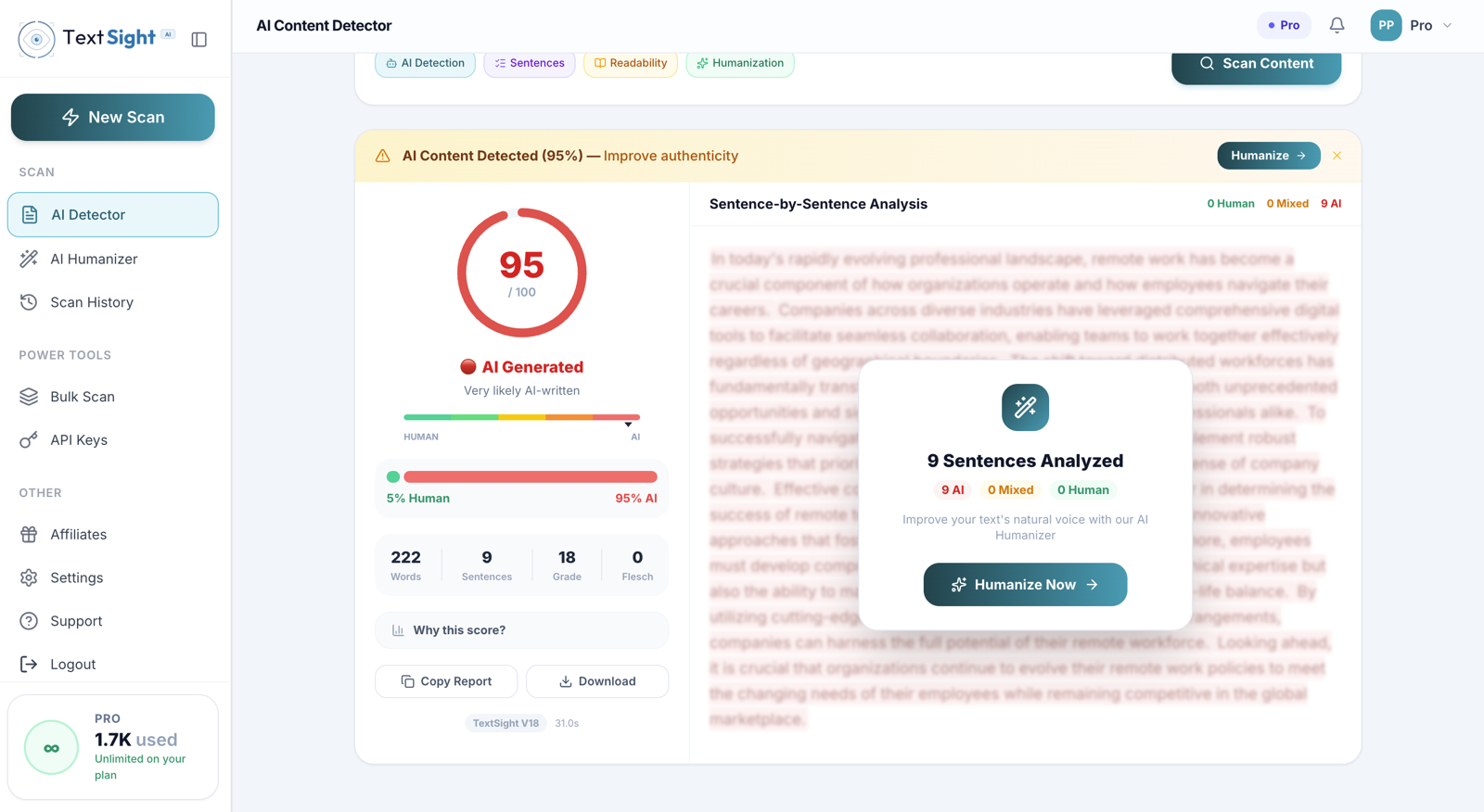
TextSight result panel showing the Authenticity Score alongside AI probability and sentence-level highlights
Quick recap

What the humanization score measures

The "humanization score" is the number that tells you how natural and human-like your writing reads. On TextSight it is branded the Authenticity Score: a 0-100 measurement computed on every scan and every rewrite, where higher means more human and lower means more AI fingerprints. It blends sentence-length variation, word predictability, vocabulary range, and structural patterns into one figure you can act on. This page is the how-to: the concrete edits that move that number up while making the writing read better.

The steps

Nine edits that raise the score

Work through these in order, or jump to whatever your draft needs most. Each one targets a specific signal the score measures, and each makes your writing genuinely more natural.

1. Vary your sentence length (burstiness)

This is the single biggest lever. Human writers swing between a blunt four-word sentence and a long, winding one that carries three ideas at once. Models tend to settle into a steady, medium rhythm where every sentence is roughly the same length. That evenness is called low burstiness, and detectors notice it fast. Read your draft and look for runs of similar-length lines. Cut one in half. Let the next one breathe and run long. The point is contrast, not chaos.

2. Mix active and passive voice naturally

Lean on active voice for most sentences, since it reads cleaner and more direct. But do not scrub passive voice out entirely. Real human writing slips into passive constructions where they fit ("the results were reviewed by two editors") and back into active for the next thought. A draft that is 100% active in lockstep can read just as mechanical as one that is all passive. Aim for a natural mix that follows the meaning rather than a rule.

3. Cut AI buzzwords and overused transitions

Certain words are flares that say "a model wrote this": delve, moreover, furthermore, in conclusion, it is important to note, tapestry, navigate the landscape. Search your draft for them and replace each with plainer wording you would actually say out loud. You rarely need a formal transition word at all; a new sentence usually carries the reader fine. Keep the idea, drop the signpost.

4. Add concrete specifics, examples, and personal voice

Generic prose scores low because it is generic. Real names, exact numbers, a dated example, a one-line anecdote, a genuine opinion. These are hard for a model to invent and unmistakably human to a reader. Where your draft says "many studies show," name one. Where it stays abstract, add the specific case you have in mind. This is also the safest way to lift a score: you are adding real substance, never removing it.

5. Vary paragraph length; use some short paragraphs

Models love uniform blocks: four neat paragraphs, each three to four sentences long. Break that pattern. Let one paragraph run six sentences and the next be a single line that lands a point. A short paragraph after a long one gives the reader a beat and signals a human hand shaping the page. The structural evenness the score penalises lives at the paragraph level too, not just the sentence level.

6. Reduce hedging and formulaic transitions

Phrases like "it could be argued that," "in many ways," and "generally speaking" pad sentences without adding meaning, and models reach for them constantly. So do formula connectors strung at the start of every paragraph. Trim them. Say the thing directly. Confident, specific claims read more human than cautious ones wrapped in three qualifiers, and the score rewards the difference.

7. Use contractions where natural

In any register short of stiff formal academic prose, real people write it's, you're, don't, and we'll. Models often default to the spelled-out forms, so a draft with zero contractions can read subtly robotic. Add them where the tone allows. The exception is genuinely formal writing where contractions would be out of place; match the register rather than forcing them everywhere.

8. Reduce em-dash overuse

Heavy em-dash use is one of the strongest AI-writing tells in 2026, so this one is counterintuitive but important: cutting em-dashes helps your score. If your draft sprinkles them through every other sentence, the punctuation rhythm alone can flag it. Convert most em-dashes back to commas, periods, parentheses, or simply two shorter sentences. Keep an occasional one for genuine emphasis. Whatever you do, do not add more to "sound natural" — dense dashes do the opposite.

9. Read it aloud and edit for rhythm

Reading the draft out loud is the fastest way to catch robotic cadence. Where you stumble, where a sentence drones, where three lines in a row start the same way, and your ear hears it before any tool does. Reshape those spots until the passage sounds like you actually talking. This single habit folds in most of the steps above and is the closest thing to a one-move fix.
Work smarter

Use TextSight's sentence-level feedback

You do not have to guess which edits matter. Paste your draft into the AI Detector and every sentence comes back colour-coded: the lines that read as human, and the lines that read as AI. Instead of rewriting the whole piece, revise only the flagged sentences using the steps above, then rescan and watch the overall score climb.

That tight loop (scan, fix the red lines, rescan) is how most people move a draft from the Mixed band into Mostly Human or Original in one sitting. It is also the honest way to do it: you are responding to specific feedback about specific sentences, not blindly shuffling words.

Scan your draft free →
When to reach for it

When to use the AI rewriter

Some passages stay stubborn no matter how many times you read them aloud. That is where the AI rewriter earns its place: feed it the sentences that keep flagging and it reshapes the rhythm and vocabulary for you, then recomputes the score so you can see the effect.

One firm rule: preserve your meaning and your voice. The goal is authentic writing, not gaming a number. After any rewrite, read it back and confirm every fact, name, figure, and list item survived intact. If a pass dropped a detail or bent your argument, undo it and revise that sentence by hand instead. A higher score on writing that no longer says what you meant is a loss, not a win.

Treat the rewriter as an assistant for the hard 10%, with you editing the rest. The best results come from your own specifics and voice plus the tool's help on cadence, never from handing the whole draft over and shipping whatever comes back.

Avoid these

Common mistakes that backfire

Stuffing in synonyms

Swapping every other word for a thesaurus pick makes prose read stranger, not more human, and the awkward word choices often score worse. Rewrite for rhythm and clarity, not synonym density.

Adding em-dashes

It feels stylish, but dense em-dash use is a top AI tell in 2026. Adding them pushes the score down. Reduce them instead, as covered in step 8.

Deleting content to trick the score

Cutting facts, examples, or list items to nudge a number leaves you with thinner, worse writing that often still reads as AI. Rephrase and extend, never gut your content.

Chasing the number, not the writing

If you optimise purely for the score, you can land odd, hollow prose. The score is feedback on rhythm and voice. Fix those and the number follows on its own.

FAQ

Frequently asked

What is a good humanization (Authenticity) score?

It depends on the stakes. For personal writing and internal docs, anything in the Mostly Human band (61 to 80) is fine. For blog posts and marketing copy, target 70 or higher. For academic submissions, aim for 80 or higher. For compliance, legal, or journalism, target the Original band (81 to 100). A high TextSight score correlates with passing other detectors but does not guarantee it, so verify on a specific tool if that tool is the gate.

Does rewriting change my meaning?

It should not, and that is the whole point. Improving the score is about how the writing reads, not what it says. When you revise sentences or run the AI rewriter, keep every fact, list item, name, and number. Change the rhythm, the vocabulary, and the voice. If a rewrite drops a concrete detail or alters your argument, undo it. The goal is authentic writing that still means exactly what you intended.

Why did my honest writing score low?

Human writing scores low when it accidentally resembles AI output: a very even sentence rhythm, heavy academic transitions, parallel triplet structures, hedge phrases, and uniform paragraphs. ESL writing and dense technical prose are especially prone to this. Open the sentence-level highlights, see which lines triggered, and revise just those. Vary length, drop a transition or two, and add a concrete detail. The score usually climbs after a single pass.

Can I improve the score without an AI rewriter?

Yes. Most score gains come from manual editing: varying sentence and paragraph length, cutting buzzwords, reducing em-dashes and hedging, adding specifics, and using natural contractions. The AI rewriter is a shortcut for stubborn passages, but you can reach the Original band by hand. Scan, read the highlighted sentences, and revise them yourself.

Will adding em-dashes raise my score?

No, the opposite. Dense em-dash use is one of the strongest AI-writing tells in 2026, so adding them tends to lower a humanization score rather than raise it. If your draft is full of em-dashes, convert most of them to commas, periods, or parentheses. Vary your punctuation the way a careful human writer would.

Is improving my score the same as bypassing detection?

No. The aim is to make honest writing read naturally, not to disguise content or trick a grader. Deleting facts, stuffing synonyms, or gutting list items to game a number produces worse writing that often still reads as AI. Use the score as feedback on rhythm, voice, and specificity. Better writing and a higher score come from the same edits.

Related reading

Authenticity Score →
What the score is and how it's calculated
Humanize ChatGPT output →
Make raw model drafts read naturally
AI detector false positives →
Why honest writing sometimes flags
Best AI humanizer 2026 →
How the rewriters compare

See your score, then watch it climb.

Scan your draft, read the sentence-level highlights, apply the steps, rescan. 3 free scans/day.